

A Protected Characteristic Without Protection
Gender reassignment is enshrined in UK law. So why are trans girls being publicly referred to as boys by figures at registered charities?
There is a word in equality law that carries real meaning: “protected.” It tells us that certain characteristics of a person’s identity cannot lawfully be used as the basis for discrimination, for harassment, or for exclusion in the settings where people live, learn, and work. Gender reassignment has been one of those nine protected characteristics in UK law since the Equality Act came into force in 2010.
It was not removed, narrowed, or diminished by the Supreme Court’s ruling on sex last April. It remains in the legislation, intact and enforceable.
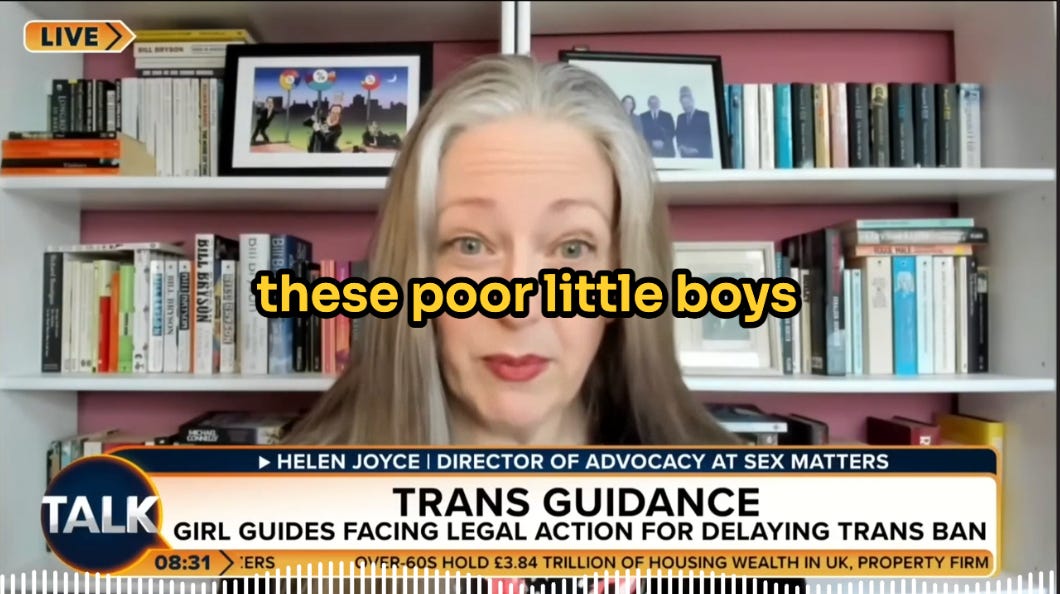
Yet at this moment, in response to policy decisions by major registered charities, senior figures associated with those organisations are publicly describing transgender girls not as girls, not as children with a protected characteristic under the law, but as boys.
Not in private, but in press statements, in newspaper coverage, and in public statements to the media. I want to think clearly about what that means, what the law actually does and does not provide in that situation, and why the gap matters so much.
What the Equality Act actually says
Section 7 of the Equality Act 2010 defines gender reassignment as a protected characteristic for any person who is proposing to undergo, undergoing, or having undergone a process for the purpose of reassigning their sex. You do not need a Gender Recognition Certificate. You do not need to have had any medical treatment whatsoever. You need only to have taken steps, however initial, towards living in a gender different from the one recorded at your birth. That threshold is deliberately low, because the legislators understood that protection should not be contingent on proof of medical intervention.
The Act provides protection against direct discrimination, indirect discrimination, harassment, and victimisation in relation to that characteristic. Harassment, under Section 26, is defined as conduct related to a protected characteristic that has the purpose or effect of violating a person’s dignity, or creating an intimidating, hostile, degrading, humiliating, or offensive environment. These are substantive and enforceable legal obligations that apply to employers, service providers, educational institutions, and clubs and associations.
There is also a different and more powerful provision that receives far less attention in this debate. Section 149 of the Act, which sets out the Public Sector Equality Duty, requires any body that is exercising public functions to have active regard to the need to eliminate harassment and to foster good relations between people who share a protected characteristic and those who do not. This is a proactive duty, not a reactive one, and it is not limited to individual relationships. Whether a registered charity whose stated purpose is to influence public policy and public institutions is exercising a "public function" within the meaning of that section is a genuinely arguable question, and one that I think deserves much more scrutiny than it has received.
The current climate in the charity sector
The past year has brought significant and, for many families, deeply painful changes across UK civil society. Following the Supreme Court’s ruling in For Women Scotland v The Scottish Ministers, a number of organisations have been persuaded to revise their policies on membership and participation. Girlguiding, which serves around 300,000 young people aged four to eighteen, announced in December 2025 that trans girls would no longer be able to join, and in March 2026 it confirmed that current trans girl members must leave its groups by 6 September 2026. The Women’s Institute has ended formal membership for transgender women from April 2026.
The legal context here is complex. There are real tensions between the Equality Act’s provisions on sex and its provisions on gender reassignment, and those tensions are still being worked through in guidance, policy, and case law. I do not think it serves anyone well to pretend that the legal questions are simple, because they are not. What I will note is that Girlguiding itself, even while implementing these exclusionary changes, has consistently referred to the affected children as trans girls in its own official communications. That consistency of respectful language within their own statements is worth noting.
What I am addressing here is not the policy decisions on membership themselves, but the language that has accompanied those decisions in wider public commentary. In coverage of the Girlguiding announcement, figures at organisations that hold charitable status have described transgender girls in public statements not as girls, not even as transgender children, but in terms that deny their gender identity entirely. This has been documented in national media. It has been said by people whose organisations hold, or seek to hold, charitable status with the Charity Commission.
What trustees are actually responsible for
When an organisation registers as a charity in England and Wales, its trustees take on a set of legal duties under the Charities Act 2011. They must act in the interests of the charity and its beneficiaries. They must act with reasonable care and skill. They must act with integrity, and they must not act in ways that would bring the charity into disrepute or damage its reputation. These duties apply not only to formal governance decisions made at board level, but to how trustees and their organisations represent themselves and their work in public.
The Charity Commission has the power to investigate charities where there is concern that trustees have breached these duties. The Commission has acknowledged that it is an active regulator in this space and has received formal complaints relating to the conduct of charities touching on trans-related matters. Its regulatory framework includes not just membership policy, but the broader standards of behaviour expected of those who hold the privilege of charitable status.
There is a question that I think deserves more attention than it is currently receiving. If a charity’s objects include promoting human rights, advancing education, or operating for the public benefit broadly defined, how do those objects sit alongside public communications that deny the identity of children who hold a protected characteristic under UK law? This is not a question about whether those charities should or should not change their membership rules. It is a question about what standard of language and dignity we ought to expect from organisations that have asked for, and been granted, the privileges that charitable registration confers.
The real and human cost of this gap
I want to be very clear about who bears the cost of this gap between what the law provides and what it actually reaches. It is not an abstract policy problem. It is a seven-year-old girl who hears herself described as a boy on the news. It is a ten-year-old who has earned her badges, made her friends, and built her sense of belonging at Brownies, and who is now receiving a letter telling her that she must leave by September. It is a parent trying to find the words to explain to their child why some adults do not see her as she is, even when those adults are associated with organisations that are supposed to serve children.
Trans girls and their families are navigating an already deeply difficult landscape. The NHS waiting lists for gender identity services are, in some regions, measured in years. Access to age-appropriate healthcare is severely limited. Now children who have found community and confidence in organisations like Girlguiding are being asked to go. While that happens, the language being used about them in wider public discourse is not the language of their protected characteristic. It is language that erases them.
That language has consequences. The research on the mental health and wellbeing of transgender young people is consistent: the way trans children are spoken about by adults and institutions has a direct and measurable impact on their wellbeing. Being misgendered is not a minor or trivial experience for a child who is already navigating gender dysphoria and facing barriers to care and to social belonging. It is a further harm, and it is a harm that the law, as currently constituted, does very little to address.
What I believe needs to change
I want to set out three things that I believe would help, not as demands, but as genuine suggestions from someone who has spent a long career thinking about the welfare of trans people and about how institutions can do better.
The first is clearer guidance from the Charity Commission on the standards of language and communications expected of trustees and of organisations operating in their name, particularly when those communications concern people with protected characteristics. This does not mean compelling charities to take a particular policy position. It means making clear that the duties of integrity and of protecting a charity’s reputation extend to how organisations speak about the people their decisions affect, including children.
The second is engagement from the Equality and Human Rights Commission on the gap between the protection that gender reassignment formally provides under the Act and the public discourse that is currently surrounding trans children. The EHRC is the statutory body responsible for promoting and enforcing equality law in Great Britain. It has a responsibility to name the places where that law’s coverage falls short and to provide clarity about what standards of conduct it expects, even in contexts the Act does not directly regulate.
The third, and perhaps the most straightforward, is an appeal to the people who lead and speak for these organisations. Referring to a transgender girl as a boy is not legally required by anything the Supreme Court ruled. The For Women Scotland judgment made no finding about how trans children should be addressed or described in public communications. Describing trans girls in demeaning terms is a choice, and choices about how we speak about children, particularly children who are already navigating great vulnerability, say something about the kind of society we want to be.
The truth always wins. Gender reassignment is, and remains, a protected characteristic in UK law. That protection was built into our legal framework because legislators understood that trans people, including trans children, deserve dignity and respect. The challenge now is to extend that protection into the spaces where it is most needed, and to hold institutions to a standard of language and conduct that matches the values our equality law is supposed to express.
Dr Helen Webberley, Gender Specialist and Medical Educator
www.helenwebberley.com
Resources
- Equality Act 2010, Section 7 (Gender Reassignment)
- EHRC: Gender Reassignment Discrimination Guidance
- For Women Scotland v The Scottish Ministers [2025] UKSC 16
- Charity Commission: The essential trustee: what you need to know, what you need to do