

Dr Webberley Responds: Is a Trans Woman Playing Pickleball “Cheating”?
What the science actually says about trans women in sport
The Background
A clip has been doing the rounds on X this week. Piers Morgan interviewing me alongside a trans pickleball player, accusing her of “cheating” simply because she competes in the women’s category.
It’s a powerful word, cheating. It implies deception, rule-breaking, an unfair advantage deliberately exploited. But is that what’s actually happening when a trans woman plays sport after transitioning?
Let’s look at what the research tells us.
The Facts
The concern typically raised is that trans women who went through male puberty retain physical advantages that make competition unfair. It’s a reasonable question to ask. So what does the science say?
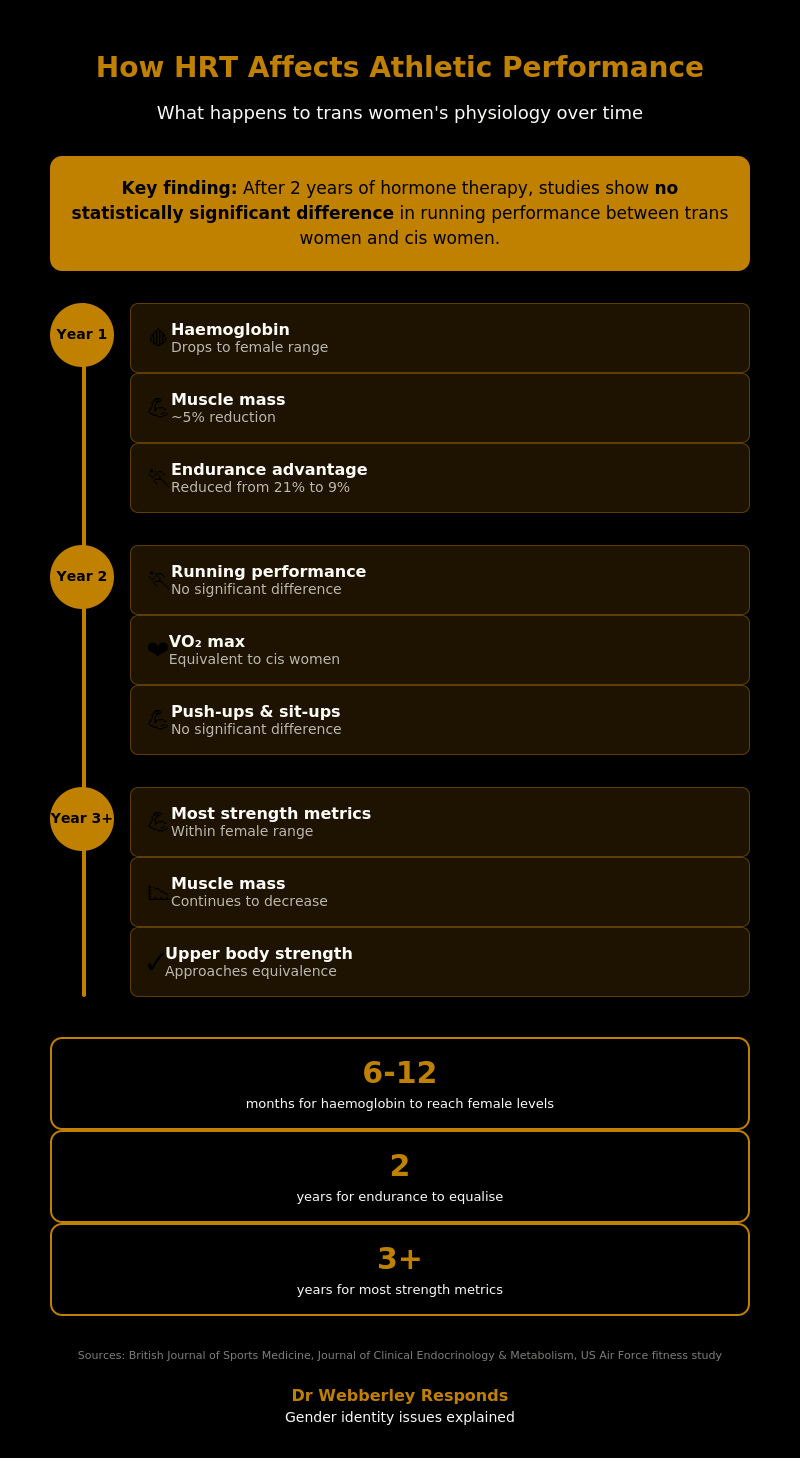
Endurance equalises relatively quickly. After two years of hormone therapy, studies show no statistically significant difference in running performance between trans women and cis women. In one large study of Air Force personnel, trans women’s 1.5-mile run times were essentially identical to cis women’s after two years on HRT.
Strength takes longer to change, but it does change. Muscle mass drops by around 5% in the first year and continues to decline. By two years, measures like push-ups and sit-ups show no significant difference between trans women and cis women. Upper body strength may take longer to fully equalise, with some studies showing residual differences at three years.
Aerobic capacity reaches parity. Haemoglobin levels (which affect oxygen-carrying capacity) drop to the female range within 6 to 12 months. VO2 max, the measure of aerobic fitness, becomes indistinguishable from cis women’s levels.
The longer someone is on HRT, the smaller any difference becomes. This isn’t a static situation. The body continues to change over years of hormone therapy.
What About Pickleball?
Here’s what struck me about the accusation of “cheating” in pickleball specifically.
Pickleball is a skill-based sport. It rewards hand-eye coordination, court positioning, shot selection, reflexes, and tactical awareness. Yes, there’s a physical element, but it’s not weightlifting. It’s not the 100 metres.
The research consistently shows that skill and technique are not affected by whether someone went through male or female puberty. A trans woman doesn’t gain better hand-eye coordination or court sense from testosterone. Those come from practice, talent, and experience.
And if we’re talking about a trans woman who has been on hormone therapy for the required period, her endurance and aerobic capacity will be in the female range. Her strength will have significantly reduced. What remains is her skill at the game.
Is that cheating? Or is that just being good at pickleball?
My View
The word “cheating” does a lot of heavy lifting in this debate. It’s designed to shut down conversation, to paint trans women as frauds and deceivers rather than athletes who are following the rules set by their sport.
Trans women who compete in women’s categories are not breaking any rules. They meet the eligibility criteria. They undergo hormone therapy that fundamentally changes their physiology. They are monitored and tested.
Does that mean there are no complex questions to work through? Of course not. Sports governing bodies are continually reviewing the evidence and updating their policies. That’s appropriate. Science evolves, and policy should evolve with it.
But accusing an individual trans woman of “cheating” for playing a sport she loves, in a category she’s eligible for, after meeting all the requirements? That’s not a scientific argument. That’s just cruelty dressed up as concern for fairness.
I believe all humans have the right to live authentically and to participate fully in society, including in sport. Let’s have the nuanced conversation about policy by all means. But let’s stop throwing around words like “cheating” to describe people who are simply playing by the rules.
Over to You
What’s your take? Should eligibility depend on the specific demands of each sport? And how do we have this conversation without demonising individual athletes?
I’d love to hear your thoughts in the comments.
This is part of a series examining cases, commentary and hearings concerning gender identity. If you have a case or article you’d like me to review, get in touch.