

Have You Had Your Say About The Cass Review Yet? 120 People Already Have.
I am collecting testimony on the real impact of the Cass Review. 120 responses are in. We need yours.
Your voice matters. Whether you are trans, a parent, a clinician, or an ally, we want to hear from you.
I am collecting testimony from people who have been directly affected by the Cass Review. Trans people, their families, clinicians, and allies. I want to hear how it has changed your access to healthcare, how it has affected the way you are treated, and how it has shaped your daily life.
I am doing this for two reasons.
First, because these voices were not included in the Cass Review itself, and they should have been.
Second, because I have referred Dr Hilary Cass to the General Medical Council, and I want the GMC to understand the real-world impact of her work. Your testimony will form part of that referral.
You can choose whether your response is shared publicly, submitted to the GMC, or both. You can remain anonymous. You are in control.
What 120 people have already told us
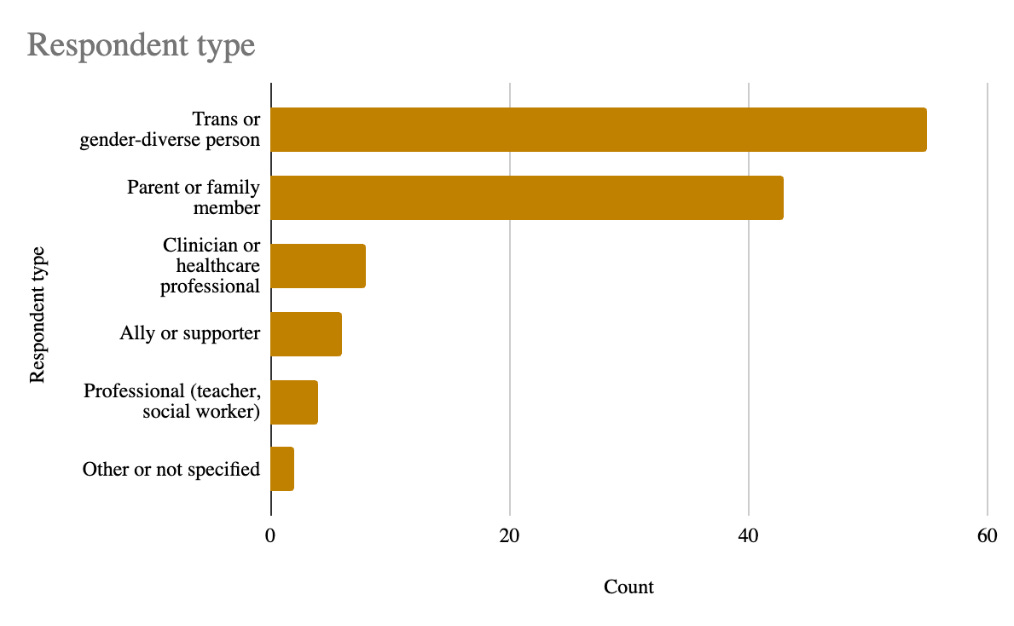
As of today, 120 people have responded. The testimony has come from across the United Kingdom, and from the United States, Australia, Canada, Ireland, France, South Africa, and Denmark. It has come from trans people, parents, partners, clinicians, teachers, trade unions, and allies.
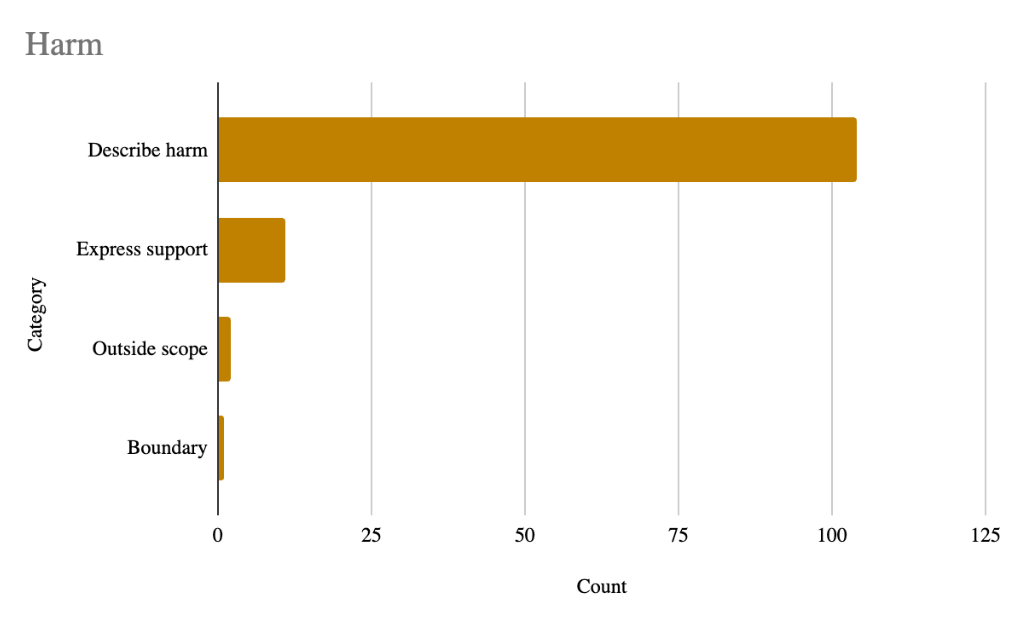
Of the 120 responses, 104 describe harm. 11 express support for the Cass Review. 2 fell outside the scope of the questions asked. 1 raises a genuine and thoughtful question that deserves a proper answer.
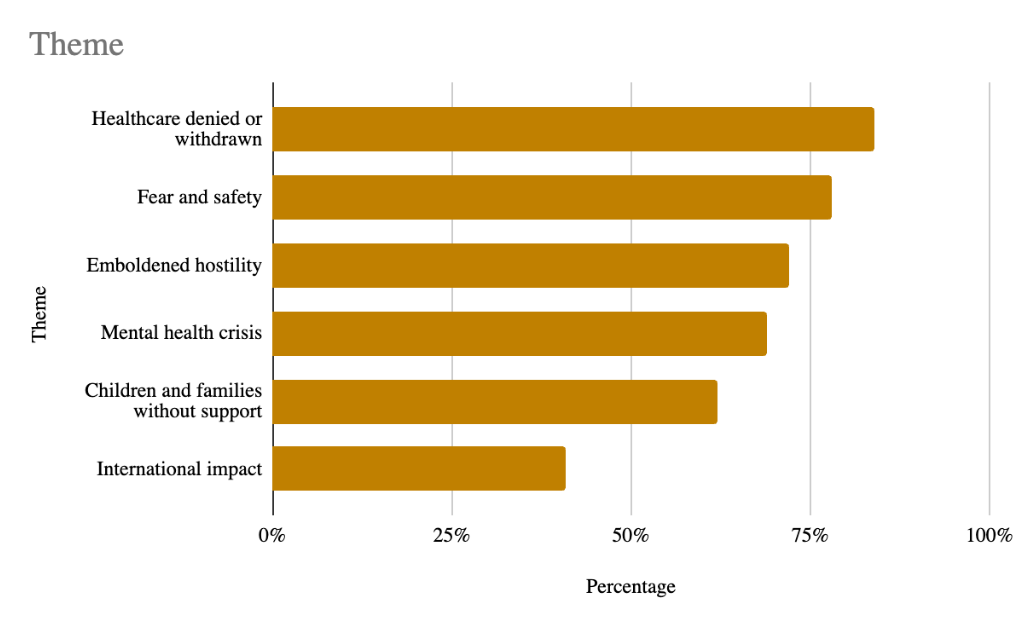
Here is what people are telling us.
Healthcare denied or withdrawn
This is the most commonly reported harm. People describe being refused treatment they were already receiving, being turned away by GPs, and facing waiting lists that stretch for years with no end in sight. Adults who have been on hormone therapy for over a decade are having their prescriptions stopped. Children who have been in the system for years are being told to start again from scratch.
“I had my GP cite the Cass Review as a means to stop my anti-androgen and HRT. I am in my mid-30s and have been taking it since I was 21.
— A trans person from England
“When lived in the UK, despite being 27 and being on the NHS pathway since I was 18, the GPs in my city all decided to stop prescribing.”
— Isabelle, trans person, Ireland
“Our daughter now 19 with a diagnosis of Gender Dysphoria via NHS GIC still cannot access NHS hormones. She was assessed, diagnosed, and told she met the criteria, and then everything stopped.”
— A parent from the UK
“I live in Cornwall. Most local GPs have started restricting or outright denying access to shared care with private prescribers, including blood tests.”
— Senna, trans person, England
“Delayed care. Caused issues regarding access to services. Moved into adult services now and still nowhere near first appointment.”
— A parent from England
“My friends have killed themselves on the waitlist. I am five years on the waitlist and have been DIYing because I have no other choice. Doctors have laughed at me.”
— A trans person from England
For some, the only option left is to self-medicate, with all the risks that carries.
“Dissuaded me further from pursuing the NHS as a route to transition, instead resorting to purely DIY methods.”
— Layla, trans person, Wales
Fear and safety
Many respondents describe a growing climate of fear. Trans people say they feel less safe in public, at work, and in healthcare settings. Some have stopped going out. Some have reversed steps they had taken to live openly. One respondent, aged 70, said it was easier to be trans in the 1960s.
“I find it frightening and extremely distressing. I am 70. I grew up trans in the sixties and seventies and honestly it was easier then. Now there is hostility everywhere.”
— Alex, trans person, UK
“I feel extremely vulnerable. I am 74 and I am scared to go out. I have been attacked and beaten up and the police were not interested. I was sexually assaulted. They wanted to see if I was real.”
— Joann, trans person, England
“I no longer feel comfortable being openly trans. I feel privileged to pass completely. Last year I applied for a GRC and new passport, to my financial cost, to ensure my safety.”
— A trans person from England
“I changed my name back at work to stop any problems happening to me and had to fight tooth and nail just for that.”
— A trans person from the UK
“I am safer as a trans person in the USA. Read that again.”
— A trans person born in the UK, now living in the US
Mental health crisis
Respondents describe anxiety, depression, suicidal thoughts, and a profound sense of being abandoned. Parents describe watching their children deteriorate. The emotional weight of these responses is significant.
“The mental health impact has been profound. I feel that I have somehow regressed to an earlier stage of public lack of confidence.”
— Chryssy, trans person, England
“It has contributed to an overall atmosphere of hate and persecution that has caused a friend’s minor child to become suicidal.”
— Allison, parent, United States
“My daughter has struggled mentally with the implications. In fact, she has been suicidal at times.”
— A parent from England
“As a parent, the Cass Review has not just affected the people around me. It has settled into my own daily thoughts. I carry a constant, quiet worry about what will happen to the people I love.”
— A healthcare professional and parent from the UK
“This review has diminished my trust in not just the NHS but doctors as a whole. Evidence has been overruled by political ideology.”
— A trans person, England
Children and families left without support
Parents describe being caught between systems that are supposed to help and a reality in which no help is available. Waiting lists are measured in years. Children who were mid-assessment have been returned to the start. Families describe watching their children suffer while being told there is nothing that can be done.
“In March 2026 my transgender son would have been on the gender affirming care waiting list for four years. We tried going private but ran out of money.”
— A parent from the UK
“My family member is 14 and has been in the GIDS system since she was three years old. She was at a crucial point in her ongoing assessment when everything was pulled away.”
— A parent from the UK
“Our son told us he was a boy as soon as he could speak, around the age of two or three. By seven, his distress at not being a boy had intensified significantly, including suicidal thoughts.”
— A parent from England
“The Cass Review essentially cancelled my teen’s Gillick Competence just because he is trans.”
— A parent from Scotland
“I feel exhausted all the time. I have a 12-year-old sibling who is gender diverse, and I just hope they never need to go through the same painful processes.”
— Jamie, trans person, England
“Wait time to see a paediatrician is endless. It was six months waiting for a GP call. It has been a year since then.”
— Jacqui, parent, UK
Emboldened hostility
People describe a shift in public attitudes that has made transphobia feel not just tolerated but endorsed. The Cass Review is repeatedly cited as having given permission for hostility that was already present to become open and organised.
“The review has further emboldened transphobia in the UK. It is markedly worse now than 10 years ago, and increasingly dangerous.”
— A parent from the UK, England
“The Cass Review has invariably bolstered the anti-trans movement in the UK and internationally.”
— Katherine, trans person, UK
“The main impact of the Cass Review is the sense that other people have decided that you are abnormal and that it justifies treating you accordingly.”
— H, nonbinary person, UK
“I am a trans woman. I used to be heavily involved in organising Prides. Since the puberty blocker ban came in I have noticed a huge downward shift in the way trans people are treated.”
— Rose, trans person, UK
“It has severely affected how my young person feels. They now truly believe that our society is transphobic and does not understand what it means to be trans.”
— A parent from England
International impact
The influence of the Cass Review has spread well beyond the United Kingdom. Respondents from Australia, the United States, Canada, South Africa, Ireland, and Denmark describe how it has been used to justify restricting or removing access to gender-affirming care in their own countries.
“The current Queensland and Northern Territory Governments have based their decision on stopping public healthcare patients from receiving puberty blockers on the Cass Review. I wake up every morning worrying about what is going to happen.”
— Melissa, parent, Australia
“It has played a significant role in increasing the difficulty of obtaining gender-affirming healthcare in Denmark.”
— A trans person from Denmark
“It has been used as supporting evidence by the growing anti-trans movement here in South Africa, specifically to attack not only healthcare providers but also trans organisations.”
— Dr GN de Bever, clinician, South Africa
“I have had the Cass Review used to justify various forms of aggression towards my experience as a nonbinary person.”
— Gennifrey, nonbinary person, Canada
“As of 2026, my state has outlawed gender-affirming care for youth going forward.”
— A parent from the United States
A note on the supportive responses
Eleven responses expressed support for the Cass Review. It is important to acknowledge them honestly and to explain what they tell us.
Of the eleven, six come from clinicians or commentators based outside the United Kingdom, including the United States and South Africa. Two come from trans people in the UK who say they are comfortable with the review or believe policy should be stricter. One comes from a respondent who identifies as a “sex realist” and whose response included personal abuse directed at me. One comes from a parent in the UK who does not believe gender identity is a medical matter. One comes from a professional who views the evidence base as weak.
Two of the trans respondents who express support raise points that deserve a thoughtful answer. One says they are “not an ideologue” and feels the review is fair. Another believes policy should sit within the domain of research. These are not hostile positions. They reflect a genuine perspective, and they are entitled to it.
What remains striking is the gap between who supports this review and who is harmed by it. The people describing harm are overwhelmingly those living it: trans people, their parents, their families. The people expressing support are, with a small number of exceptions, at a distance from the direct consequences.
One response that deserves its own answer
One respondent, a trans person in the UK, supports the call for more research into puberty blockers. They describe being “confused by the resistance to evidence being collected.”
This is a fair question, and it deserves a proper answer. The trans community is not opposed to research. What the community opposes is the withdrawal of existing care while that research is carried out. You do not take away someone’s treatment and then ask whether it was working. You study it while continuing to provide it. That is how ethical research operates in every other area of medicine.
Have your say
This testimony is ongoing. Every new response strengthens the picture and makes it harder to look away from what is happening.
If the Cass Review has affected you, your family, or your patients, please take a few minutes to share your experience. You can choose to remain anonymous. You can choose whether your words are submitted to the GMC, shared publicly, or both. You are in control of how your voice is used.
Your voice matters. Whether you are trans, a parent, a clinician, or an ally, we want to hear from you.
If you have already responded, thank you. Your voice is part of something that matters.
Subscribe to Dr Webberley Responds for updates on the GMC referral, new testimony, and what happens next.