

I Have Referred Dr Hilary Cass to the GMC
Why I believe the Cass Review falls short of the professional standards expected of every registered doctor.
Yesterday, Dr Hilary Cass appeared on BBC’s Sunday with Laura Kuenssberg. During the interview, she told the nation that most gender-questioning children “grew out of it and became gay men.” She said that children have been “misled” by social media. She described clinicians who provide gender-affirming care as “charlatans.” She called established surgical procedures “quite brutal.” She claimed that social transition can “lock” a child onto a trajectory that “may not have been the correct natural trajectory for them.”
She said all of this on national television, positioned as an authoritative medical expert, without once acknowledging that she is not a gender specialist, has no clinical experience in this field, and has no research history or publications in transgender healthcare.
I have spent months carefully examining the Cass Review1, reading the peer-reviewed critiques, studying the systematic reviews it commissioned, and comparing the review’s conclusions with its own evidence base. Today, I have submitted a formal referral to the General Medical Council raising concerns about the professional conduct of Dr Hilary Cass across all four domains of Good Medical Practice 2024. I do not do this lightly. Referring a fellow doctor to the GMC is one of the most serious steps any medical professional can take. But yesterday’s interview crystallised for me exactly why this referral is necessary, because the pattern of conduct I have documented is not historical. It is ongoing, and it is happening on the biggest platforms in the country.
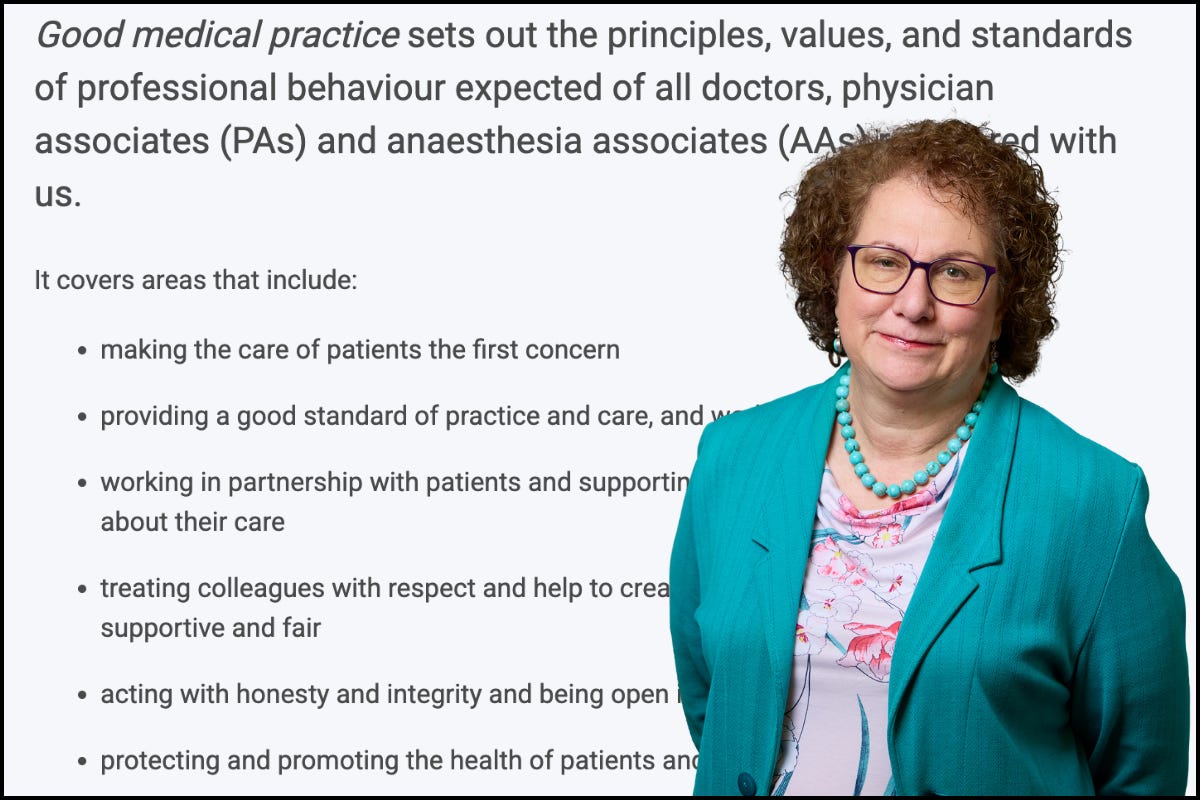
What she said yesterday
I want to go through some of what Dr Cass said on the BBC yesterday, because it illustrates the concerns in my referral more clearly than any academic paper could.
She told Laura Kuenssberg that in the 1970s, most prepubertal boys presenting with gender incongruence “grew out of it and became gay men.” She then used this to argue that socially transitioning children risks “locking” them onto the wrong path. There are two serious problems here. First, the desistance research she is referencing has been extensively critiqued in the peer-reviewed literature for methodological flaws, including the inclusion of children who never met diagnostic criteria for gender dysphoria in the first place. Second, she is conflating gender identity with sexual orientation, which are understood in modern clinical practice to be distinct. A former president of the Royal College of Paediatrics and Child Health should know this.
She claimed that children have been “misled” by social media and that they were “being given a narrative” that not conforming to gender stereotypes means they are trans. This framing positions the significant increase in young people seeking support for gender incongruence as a social phenomenon rather than a healthcare need. It is speculation, presented as established fact, to millions of viewers.
She referred to clinicians providing gender-affirming care as “charlatans just handing out inappropriate drugs.” These are registered medical professionals following international clinical guidelines endorsed by the Endocrine Society, WPATH, and professional bodies around the world. To dismiss them in this way on national television is a serious departure from the standards of collegiality and accuracy expected of any doctor, let alone one whose review has shaped national policy.
She described gender-affirming surgeries as “quite brutal.” This is inflammatory, stigmatising language about established medical procedures that are carefully considered, fully consented, and life-changing for the people who receive them. It is not the language of a balanced, objective reviewer.
Perhaps most tellingly, she framed the entire debate as one in which children have been “weaponised” by “people at the extremes” on “both sides,” while positioning herself as the calm, reasonable voice in the middle. This is a carefully constructed narrative, and it does not hold up under scrutiny. One “side” of this debate is asking for evidence-based healthcare. The other is seeking to restrict it. Placing these positions as equivalent extremes is itself a departure from the evidence.
Who is Dr Hilary Cass?
Dr Hilary Cass is a British paediatrician, a former president of the Royal College of Paediatrics and Child Health, a Fellow of both the Royal College of Physicians and the RCPCH, and now a member of the House of Lords.2 She was appointed to lead the Independent Review of Gender Identity Services for Children and Young People, which published its final report in April 2024.
She is not a gender specialist. She has no documented clinical experience in the assessment or treatment of gender incongruence, and no track record of research or publication in this field. Her career has been in paediatric neurodisability, including conditions such as autistic spectrum disorders, cognitive impairment due to epilepsy, and care of children with visual loss and multiple disabilities. This is distinguished and important work, but it is not this field. Despite this, her review has been treated as the definitive word on transgender healthcare for young people, and its recommendations have directly shaped NHS policy, government legislation, and legal proceedings around the world.
What does the referral say?
My referral sets out detailed concerns across all four domains of Good Medical Practice3, the professional standards that every registered doctor is expected to meet. The concerns are supported by published peer-reviewed research, formal risk of bias analyses, and the responses of international professional bodies.
The review’s own commissioned systematic reviews found moderate quality evidence supporting the very treatments the review went on to recommend restricting. The research the review itself paid for did not support the conclusions it reached. A formal ROBIS assessment, published in BMC Medical Research Methodology in 20254, found a high risk of bias in all seven systematic reviews commissioned by the Cass Review.
Specific claims in the review were presented as established fact without supporting citations or evidence. These include claims about social transition and the causes of gender dysphoria that have no basis in the peer-reviewed literature. The very claim Dr Cass repeated on the BBC yesterday, that social transition can “lock” a child onto the wrong trajectory, appears in her review without a single supporting citation.
Fifteen Australian clinicians documented striking internal contradictions between the review’s own evidence and its conclusions. A team from Yale, representing 86 years of combined clinical experience and over 4,800 patients treated, raised serious methodological concerns. The Endocrine Society, WPATH, and professional bodies across the world responded by reaffirming their support for gender-affirming care and noting that the review did not include the expertise of those with direct clinical experience.
Why does this matter?
The Cass Review has had an enormous and very real impact on people’s lives. Its recommendations have been used to restrict access to healthcare for transgender children and young people in the UK. Its findings have been cited in US Supreme Court proceedings and in state-level legislation across America. Politicians, media commentators, and campaigning groups have adopted it as authoritative evidence to support the restriction of transgender rights and healthcare.
Yesterday’s BBC interview is a perfect illustration of why this matters. Dr Cass was not asked a single challenging question. She was not asked about the peer-reviewed critiques. She was not asked about the ROBIS assessment. She was not asked why her review’s conclusions contradicted its own commissioned research. She was given a national platform to repeat contested claims as fact, dismiss experienced clinicians as charlatans, and present herself as the measured centre of a debate in which she has, in reality, taken a very specific and consequential position.
When a single review has this much power over the lives of real people, the professional standards that underpinned its creation matter enormously. If there are legitimate questions about whether those standards were met, they deserve to be examined. That is what the GMC is for.
Is this not just a difference of opinion?
Some people will say this is a controversial area and that reasonable people can disagree. I understand that. But this referral is not about a difference of clinical opinion. It is about whether the professional standards of honesty, accuracy, competence, and integrity that apply to every registered doctor were met in the production, communication, and public presentation of this review.
The whole point of professional standards is that they apply consistently, regardless of the political or social context. If a doctor leading a major clinical review gets more latitude to depart from standards of honesty and accuracy because the subject matter is controversial, then professional regulation becomes meaningless in exactly the situations where it is most needed.
Transgender patients are patients. Their wellbeing and their access to safe, evidence-based care deserve exactly the same regulatory protection as that afforded to any other patient group. To look away because the subject matter is politically difficult would send a deeply troubling message.
A question of responsibility
Dr Cass is not a junior doctor who made an error of judgement. She is a former president of the Royal College of Paediatrics and Child Health, one of the most senior paediatricians in the country, and now a member of the House of Lords. When she sits on the BBC and tells the nation that children have been “misled” and that gender-affirming clinicians are “charlatans,” those words carry enormous weight precisely because of who she is.
That seniority does not make these concerns less serious. It makes them more serious. A doctor of her standing would be acutely aware of the obligation to work within the limits of her competence, to ensure the accuracy of professional communications, and to take care that her public statements do not mislead. The expectations of Good Medical Practice do not diminish with seniority. They increase.
What happens next?
The GMC will review my referral and decide whether to investigate. That process takes time, and I respect that. What matters is that the concerns are now formally on record, supported by evidence, and in the hands of the body responsible for upholding professional standards in medicine.
I will keep you updated as this progresses.
Files

References
Budge, S.L., Abreu, R.L., Flinn, R.E., Donahue, K.L., Estevez, R., Olezeski, C.L., Bernacki, J.M., Barr, S., Bettergarcia, J., Sprott, R.A. & Allen, B.J. (2024). Gender Affirming Care Is Evidence Based for Transgender and Gender-Diverse Youth. Journal of Adolescent Health, 75(6), 851–853.
Coleman, E., Radix, A.E., Bouman, W.P. et al. (2022). Standards of Care for the Health of Transgender and Gender Diverse People, Version 8. International Journal of Transgender Health, 23(Suppl 1), S1–S259.
General Medical Council. (2024). Good Medical Practice. London: GMC. Available at: www.gmc-uk.org/professional-standards/good-medical-practice-2024
General Medical Council. (2024). Good Practice in Research. Professional Standards. London: GMC.
Grijseels, D.M. (2024). Biological and psychosocial evidence in the Cass Review: A critical commentary. International Journal of Transgender Health.
Hembree, W.C., Cohen-Kettenis, P.T., Gooren, L. et al. (2017). Endocrine Treatment of Gender Dysphoric/Gender Incongruent Persons: An Endocrine Society Clinical Practice Guideline. The Journal of Clinical Endocrinology & Metabolism, 102(11), 3869–3903.
Horton, C. (2024). The Cass Review: Cis-supremacy in the UK’s approach to healthcare for trans children. International Journal of Transgender Health.
McNamara, M., Baker, K., Connelly, K., Janssen, A., Olson-Kennedy, J., Pang, K.C., Scheim, A., Turban, J. & Alstott, A. (2024). An Evidence-Based Critique of ‘The Cass Review’ on Gender-Affirming Care for Adolescent Gender Dysphoria. The Integrity Project, Yale Law School.
Moore, J.K. et al. (2025). Cass Review does not guide care for young trans people. Medical Journal of Australia.
Noone, C., Southgate, A., Ashman, A., Quinn, É., Comer, D., Shrewsbury, D., Ashley, F., Hartland, J., Paschedag, J., Gilmore, J., Kennedy, N., Woolley, T.E., Heath, R., Goulding, R., Simpson, V., Kiely, E., Coll, S., White, M., Grijseels, D.M., Ouafik, M. & McLamore, Q. (2025). Critically appraising the Cass report: Methodological flaws and unsupported claims. BMC Medical Research Methodology, 25(1), 128.
Taylor, J. et al. (2024). Systematic reviews commissioned by the Cass Review, published in Archives of Disease in Childhood.
WPATH & USPATH. (2024). Comment on the Cass Review. 17 May 2024.
Thank you,this needs to be done.
To me it is very clear that Dr Hilary Cass speaks from a viewpoint many have laid down to try gain advantage over the transgender people of the 'world'. Given a huge number of these ill-informed people and might add who feed the uneducated to bolster their numbers to present the argument of the existence of only two sex, male and female. TY for your work Dr Webberley