

Thirteen Lives, One Truth: The Beauty of Living as Yourself
Cosmopolitan gave thirteen trans and non-binary people a platform to share what the past year has really felt like. I want to hold on to the parts that filled me with hope.
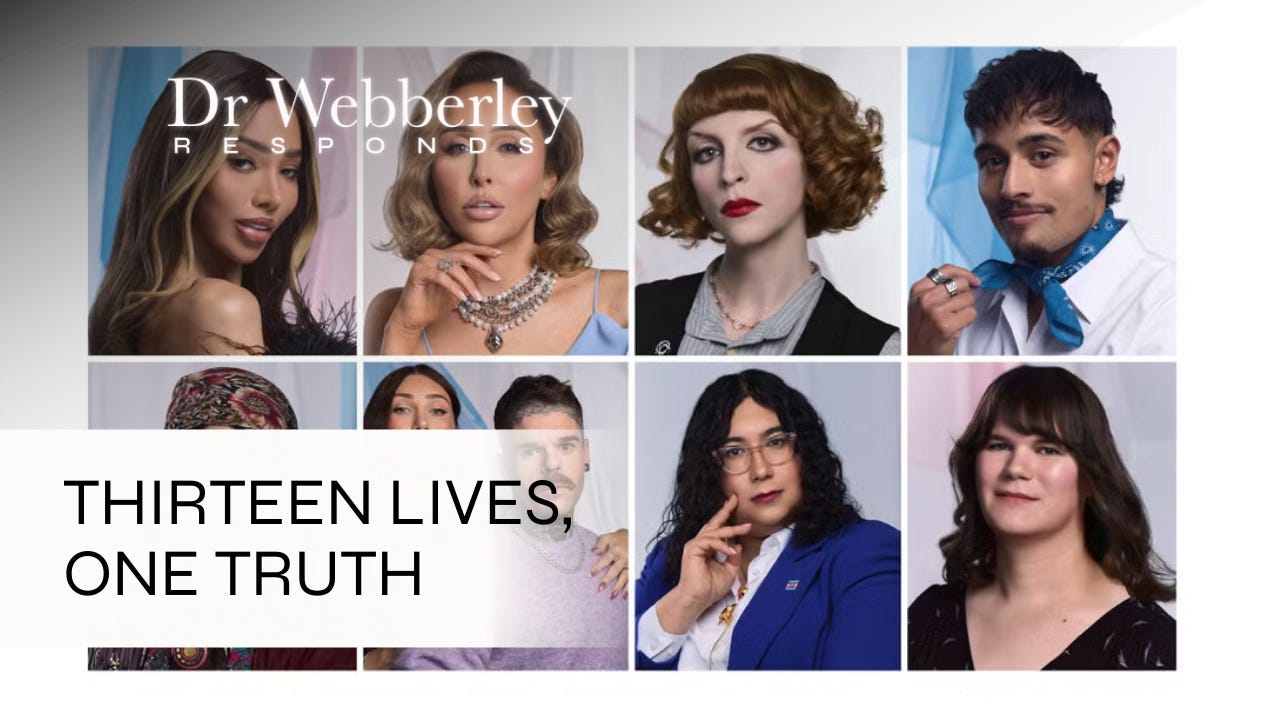
I have been sitting with the Cosmopolitan feature for a few days now, going back to it, reading a passage here and there. It is a remarkable piece of journalism: thirteen people, each with their own story, each with their own way of describing what the past year has felt like since the UK Supreme Court ruled in April 2025 that, for the purposes of the Equality Act, a person’s sex is their biological sex as recorded on their original birth certificate. The pain in some of those accounts is real and I do not want to gloss over it. People have been anxious, isolated, and frightened. Some have taken time off work. Some have changed the way they move through the world entirely.
But something else kept catching my eye. Something that I think deserves to be lifted up and looked at carefully, because in times like these it is very easy to miss it. Between every story of fear and hardship, there was something quieter and more enduring: the extraordinary, stubborn, beautiful fact of people living as themselves.
That is what I want to talk about today.
First, a word about the ruling itself
I want to be clear, because clarity matters here. The Supreme Court did not define what a woman is. It ruled that, for the specific purposes of the Equality Act, the word ‘sex’ refers to biological sex. That is a legal distinction with real-world consequences, and those consequences are still unfolding. Most public bodies are still waiting for guidance from the Equality and Human Rights Commission on how to implement the ruling. Trans people remain protected under the Equality Act against discrimination and harassment: that has not changed.
The uncertainty, as the Cosmopolitan feature makes clear, has created its own kind of harm. When things are unclear, it is often the most vulnerable people who fall through the gaps. I hold that knowledge carefully alongside everything else I am about to say.
Thirty years of hiding, then four years of love
The story that stopped me completely was Alexis’s. She came out as transgender at fifteen. She was on the path to hormones when society’s weight pressed down on her and she pulled back. Over the next twelve years she built a dancing career, travelled the world, and eventually fell in love with Liam, who proposed just months before she finally told him who she truly was.
His response, when she told him? He said, ‘Okay, how do we make that happen?’ They were married last year. The day the ruling was announced, Alexis was planning her wedding.
In the feature she says this, and I find it one of the most powerful things I have read in a long time: she spent thirty years hating herself, and the past four years made her love herself. No one, she says, can undo everything she has done to get here.
No one can undo that. Not a court ruling. Not hostile legislation. Not any amount of noise in the media. Those four years happened. That love is real. That wedding day was real. Liam, speaking about their life together, says simply that they are a normal Yorkshire couple, and he wants people to look at them and think: ‘Oh, so people like that exist. Maybe we should not be scared.’
The defiance of living fully and loudly
Jude, an artist from Leeds in her twenties, responded to the ruling in a way I find quietly magnificent. She cut her waist-length hair into a flapper-style bob, pushed forward more publicly with her art, and refused to be driven back into conformity. When high-profile anti-trans figures began targeting her work, she did not disappear. She carried on.
She talks about a saying in the vintage community: ‘vintage style, not vintage values.’ You can appreciate the aesthetics of the past while rejecting its bigotry. She points to anarchist, communist, and punk movements as precedents. Her position is that if the people who harass us drive us back into lives of conformity and fear, then they have won. So she carries on, making her art, wearing her clothes, being herself. There is real wisdom in that, and real courage.
Community is not a comfort: it is a force
Munroe Bergdorf has been watching these patterns for sixteen years since her transition. She says the ruling was a wake-up call: we in the UK have grown up with an arrogance about our rights, an assumption that they will simply always be there. She is clear-eyed about the tactics being used against the trans community, and equally clear-eyed about the response. London Trans Pride is now the largest Trans Pride in the world. The community, she says, is more organised and more empathetic than ever.
Alexandra Parmar-Yee, who experienced transphobic abuse on the Tube in the immediate aftermath of the judgment, channelled her anger into action. She organised a mass lobby of Parliament in June 2025, bringing nine hundred trans people and allies face to face with their MPs. She believes it was the largest lobby of its kind in history. She changed her middle name to her late mother’s, carries her spirit with her, and keeps working. Her motivation is not rage, it is love and determination, a commitment to doing everything she can to work towards hope.
Joy is not naive: it is an act of resistance
Nyongbella, who appeared on Drag Race UK, speaks about something that resonates deeply with me. She says that it can get to even the strongest of people, and it is okay to admit that. Then she adds this: she has found that looking for the joys in life, day to day, making life worth living, helps her to persevere. She knows that the best day of her life is yet to come.
She is not pretending things are fine when they are not. She is doing something much harder: holding the difficulty and the joy at the same time, and choosing to orient herself towards the future. That is not naive. In the context of what trans people are living through right now, it is one of the most radical and courageous things a person can do.
A message to young trans people
Ella Morgan, who has appeared on multiple television programmes and is a charity patron for Switchboard LGBT+, addresses young trans people directly in the feature. She speaks honestly about her own struggles over the past year, including the return of an eating disorder she thought she had left behind, and the anxiety of not knowing where she was allowed to go. Then she says something I want every young trans person to hear.
Wherever your transition takes you, she says, physically, spiritually, mentally: never give up. There are always going to be people who are against you. There are also so many people who will be there for you, who will support you and build you up. It is so much better to get to live your life as your true self than to spend it hiding and fearing who you are.
I could not have said it better myself, and I have been trying to say something like it for thirty years as a doctor. Living as yourself is not a luxury or a privilege. It is a human need. When that need is met, people flourish. When it is suppressed, people suffer. The evidence for this is not abstract: it is in the faces and the words of these thirteen people.
What this feature means to me as a doctor
I spent a decade in gender healthcare. The thread that runs through every single consultation I ever had is this: when people are allowed to live as themselves, their health improves, their relationships improve, and their capacity for joy returns. When they are prevented from doing so, everything suffers.
The Cosmopolitan feature is not a collection of statistics. It is thirteen human beings telling us, in their own words, what it feels like to live through a period of profound uncertainty and hostility, and what it feels like to keep going anyway. As a doctor and as a human being, I am grateful to each of them for speaking.
I am also grateful to Cosmopolitan for commissioning it. In a media landscape that often treats trans lives as a debate to be had rather than a reality to be witnessed, this feature does something genuinely valuable: it lets trans people speak in their own voices, without filtering or framing. More of that, please.
To you, reading this
If you are trans and reading this, I want you to know that you are seen, and your life matters. The world is telling a very loud story about you right now, and a great deal of that story is wrong. The quiet, true story, the one in these thirteen lives, is about love and courage and the extraordinary stubbornness of people who know who they are.
If you are an ally reading this, thank you for being here. Please keep talking about these stories. Share this feature. Share the Cosmopolitan piece. Let people who have never met a trans person hear from thirteen of them at once. Zelah Glasson, who was the first trans man cast in the ITV reboot of Big Brother, puts it beautifully: when you sit down with someone and listen to them, beliefs can start to shift. Television, journalism, conversations between friends, all of it matters.
The truth always wins. It just sometimes needs more voices to carry it.
With love,
Dr Helen Webberley
Gender Specialist and Medical Educator
Resources
Switchboard LGBTQIA+ national support line: 0800 0119 100 or switchboard.lgbt
Trans+ Solidarity Alliance: lobbying and community advocacy for trans rights
The Trevor Project research on anti-trans legislation and youth mental health
Dear Dr. Webberley, thank you for writing this. I'm a 75 year old trans father and grandmother, writer and performer and Catriona Innes, who commissioned and wrote this article, is my daughter. I am so proud of her. Her and her big sister Rebecca are so loving and brave and kind.
So thank you for drawing attention to Katie's work in such a beautiful and heartfelt way.
And thank you for all your work. I write about trans issues too - in my substack The Light Inside - and I really believe all our work makes a difference.
Love and thanks to you
Jo Clifford
Fabulous article,well done Cosmopolitan.
We need more positive articles like this instead of negative articles such as "Trans woman who stalked her surgeon jailed" published 12th March by BBC, The Mail, The Sun and GB News
https://www.bbc.co.uk/news/articles/c75e0k71q29o