

Your GP Can Refuse a Bridging Prescription. But Can They Justify It?
A plain-language guide to what bridging hormones are, why trans people need them, and what the guidance actually says when your GP says no
If you are a trans person who has ever been told by your GP that they cannot prescribe hormones for you while you wait for a Gender Identity Clinic appointment, you are not alone, and you are not being difficult by questioning that decision. This piece is for you, and it is also for anyone who supports you, whether that is a friend, a parent, a partner, or a healthcare professional who wants to understand the landscape properly.
I want to walk through what bridging prescriptions are, why people need them, what GPs say when they refuse, whether those reasons actually hold up against the guidance, and what you can do if you feel you are being left without care you need.
What Is a Bridging Prescription?
A bridging prescription is a prescription for gender-affirming hormones, typically oestrogen or testosterone, issued by a GP to a trans person who is on the waiting list for a specialist Gender Identity Clinic (GIC) and has not yet had their first appointment. The word ‘bridging’ describes exactly what it does: it bridges the gap between where someone is now, waiting, sometimes for years, and where they need to be, in specialist care with a formal prescription in place.
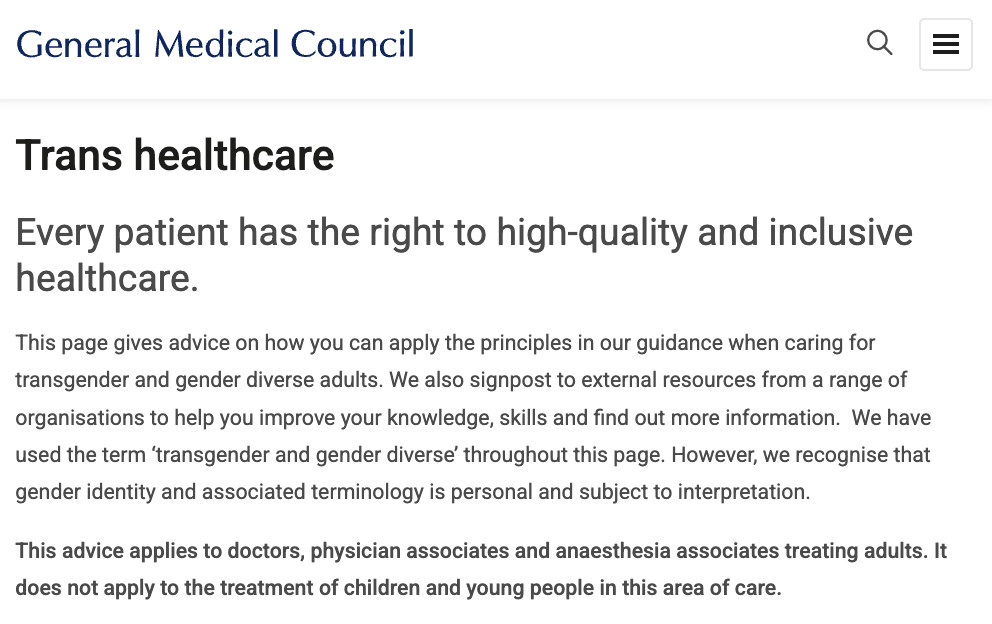
The GMC’s trans healthcare ethical hub describes bridging prescriptions as a ‘holding and harm reduction strategy’, and the Royal College of Psychiatrists has explicitly endorsed their use for patients presenting on illicit hormones who are awaiting assessment at a Gender Identity Service. [1, 2]
These are not experimental treatments. The medications involved, oestrogen preparations, testosterone gel and injections, and anti-androgens, are the same medications prescribed to menopausal women, to men with low testosterone, and to patients across a range of endocrine conditions. They are well understood, well monitored, and well within the clinical competence of a GP who takes the time to read the available guidance.
Why Do Trans People Need Them?
The honest answer is that NHS waiting times for Gender Identity Clinics in England are devastating. At Leeds Gender Identity Service, the current standard waiting list stands at over 6,700 people, with appointments being offered to those who were referred in approximately August 2019. [3] That is a wait of six years and counting.
During that time, a trans person’s mental health, physical wellbeing, and safety do not pause. Some people, facing years without any access to the treatment they know they need, turn to self-medication, buying hormones from unregulated online sources without any medical supervision, without proper dosing guidance, without blood test monitoring, and without any professional to contact if something goes wrong. This is not a choice made lightly. It is a choice made by people who feel they have no other option.
The GMC’s own guidance acknowledges this directly, noting that some trans people, facing continued deterioration in their mental health while waiting for a specialist appointment, become desperate for medical intervention and may turn to self-medication with products bought online from an unregulated source, without prior medical assessment or supervision. [1]
A bridging prescription, issued by a GP working within proper clinical frameworks, with appropriate blood tests and monitoring, is categorically safer than that alternative. It is harm reduction in the most straightforward sense of the term.
What Reasons Do GPs Give for Saying No?
When GPs or practice managers refuse bridging prescriptions, there are a handful of reasons that come up repeatedly. You may have heard some of these yourself.
The first is a claim about competence: that the clinicians at the practice are not trained or clinically competent to initiate or issue bridging hormone prescriptions. The second is that secondary care gender specialist involvement is required before anything can happen. The third is that without a shared care agreement in place, the practice cannot prescribe. The fourth is that this approach is consistent with GMC standards and national guidance. The fifth is a general statement that GPs must practise within their competence. The sixth is that bridging prescriptions sit outside normal primary care expertise unless a GP has specific extended training in transgender care.
These reasons often appear together, in letters or verbal explanations, presented as though they form a coherent, policy-backed position. It is worth examining each one carefully.
Do Those Reasons Actually Stack Up?
On competence
The GMC is clear that lack of current knowledge is not a reason to refuse care. It places a duty on doctors to develop their competence, including by contacting the specialist service for advice. The acting Chief Executive of the GMC, in direct response to concerns raised by the BMA about this very issue, confirmed that the GMC does not believe care for patients with gender dysphoria is a highly specialised treatment area requiring specific expertise, and that GPs should acquire the knowledge and skills to be able to deliver a good service. [4]
The GMC’s own guidance also states explicitly: ‘If you feel you lack knowledge about the healthcare needs of trans people, you should in the short term ask for advice from a gender specialist. In the longer term, you should address your learning need as part of your continuing professional development.’ [5] Lack of knowledge today is a prompt to learn, not a reason to close the door.
On the requirement for secondary care involvement
This is a misreading of the guidance. The GMC does say a GP should seek the advice of a gender specialist before issuing a bridging prescription at the lowest acceptable dose. That is different from requiring a formal secondary care referral or a specialist sign-off as a prerequisite. Advice can be sought informally, by telephone or email, from the relevant GIC. Several NHS Gender Identity Clinics explicitly publish contact details for this purpose and actively encourage GPs to reach out. [3, 6]
On the shared care agreement requirement
This is the most significant misrepresentation in the standard refusal letter, and it matters that we name it clearly. A shared care agreement is a formal arrangement for patients who are already under the care of a GIC and whose ongoing prescribing is being transferred to primary care. A bridging prescription, by definition, applies to patients who are not yet under specialist care. These are two entirely separate situations, and conflating them is factually incorrect. The guidance on bridging prescriptions exists precisely for patients who do not yet have a specialist involved, and a shared care agreement is not a prerequisite for a bridging prescription. [1, 2, 7]
On consistency with GMC standards
This claim is directly contradicted by the GMC’s own words. The GMC’s ethical hub states: ‘This information is aimed at reassuring doctors who wish to prescribe for their transgender and gender diverse patients that it would not be against our guidance to do so.’ [1] A GP citing GMC standards as the reason they cannot prescribe is, in effect, inverting what those standards say.
On practising within competence
This principle is real and important. No doctor should prescribe something they genuinely do not feel safe prescribing. The issue is that this principle has been stretched, in the context of trans healthcare, far beyond its intended meaning. The medications involved in bridging prescriptions, standard hormone preparations, are not unfamiliar to primary care. GPs prescribe HRT to menopausal women and testosterone to men with hypogonadism routinely. The clinical principles are directly transferable, and the monitoring parameters are well documented in freely available NHS and GIC guidance. [5, 8]
On the absence of conscientious objection
It is worth noting, because it is sometimes implied but rarely stated, that there is no conscientious objection clause in UK law for the care of transgender patients. The Abortion Act 1967 permits doctors to decline to participate in terminations on grounds of conscience. No equivalent provision exists for trans healthcare. Trans people are entitled to objective, non-judgmental medical advice and treatment, and that entitlement is protected by the Equality Act 2010. [9]
What Should a GP Do to Develop Competence?
NHS Gender Identity Clinics have put considerable effort into producing exactly the resources a GP needs to prescribe safely and confidently. These are not obscure documents buried in academic journals. They are freely available, written specifically for primary care, and in many cases include detailed clinical guidance on initiating, dosing, and monitoring hormone therapy.
Leeds Gender Identity Service has a dedicated Healthcare Professional Hormone Support Hub on its website, with published guidance on initiating feminising and masculinising hormone treatment, information on hormone regimens, guidance on bridging prescriptions, and a framework for collaborative working. [3]
Sheffield Gender Identity Clinic publishes prescribing guidelines for GPs covering trans women, trans men, and progesterone prescribing. [6]
Nottingham Centre for Transgender Health has published a Guide to the Prescribing of Hormone Treatment and Collaborative Working Arrangements with GPs, alongside the Nottinghamshire Area Prescribing Committee’s Collaborative Care Protocol. [8]
Sussex Partnership NHS FT offers sign-up for Local Commissioned Service training specifically designed to build GP confidence and knowledge on prescribing and monitoring hormone therapy for trans, non-binary, and intersex patients. [10]
The Midlands and Lancashire Commissioning Support Unit has published separate prescribing documents for trans women and trans men. [11]
TransActual maintains a consolidated list of all these resources, and more, on its health professionals prescribing page at transactual.org.uk, which is a useful single reference to share with a practice. [11]
The RCGP offers a Gender Variance e-learning module. The Royal College of Physicians has developed professional credentials for those working in adult gender identity services. The GMC’s ethical hub links to further training materials from HEIW and NHS Education for Scotland. [1, 12]
There is no shortage of support available. A GP who says they cannot develop the competence to prescribe bridging hormones has not yet looked for the resources that are waiting for them.
What Are Your Next Steps?
If your GP has refused a bridging prescription and you believe they have not given a sound clinical reason, there are several routes available to you. These are listed in order of escalation, and you do not need to use all of them, but it helps to know they exist.
I have written a full step-by-step guide to this process, with template letters you can use, which you can find here: What To Do If Your GP Refuses to Prescribe Your Gender-Affirming Medication. [13] The steps below give you a summary of what is covered.
Ask for the reason in writing.
Before anything else, ask your GP to document their reason for refusal in writing. This creates a formal record, and many clinicians will reconsider once they know their reasoning is being noted. Under the NHS Constitution, you have the right to have your concerns taken seriously and to understand the clinical basis for any decision that affects your care. [13]
Ask to see a different GP within the same practice.
You are entitled to see any GP at your registered practice. A refusal from one clinician does not represent the position of the whole practice, and another GP may feel differently.
Complain to the practice.
The first formal stage is to make a written complaint to the practice itself. In your complaint, include the reason given for refusal, the impact on your health and wellbeing, how long you have been waiting for a GIC appointment, and a note that you are protected under the Equality Act 2010 as someone with the characteristic of gender reassignment. If you feel the refusal is discriminatory, say so. My template letter for bridging prescriptions, available to download in the article linked above, gives you a framework for doing exactly this. [13]
Complain to your Integrated Care Board (ICB).
You can complain to the ICB rather than the practice directly, but not both. The ICB is the commissioner of primary care services in your area and has a complaints process. This is the appropriate route if you do not feel comfortable complaining to the practice, or if the practice has already responded and you are not satisfied. [13]
Contact PALS.
The Patient Advice and Liaison Service is free, confidential, and independent. PALS can help you navigate the complaints process and can sometimes facilitate rapid informal resolution without the need for a formal complaint. [13]
Escalate to the Parliamentary and Health Service Ombudsman.
If your complaint has not been resolved at practice or ICB level, you can take it to the Ombudsman, which is independent of the NHS. You must do this within 12 months of the original incident. The Ombudsman can recommend that staff receive training and that an apology be issued, among other remedies. [13]
Complain to the GMC.
You can raise a complaint with the General Medical Council if you believe your GP has made a serious or repeated mistake, has discriminated against you, or has otherwise failed to meet the GMC’s professional standards. The GMC cannot compel your GP to prescribe, but a complaint puts the conduct on record and can trigger a fitness to practise process. You can use the GMC’s online form to submit your concerns. [4, 13]
Consider a legal challenge.
If you believe you have experienced unlawful discrimination under the Equality Act 2010, you may have grounds for legal action. A number of law firms hold expertise in equality law and regulatory medicine, and many will offer an initial assessment. There are time limits on legal challenges, so if this is a route you are considering, it is worth seeking advice promptly. [13]
I want to be clear about something, because it matters. Asking your GP to do their job is not unreasonable. It is not demanding. It is not making things difficult. You are a patient with a healthcare need, and there is clear, published, accessible guidance that supports your right to receive care. The resources exist. The guidance exists. The obligation exists.
If you want help understanding how to frame a conversation with your GP, or how to write a formal complaint, please do leave a comment or get in touch. You should not have to navigate this alone.
Dr Helen Webberley, Gender Specialist and Medical Educator
www.helenwebberley.com
References
1. GMC Trans Healthcare Ethical Hub (updated January 2024): https://www.gmc-uk.org/professional-standards/ethical-hub/trans-healthcare
2. Royal College of Psychiatrists: Supporting Transgender and Gender-Diverse People (2018): https://www.rcpsych.ac.uk/pdf/PS02_18.pdf
3. Leeds and York Partnership NHS FT: Gender Identity Service, Healthcare Professional Hormone Support Hub: https://www.leedsandyorkpft.nhs.uk/our-services/gender-identity-service/
4. GMC Acting Chief Executive response to BMA on bridging prescriptions: http://www.thegoodhealthsuite.co.uk/GP/professional/1056-gmc-clarifies-hormone-guidance-for-gps-prescribing-for-transgender-patients
5. NECS Medicines Optimisation: Primary Care Responsibilities in Prescribing and Monitoring Hormone Therapy for Transgender and Non-Binary Adults: https://medicines.necsu.nhs.uk/primary-care-responsibilities-in-prescribing-and-monitoring-hormone-therapy-for-transgender-and-non-binary-adults/
6. Sheffield Gender Identity Clinic: Information for GPs: https://www.sheffieldpartnership.nhs.uk/services/gender-identity-clinic/information-gps
7. BMA: Role of GPs in Managing Adult Patients with Gender Incongruence (March 2022): https://www.bma.org.uk/media/5481/bma-role-of-gps-in-managing-adult-patients-with-gender-dysphoria-mar2022.pdf
8. Nottinghamshire Area Prescribing Committee: Collaborative Care Protocol, Hormone Therapy for Transgender Adults: https://www.nottsapc.nhs.uk/media/xo3lnhwi/transgender-prescribing-position-statement.pdf
9. Equality Act 2010, Section 7 (Gender Reassignment): https://www.legislation.gov.uk/ukpga/2010/15/section/7
10. Sussex Partnership NHS FT: Frequently Asked Questions for Health Professionals: https://www.sussexpartnership.nhs.uk/our-services/specialist-services/sussex-gender-service/frequently-asked-questions-faqs-health-professionals
11. TransActual: Health Professionals Prescribing (clinical resource list): https://transactual.org.uk/healthcare-professionals/prescribing/
12. RCGP: Transgender Care: https://www.rcgp.org.uk/representing-you/policy-areas/transgender-care
13. Dr Helen Webberley: What To Do If Your GP Refuses to Prescribe Your Gender-Affirming Medication (includes template letters): https://www.helenwebberley.com/p/what-to-do-if-your-gp-refuses-to
14. NHS England: Feedback and Complaints About NHS Services: https://www.england.nhs.uk/contact-us/feedback-and-complaints/complaint/