

Ten Years Ago the NHS Was Found to be Failing Trans People
So what did the 2025 Levy Review identify?
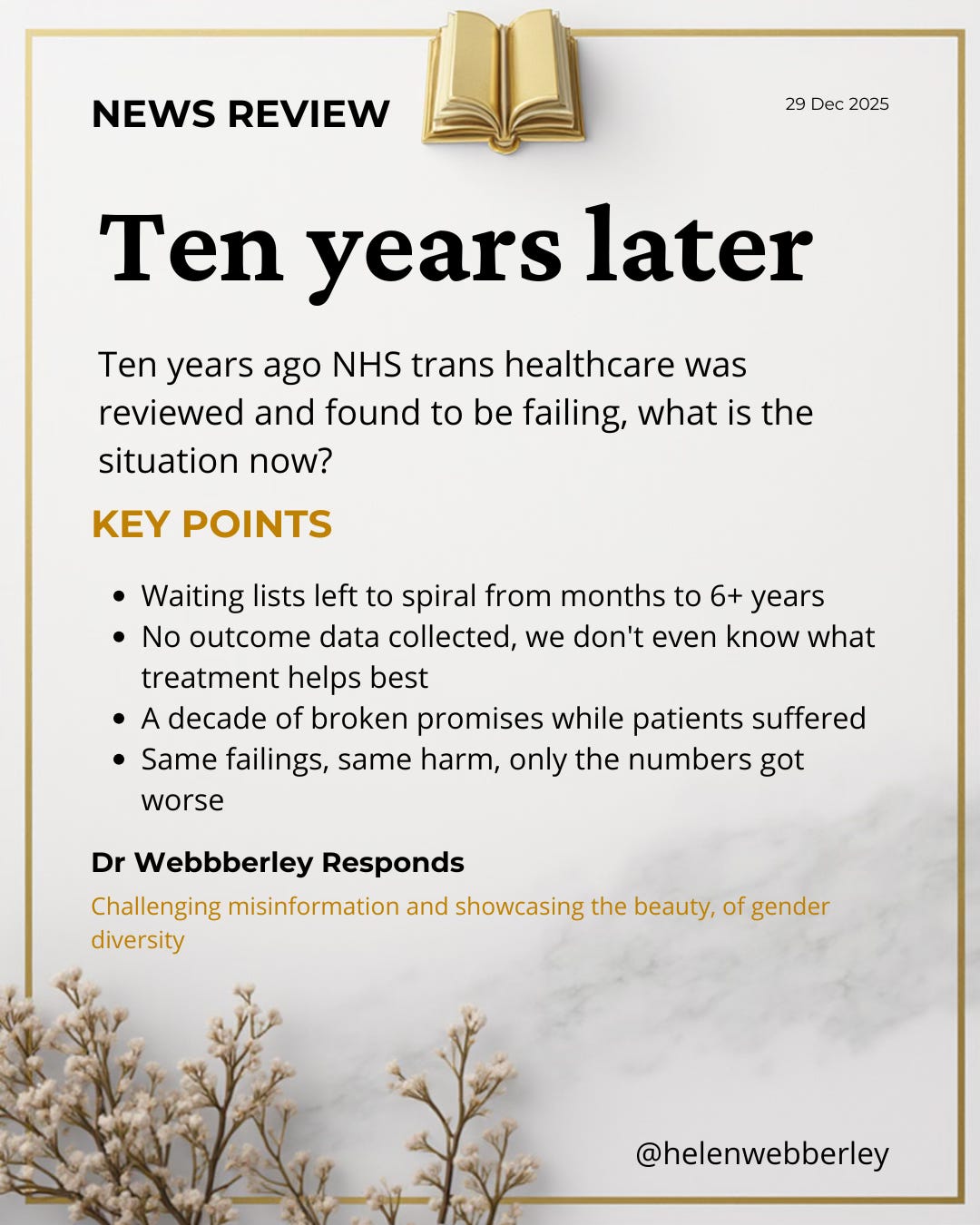
In 2016, the House of Commons Women and Equalities Committee published a landmark report1 on transgender equality. It was thorough, compassionate, and clear-eyed about the failures of NHS gender services. The committee heard from patients, clinicians, and advocates. They documented the harm being done by underfunded, understaffed clinics with impossibly long waiting lists.
Their recommendations were sensible and achievable:
Improve access.
Train staff.
Reduce waiting times.
Treat transgender people with dignity.
The government responded2 with promises:
More funding.
Better training.
Streamlined processes.
A coordinated, multi-agency approach.
Now, nearly ten years later, the Levy Review3 of adult gender dysphoria clinics has been published. And what does it find?
The same problems. Only worse.
The Waiting Lists
In 2016, waiting times were already unacceptable. The committee called for urgent action.
In 2025, the Levy Review reports an average wait of 296 weeks, that’s nearly six years, just for a first appointment. Some clinics project waiting times of fifteen years or more if nothing changes. Over 40,000 people are now waiting, and the true figure may be higher because of duplication across services.
The promise was improvement but the reality is deterioration on a staggering scale.
Quality and Safety
The 2016 report found inconsistent protocols, a lack of specialist clinicians, and GPs who didn’t understand their responsibilities. It called for better training, clearer standards, and proper oversight.
The Levy Review finds the same inconsistencies, the same lack of standardisation, the same gaps in training. But it also finds something more troubling: there is still no meaningful collection of patient outcomes data. After a decade, we still don’t know how these services are actually helping people, and so how we can do better, because nobody has been measuring it properly.
The 2016 committee was concerned about the shift toward a younger, more complex patient population. The Levy Review confirms this shift has continued, with increased neurodevelopmental and mental health needs, but services haven’t adapted to meet them.
Governance and Leadership
Both reports identify weak governance. The 2016 committee called for clear lines of accountability and a cross-government strategy. The Levy Review finds that governance and oversight remain inadequate, with risks not always recorded or addressed, and significant variation in leadership quality across clinics.
The promised coordination never materialised. Or if it did, it failed.
What Was Actually Done?
The government’s 2016 response contained all the right words. Investment. Training. Standards. Zero tolerance for transphobia. Engagement and accountability.
However these promises and words are not actions and the result is that The Levy Review is, in effect, a catalogue of broken promises.
Some might argue that demand has grown faster than anyone anticipated, and maybe there’s some truth I that, but a competent health system plans for growth. It monitors trends and it builds capacity before crisis hits. What we have instead is a service that was already failing in 2016, left to fail more spectacularly for another decade.
The Human Cost
These are not abstract policy failures. Behind every week of that 296-week average is a person waiting. Waiting to be seen. Waiting to be heard. Waiting to access care that, for many, is not optional but essential and for some life-saving.
Some will have given up. Some will have sought care elsewhere, often at personal financial cost. Some will have suffered deteriorating mental health while waiting. Some will no longer be alive.
We don’t have good data on these outcomes either, and that’s part of the problem.
What Happens Now?
The Levy Review makes recommendations:
National standards.
Single waiting lists.
Proper data collection.
Better training.
Stronger governance.
These recommendations are sensible and they echo what was said in 2016.
The question is whether, this time, anyone will actually implement them. Whether the money will materialise. Whether the political will exists to prioritise a marginalised population that has become, in recent years, the subject of intense public controversy.
I wish I could be optimistic, but I’ve read too many reports, heard too many promises, and watched too little change, and now I see discrimination and prejudice being accepted and normalised.
The Solution?
Absolute zero tolerance on bias, discrimination and prejudice.
Education in schools, homes and society.
Urgent training for all professionals.
Informed consent models of care.
Care provided in General Practice settings.
Embrace the beauty of diversity.
Over to You
I’d love to hear your thoughts. Please subscribe to share them in the comments below.
This is part of a series examining cases, commentary and hearings concerning gender identity. If you have a case or article you’d like me to review, get in touch.
https://publications.parliament.uk/pa/cm201516/cmselect/cmwomeq/390/390.pdf
https://www.gov.uk/government/publications/transgender-equality-report-government-response
https://www.england.nhs.uk/publication/operational-and-delivery-review-of-nhs-adult-gender-dysphoria-clinics-in-england/