

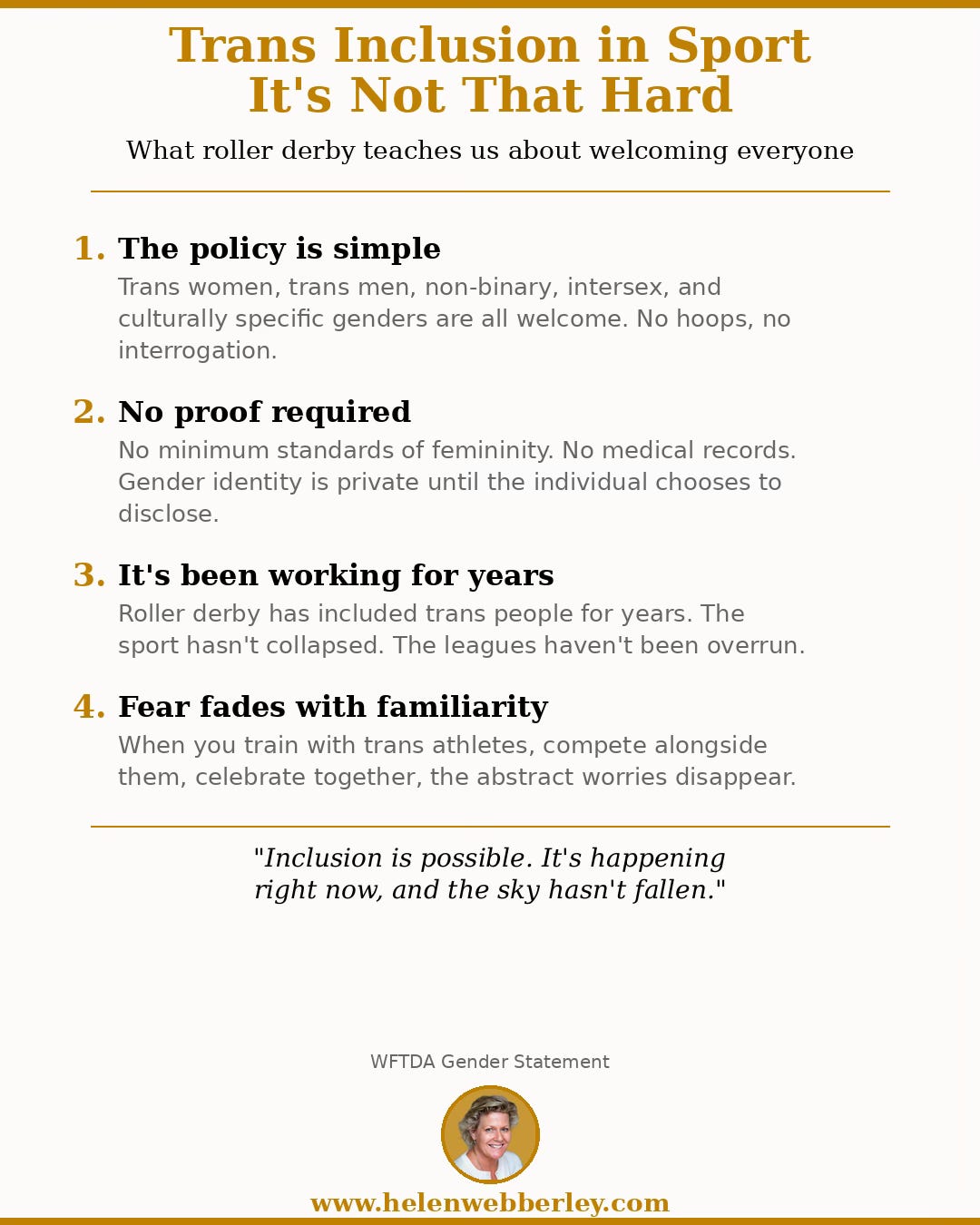
When I first read the WFTDA’s gender policy1, I honestly had to read it twice. Not because it was confusing, but because it was so refreshingly simple. Here is a major international sports organisation saying, in plain language, that trans people are welcome. All of them. No hoops, no interrogation, no minimum standards of femininity. Just: you’re welcome here.
What does the policy actually say?
The Women’s Flat Track Derby Association is the international governing body for roller derby, and their statement on gender is beautifully straightforward. Any individual of a marginalised gender can participate fully in WFTDA, including skating on a charter or holding elected office. That includes trans women, trans men, non-binary people, genderqueer and genderfluid individuals, intersex people, and those with culturally specific genders like Two-Spirit.
What strikes me most is what the policy doesn’t do. It doesn’t set minimum standards of femininity or androgyny. It doesn’t require anyone to prove their gender through appearance or documentation. It explicitly commits to not interfering with the privacy of its members for the purposes of eligibility. The gender identity of participants is considered confidential and private until the individual chooses to disclose it.
Why this matters
I spend a lot of my time challenging misinformation about trans people in sport, and so often the conversation gets stuck on hypotheticals and fear. What if someone exploits the system? What about fairness? What about safety? These questions get asked over and over, usually by people who have never actually sat down and listened to trans athletes or the communities that include them.
Roller derby has been including trans people for years, and the sport hasn’t collapsed. The leagues haven’t been overrun. What has happened is that trans people have found a community where they can be themselves, compete, train, and belong. That’s it. That’s the reality.
The language of inclusion
One thing I really appreciate about the WFTDA policy is that it acknowledges that gender is evolving. They don’t try to create an exhaustive list because they understand that would actually limit inclusion rather than expand it. Instead, they give examples while making clear that the list will be updated as needed.
This is what thoughtful policy looks like. It’s not about ticking boxes or finding loopholes. It’s about creating a framework that says: we see you, we welcome you, and we’re committed to doing the work necessary to make this a truly inclusive space.
What other sports could learn
The WFTDA policy shows that inclusion doesn’t have to be complicated. You don’t need endless committees debating testosterone levels or demanding medical records. You simply need to decide, as an organisation, that you value inclusion and that you’re willing to trust people to participate honestly.
I think the fear around trans inclusion in sport often comes from a lack of knowledge and a lack of exposure. When you’ve never met a trans athlete, when you’ve never heard their stories, it’s easy to get caught up in abstract worries. Roller derby leagues have trans members. They know these people. They train with them, compete alongside them, celebrate victories and commiserate losses together. The fear disappears when you actually know the people involved.
The bigger picture
What I love about seeing policies like this is that they prove something important: inclusion is possible. It’s happening right now, in communities around the world, and the sky hasn’t fallen. Trans people are skating, officiating, coaching, and leading in roller derby, and the sport is thriving.
When people tell me that trans inclusion is too complicated, too risky, too controversial, I think about roller derby. I think about the leagues that made a choice to welcome everyone and then just got on with playing their sport. It’s not that hard when you decide that people matter.
Have you had experience with inclusive sports communities? I’d love to hear your stories in the comments. 🫶
This is part of my work challenging misinformation and showcasing the beauty of gender diversity. If you found this useful, please share it with someone who needs to see that inclusion works.
https://resources.wftda.org/membership/diversity-and-inclusion/wftda-statement-about-gender/
For 20 years I have participated in Archery with no problems this year Archery GB have changed the rules now when my name is on a target list instead of being Lady or Gent I am Open an artificial category that only exists for trans competitors, it is outing, it is othering, it is humiliating I am soooooo disappointed.