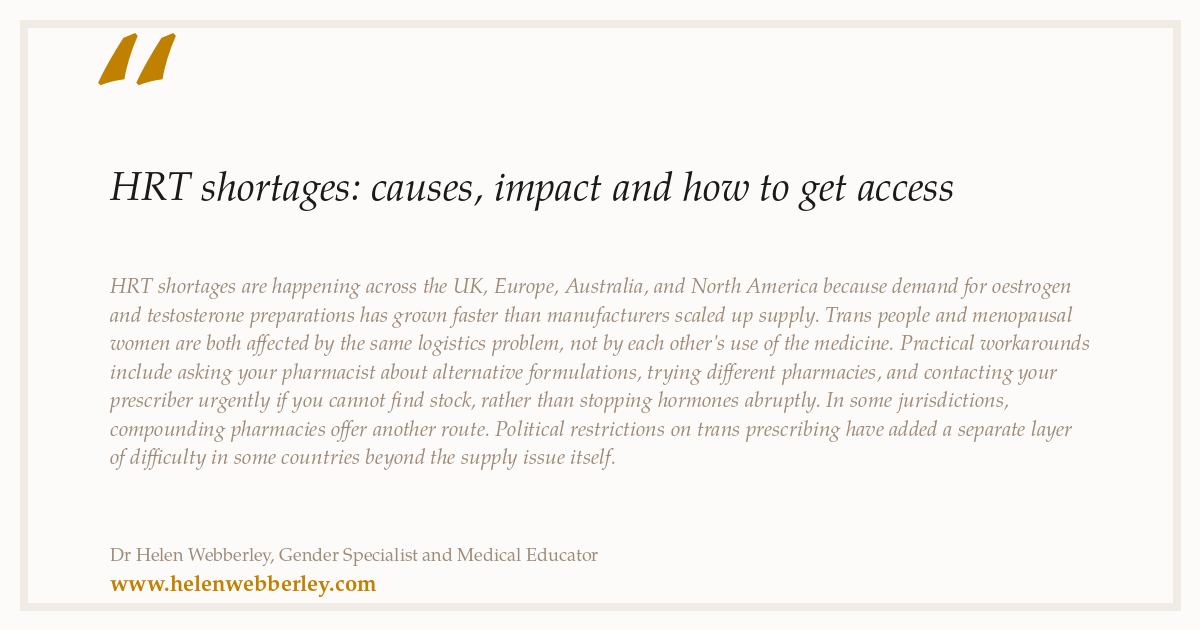
HRT shortages are happening across multiple countries at once, driven by a combination of surging demand, manufacturing bottlenecks, and supply chain fragility. Trans people and menopausal women are both affected, and the disruption is real and serious. If you are struggling to get hold of your usual preparation, you are not imagining it, and there are practical things you can do.
Why is there an HRT shortage right now?
The short answer is that demand outpaced supply, and the supply chain was not built to absorb that kind of spike. Oestrogen gels, patches, and sprays have seen demand grow dramatically over the past several years, partly because more menopausal women are seeking treatment, partly because trans healthcare has expanded, and partly because public understanding of HRT's benefits has improved substantially. Manufacturers did not scale up fast enough to meet any of that.
At the same time, the medicines involved are relatively specialist. Oestrogen gel, for instance, is not the kind of product dozens of factories produce interchangeably. When one manufacturer has a production problem, or when a distributor is slow to restock, the shortfall hits the whole market quickly. This is what happened in the UK, across much of Europe, in Australia, and in parts of North America, not always at the same moment but in overlapping waves.
Political pressure on trans healthcare has made things worse in some jurisdictions. Where governments or regulators have moved to restrict prescribing, pharmacies have sometimes become reluctant to stock products they expect to sit on shelves. That is a commercial decision with real consequences for people who need the medicine.
Who is affected, and how?
Both trans people and menopausal women are caught in the same shortage, and that matters because the framing in public debate sometimes pits them against each other. Trans people are not responsible for shortages affecting menopausal women, and menopausal women are not responsible for shortages affecting trans people. The shortage is a supply and logistics problem. The solution is more supply, not a rationing argument about who deserves the medicine.
For trans women and non-binary people using oestrogen, a gap in supply is not merely inconvenient. Stopping oestrogen abruptly can cause a rapid return of testosterone-driven changes, distressing physical symptoms, and significant deterioration in mental wellbeing. These are not minor side effects. For someone who has spent years on oestrogen and has built their sense of self around the body that hormone has shaped, a forced interruption is a serious harm.
For trans men and non-binary people using testosterone, gel and injection preparations have also faced intermittent shortages in several countries. The impact is similar: unwanted symptoms returning, mood disruption, and the particular anxiety of not knowing when or whether supply will resume.
For menopausal women, the stakes are equally real. HRT manages vasomotor symptoms, protects bone density, and for many people is central to functioning well day to day. A shortage is not an invitation to push through; it is a gap in care that needs a practical solution.
The panic-buying problem
Shortages have triggered panic buying in some places, which makes the situation worse. When people hear that their preparation may run out, the rational individual response is to stockpile. But stockpiling pulls supply away from people who cannot get enough to stockpile in the first place, which accelerates the very shortage people feared. This is not a moral failure on the part of people who stockpile; it is a predictable outcome of a system that does not give people enough certainty about future supply.
The answer is not to blame individuals for responding rationally to uncertainty. The answer is for regulators, manufacturers, and distributors to communicate clearly and to build more resilient supply chains. Some countries have introduced dispensing limits during acute shortages, which at least spreads available supply more evenly, but those limits only help if pharmacies are actually receiving stock to dispense.
What you can do right now
If your usual pharmacy does not have your preparation, there are practical steps worth trying before you assume the supply has dried up entirely.
Ask your pharmacist to check the wholesaler. Shortages are often localised: one wholesaler may be out while another has stock. A pharmacist who is willing to look will sometimes find a route that a brief phone enquiry missed.
Ask whether a different preparation of the same hormone is available. If you use a gel and it is not in stock, patches or a spray delivering the same dose may be. If you use patches and those are unavailable, a gel may be. Your prescriber needs to authorise the switch, but in an emergency most prescribers will do this quickly. If yours will not engage with that request promptly, that is worth pushing back on.
Try a different pharmacy. This sounds obvious, but it works more often than people expect. Stock is not distributed evenly, and a pharmacy a few streets away or in the next town may have what yours does not.
If you are in the UK, the MHRA publishes a medicine shortage list and notifies pharmacists when formal shortage protocols are in place. During a shortage, a pharmacist may be able to dispense an alternative without a new prescription in specific circumstances, under what is called a serious shortage protocol. Your pharmacist will know whether one is active for your medicine.
If you are outside the UK, the equivalent body in most countries is the national medicines regulator. In Australia that is the TGA, in the US the FDA, in Canada Health Canada. All of them publish shortage information, though the quality and timeliness of that information varies.
If you genuinely cannot source your preparation and you use oestrogen, do not simply stop. Contact your prescriber and ask specifically what they recommend as a bridge. Stopping abruptly is not the same as tapering, and for many people it is the abruptness that causes the worst effects.
Longer-term access strategies
The people I hear from who manage supply disruption best are usually those who have not relied on a single pharmacy, have a prescriber who will respond quickly to urgent requests, and have thought in advance about which alternative preparations they could use if their usual one disappeared. None of that is possible for everyone, but it is worth building where you can.
If your access to HRT depends on a public healthcare pathway with long waiting times, a shortage on top of that can feel catastrophic. Private prescribing, where it is accessible, offers more flexibility: a prescriber who knows you and can pivot quickly to an alternative preparation is worth having. GenderGP at gendergp.com provides gender-affirming prescribing for trans people who cannot get what they need through public routes, and they are experienced in navigating exactly these kinds of supply disruptions.
Compounding pharmacies are another route in some jurisdictions. A compounding pharmacy makes up medicines to a specific formulation rather than dispensing a manufactured product, which means they are not subject to the same supply chain pressures. Access to compounding varies: it is well established in Australia and parts of the US, more limited in the UK and Europe. It requires a prescription, and quality varies by pharmacy, so it is worth asking your prescriber if they have a compounding pharmacy they trust.
The political dimension
I would not be doing this subject justice if I ignored the fact that some of the access difficulties trans people face are not supply-chain problems at all. They are political ones. In the US, executive actions have targeted gender-affirming care, creating an environment in which pharmacists and prescribers in some states are reluctant to dispense or prescribe regardless of what the shortage situation is. In the UK, the restrictions on puberty blockers and the climate around trans healthcare have had a chilling effect on prescribers. These are harms caused by policy, not by logistics, and the answer to them is political as well as practical.
What I can say is that the medicine itself, the oestrogen, the testosterone, the progesterone, has not changed. The evidence that it helps people has not changed. The clinical need of the people who rely on it has not changed. None of the political noise alters any of that, even when it makes access harder.
If there is a topic that you would like me to cover, just let Sammy know.
Dr Helen Webberley is a Gender Specialist and founder of GenderGP. She writes about gender diversity, trans healthcare, and the life around them.