
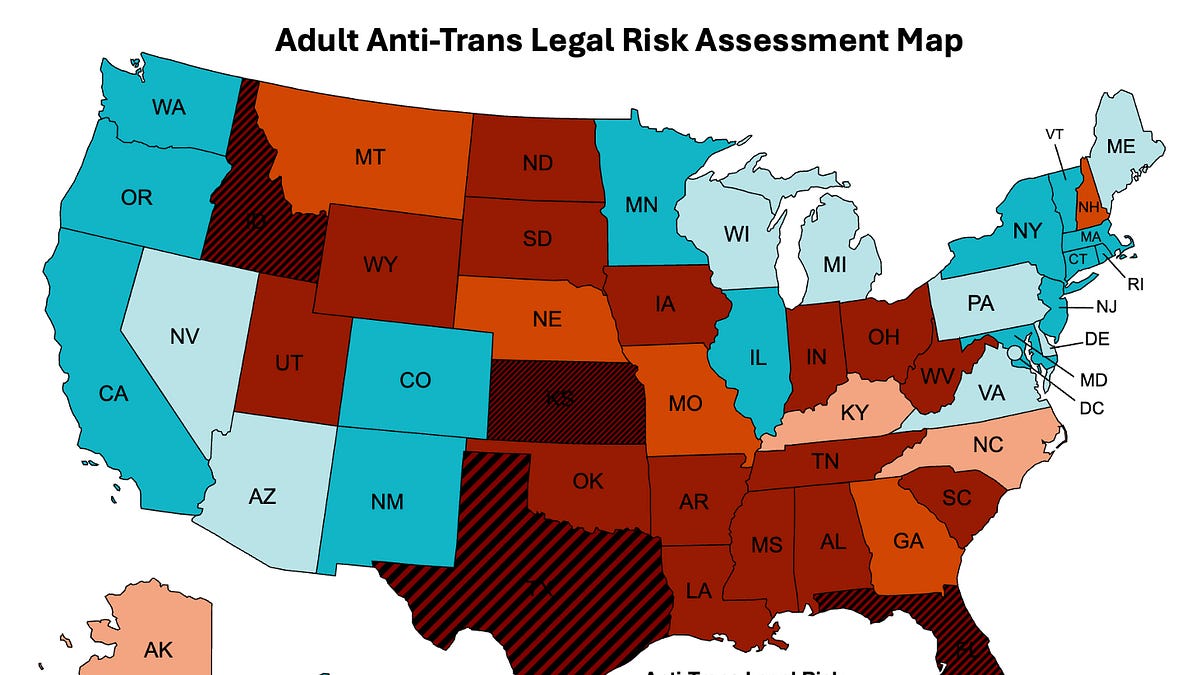
Four US states now carry 'Do Not Travel' advisories for transgender people: Florida, Idaho, Kansas, and Texas. Idaho's felony bathroom ban, carrying up to five years in prison, is the harshest bathroom law in the country. Erin Reed's July 2026 map is the clearest tool available for trans people trying to make real decisions about where to live, travel, and access care.
Idaho joins the Do Not Travel list
Every month, Erin Reed publishes her legal risk assessment map for transgender people across the United States. I read it every time. I read it because the people I hear from are real: parents wondering whether their child will be taken from them, teachers wondering whether their job will survive the next legislative session, trans adults wondering whether the state they have lived in their whole lives is still a place they can safely be themselves. These are not abstract anxieties. They are urgent, practical questions that deserve honest answers.
This month's update is one of the more sobering ones. Idaho has become the fourth state in the country to receive a "Do Not Travel" advisory, joining Florida, Kansas, and Texas. The reason is a new felony bathroom ban that carries a sentence of up to five years in prison. Five years. For using a toilet. A lawsuit has partially blocked the law, but it remains in effect wherever a gender-neutral or family restroom exists, meaning trans people in Idaho must actively seek out those specific facilities or risk a felony charge. Erin notes, with characteristic care, that this is not a designation taken lightly. She is right, and neither should we take it lightly when reading it.
What the map actually measures
Erin has been tracking anti-trans legislation for five years. She has read thousands of bills, watched hundreds of hours of hearings, and speaks regularly to activists on the ground in each state. The map she produces is not a headline-grab. It is a methodical, rubric-based assessment of the real legal environment for trans people: bathroom bans, healthcare restrictions, identification laws, social transition bans, and the broader signals, governor statements, draft legislation, party direction, that tell you where a state is heading. It is, as far as I am aware, the most thorough publicly available tool of its kind.
The categories matter. "Do Not Travel" is the highest risk. Below it sits "Worst Laws Passed," then "High Risk," and down through various gradations toward the states where things are, relatively, safer. South Carolina moved up this month too: its bathroom ban has been expanded to cover colleges and universities, pushing it into the "Worst Laws Passed" category. The direction of travel in many states is unmistakable.
The four Do Not Travel states, and why
The mechanisms differ across the four states, and the details matter. In Kansas, the bathroom ban creates a private right of action: everyday citizens can actively seek out trans people in bathrooms and sue them for large sums. It is a bounty-hunter system written into law. In Idaho, as above, the risk is criminal: a felony charge and up to five years in prison. In Florida, trans people can be arrested for using bathrooms that align with their gender identity, and a separate policy means that trans people "misrepresenting" their gender on a driving licence could be prosecuted for fraud. Pride crosswalks are being erased. In Texas, the state is not only ignoring court-ordered driving licence changes for trans adults, it is building a database of people who attempt to make such changes, and a new statewide bathroom ban has already resulted in detentions.
These are not hypothetical risks. They are the law, actively enforced, in four of the fifty states.
The federal picture
The map also reflects something I think people outside the United States sometimes underestimate: the scale of the federal rollback. Executive orders have forced nonprofits to scrub the word "transgender" from their websites. Trans history has been removed from the Stonewall National Monument. Federal funding has been withdrawn from schools and hospitals that recognise or research trans people. New barriers have been placed in the way of obtaining passports and legal documents. Several countries have issued travel advisories for trans people visiting the United States. Erin has designated the US as a whole a "Do Not Travel" zone for non-essential travel for trans people who do not have a full understanding of the current legal environment.
I want to pause on that for a moment, because it is extraordinary. The United States, a country that has long positioned itself as a beacon of individual rights and freedoms, now carries a blanket travel warning for an entire group of its own citizens and visitors. The scale of the reversal, within just a few years, is breathtaking.
What this means if you are making decisions
If you are a trans person in the United States trying to decide where to live, whether to travel, or how to assess your safety, the map is the best starting point I know of. It will not make the decision for you, and it cannot remove the anguish of having to make it at all. But it gives you something solid to work from, built by someone who has spent years understanding the terrain.
If you are outside the United States and wondering whether this has anything to do with you: the political forces driving these laws are not unique to America. The arguments, the organisations, the funding, and the rhetoric travel. What becomes law in Idaho or Texas today has a habit of becoming a campaign platform elsewhere tomorrow. Watching this map is not just an act of solidarity. It is an act of paying attention to a playbook that is being run in multiple countries simultaneously.
The people at the centre of all of this are not political abstractions. They are people who need to use a bathroom, get a driving licence, receive healthcare, and live their lives. The laws being passed right now are designed to make all of that harder, riskier, or impossible. That deserves to be named clearly, and Erin Reed is doing exactly that, month after month, with rigour and care. I am grateful for the work.
If there is a news story you would like me to cover then just let Sammy know.
Dr Helen Webberley is a gender specialist, medical educator, and advocate, and the founder of GenderGP. She writes about gender diversity, trans healthcare, and the lives of trans people and their families.
Comments