
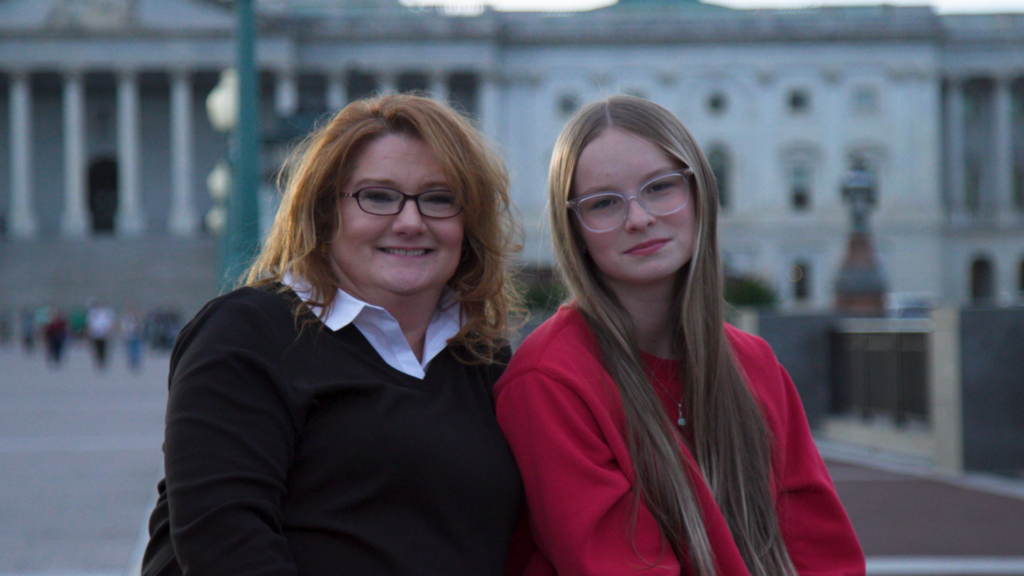
Heather Jackson sat in the United States Supreme Court in January, beside her fifteen-year-old daughter Becky, listening to the highest court in the country debate whether Becky should be allowed to run cross country with her friends. Let that land for a moment, not as a political fact, but as a human one: a mother sitting next to her teenage daughter while judges argued about her right to exist in sport.
Becky Pepper-Jackson is at the centre of West Virginia v. B.P.J., a case that will set the terms for transgender girls in school sport across the United States. She is fifteen. She loves running. She has always been last or next to last in her races, and she has never cared, because the point was always to run and be with her friends. That smile Heather describes, the big, beautiful one when Becky is out on the field, is the whole story, really. Everything else, the early morning meets, the hundreds of miles across West Virginia, the hours freezing in the stands, Heather does it all for that smile.
But there is something else happening on those sidelines, and Heather is honest about it. Adults, parents and grandparents among them, seek Becky out specifically to use the wrong pronouns and a name that is not her legal name. They do this on purpose, to get into her head, to shake her up. These are people who would not tolerate for one second the same treatment being directed at their own children. Heather says that scares her. It scares me too.
What Becky does in response is something I find genuinely remarkable. She smiles at the anger. She goes looking for the good in people even when they have given her every reason not to bother. She tells her mum: "Don't judge them like they judge us." That is not the response of someone who is confused, or fragile, or too young to know her own mind. That is the response of someone with more grace than most adults I have ever encountered.
Heather writes about the cynicism that comes with age, and how watching Becky has made her realise how much she still has to learn. I recognise that feeling completely. Over the years, the people who have taught me the most about resilience, about dignity, about how to treat other human beings, have almost always been trans people who had every reason to be bitter and chose something else instead.
What frustrates me, reading this piece, is the gap between what Heather knows about her daughter and what the court is being asked to decide. Heather knows Becky's love of running started young and was entirely her own. She knows the joy it brings her. She knows the community it gives her. She knows exactly what is at stake if it is taken away, not in the abstract, but in the specific, daily, irreplaceable reality of a teenager's life. That knowledge, the knowledge of a mother who has watched, listened, worried, driven, stood in the cold, and loved without condition, counts for almost nothing in a legal framework that treats Becky's existence as a policy question.
Courts and politicians argue over trans children as though they are theoretical. Heather writes about her daughter as though she is real, because she is. The adults on those sidelines using the wrong name treat Becky as a symbol of something they are frightened of. Heather sees a girl who wants to run.
Heather also writes about the mothers who have lost children to hate, and she names what that means plainly: her child's heartbeat is a gift, but her safety is never guaranteed. That is the reality that gets lost in every parliamentary debate, every Supreme Court hearing, every newspaper editorial about the rights of trans children. The harm is not hypothetical. The stakes are not abstract. Children are being told, by adults who should know better, that they are wrong, that they are mistakes, that they do not belong.
Becky knows she belongs. Heather has made sure of that. And on Mother's Day, that is the thing worth celebrating: not the legal battle, not the politics, not the outcome of a ruling still to come, but the fact that this girl has a mother who sat beside her in the highest court in the land and will keep sitting beside her wherever she needs to go.
Whatever the Supreme Court decides, it cannot decide whether Becky is loved. That was already decided.
Comments