
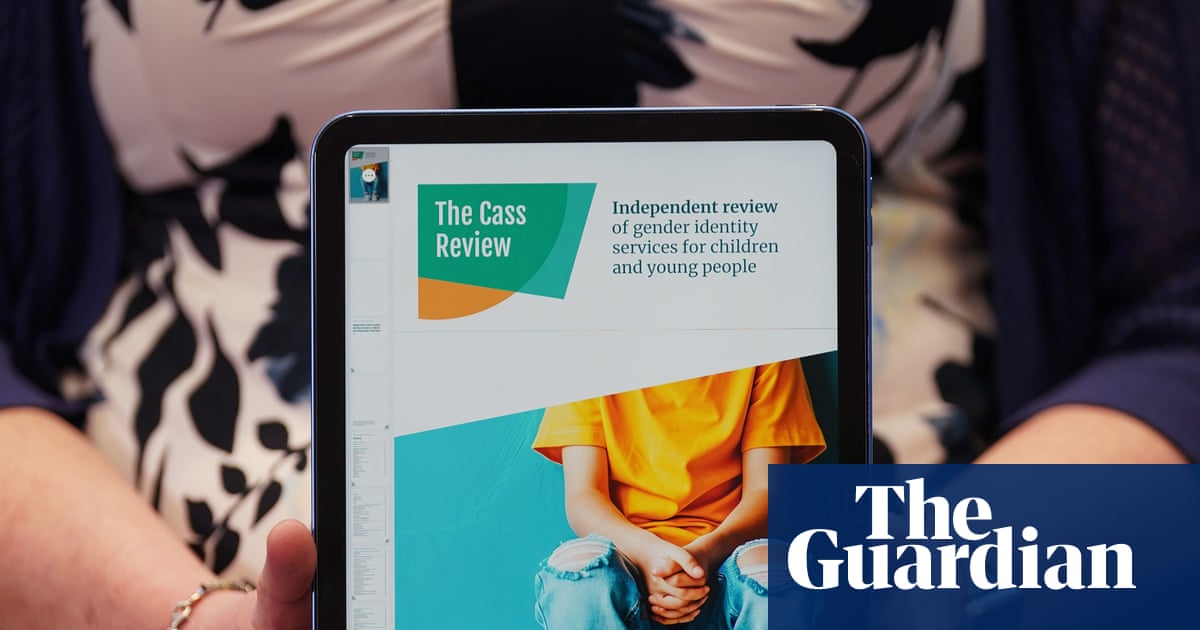
The BMA has dropped its opposition to the Cass Review, declaring the review's methodology robust and withdrawing its objection to all 32 of Hilary Cass's recommendations. This is the same BMA whose council once voted to call those findings "unsubstantiated." I want to sit with that word for a moment, because it mattered. It was one of the few times a major UK medical institution said plainly that the review which closed the Tavistock and triggered a puberty blocker ban did not meet the evidentiary standard its authors claimed for it. And now that word has been quietly retired.
The BMA's internal review, led by Professor David Strain, took 12 union members and produced a report that largely vindicates Hilary Cass's work. Strain speaks of clinicians with differing perspectives engaging constructively, of consistent respect for the underlying data. He says the review identifies the need for significant improvements in gender identity services for children and young people. Nobody would argue with that. The question is what conclusions you draw from the need for improvement, and whether those conclusions involve closing the only specialist service in England and Wales, banning puberty blockers, and leaving tens of thousands of young people with nowhere to go.
What the BMA kept, and what it gave up
To be fair to the BMA, it has not abandoned the field entirely. It is still opposing the puberty blocker ban, and the reasoning it gives is worth taking seriously: that it is a threat to clinical autonomy, that doctors spend decades learning how to prescribe medicines and a political decision should not override that. I agree. The ban is wrong, and the BMA is right to say so.
But here is the difficulty. The justification for the ban draws heavily on the Cass Review's finding that there was no evidence to support prescribing sex hormones to under-18s. If you endorse the methodology and all 32 recommendations of the review, you have already accepted much of the framework that makes the ban feel reasonable to the people who imposed it. You cannot fully rehabilitate the review and then act surprised when its conclusions are used to restrict care. The BMA is trying to hold two things at once that do not easily fit together.
The gap between commitment and reality
What strikes me most is the distance between what the BMA says medicine is committed to and what trans young people actually encounter when they try to access care. Strain's statement talks about proportionate, transparent, patient-centred care for people with gender incongruence. That sounds right. It sounds like something everyone should want. But what does it look like in practice, right now, in 2026?
It looks like waiting lists measured in years, not months. It looks like the Tavistock permanently closed, with no adequate replacement for the thousands of young people who were referred there. It looks like a puberty blocker ban that has left families scrambling for alternatives, often abroad and at enormous expense. It looks like GPs who are uncertain about their responsibilities, and specialists so thin on the ground that finding one who will actually see your child feels like a minor miracle. The BMA's report commits to better services. The people waiting for those better services are ageing out of the window in which care would have made the most difference.
Puberty does not pause while institutions deliberate. Every month of an unwanted puberty is a permanent physical change. The young people who needed care when the Tavistock closed are older now. Some of them have been through the puberty they desperately did not want. No future improvement in services gives that back.
Who carries the clinical case now?
The Cass Review has been widely criticised by international experts, including detailed published rebuttals from gender specialists across Europe and beyond. The methodology concerns that led the BMA's council to call its findings unsubstantiated in the first place did not disappear because a working group of 12 BMA members spent time with the material. Those concerns were about systematic exclusion of evidence, about citation practices, about whether the standards applied to the research on gender-affirming care were applied consistently to research in other areas of medicine. Those are serious methodological questions, and they remain unanswered.
The BMA was not the last line of defence, but it was a significant one. Its willingness to maintain opposition gave individual clinicians some institutional cover to voice their own doubts. That cover is now thinner. And in a climate where saying the wrong thing about gender medicine can attract professional scrutiny, the cost of speaking clearly is not negligible.
People tell me, again and again, that they feel there is no one left inside the system willing to say what they can see with their own eyes: that the young people in front of them are suffering, that withholding care is not a neutral act, that delay causes harm. Those clinicians are still there. They are simply quieter than they were, because the institutions that might have stood with them are choosing a different path.
What trans young people and their families need to know
If you are a young person, or a parent of a young person, trying to work out what this means for you, the honest answer is that the NHS pathway remains almost impossible to access, and this decision does not change that. The BMA's report calls for better services. Better services are not available today.
That is not a reason to stop looking for care. GenderGP can help with access to gender-affirming medical care, including the medical conversation about what options exist and what they might mean for your particular situation. A doctor who specialises in this area can look at where you actually are, which is the thing a statement from a professional body cannot do.
The institutions are having their arguments. You are allowed to get on with your life in the meantime.
If there is a news story you would like me to cover then just let Sammy know.
Dr Helen Webberley is a Gender Specialist, Medical Educator, writer, and advocate, and the founder of GenderGP.
Comments