
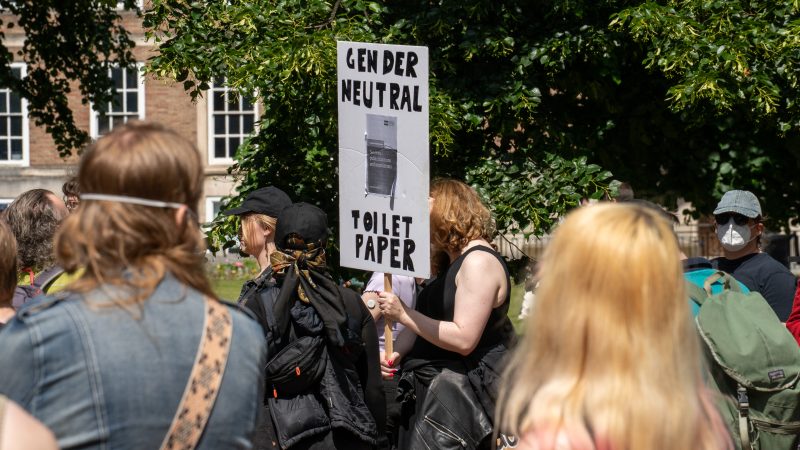
On a Saturday morning in Bristol, dozens of trans people and their allies gathered on College Green, holding blue and pink banners aloft, and said clearly and collectively: enough. The rally, organised by Bristol Pride and other trans rights groups, was one of several protests held across the country in the weeks since the Equality and Human Rights Commission issued its updated guidance on single-sex spaces. That guidance, which states that single-sex toilets and changing rooms must exclude trans men and women, has drawn fury from the communities it affects most directly. And fury, I think, is the right word.
What the EHRC guidance actually says
The guidance follows the Supreme Court's April 2025 ruling that the word "sex" in the Equality Act 2010 refers to biological sex. The Court was clear that it was interpreting legislation, not rewriting it, and it was equally clear that trans people retain protection under the characteristic of gender reassignment. What the EHRC has done in its code of practice is translate that ruling into practical instructions for public bodies, businesses, and service providers, and those instructions are stark: trans people should be excluded from single-sex spaces that correspond to their gender.
Bristol Pride has called the guidance "unworkable and cruel". I would not argue with either word. Consider what this means in practice. A trans man, living fully as a man, perhaps for years or decades, is told he must use women's facilities. A trans woman, equally, is told she must use men's. The guidance does not pause to consider the safety implications of that, or the humiliation of it, or the fact that the people most likely to experience harm from these arrangements are trans people themselves.
"The segregation is already socially in place"
The Bristol artist Roux addressed the crowd and said something that has stayed with me. He described ten to fifteen years of escalating pressure, trans people pushed "systemically out of education, out of healthcare centres, out of employment". And then he said: "The segregation that is being proposed by the EHRC laws is already socially in place."
What he described is a lived reality that many trans people I have heard from over the years would recognise immediately. The formal guidance does not create the exclusion from scratch. It ratifies and amplifies something that has been building for years, the slow narrowing of safe spaces, the sense that institutional structures are being turned against you, one policy at a time.
When institutions fail, communities show up
What happened on College Green matters because of who showed up and why. These are not professional campaigners performing outrage for cameras. They are trans people and the people who love them, many of whom have watched the last several years with mounting dread, and who have decided that silence is no longer an option. They carried placards that read "Our fight for bodily rights" and "Trans liberation now". They came out on a Saturday morning because they felt they had to.
I have enormous respect for that. When the institutions that are supposed to protect you instead issue guidance that excludes you, the question of where you turn becomes urgent. Legal challenge takes time and money. Political change takes longer still. Community, showing up for each other, making visible what those in power would prefer to keep quiet, that is immediate. It is real. And across several cities in the space of a few weeks, that is exactly what trans communities and their allies have chosen to do.
What this guidance is not
The EHRC has framed its code of practice as practical implementation of a legal ruling. But guidance is not statute. The Supreme Court did not instruct the EHRC to issue a blanket exclusion of trans people from single-sex spaces: it interpreted the meaning of a word in a piece of legislation. The code of practice is the EHRC's policy response to that interpretation, and policy responses can be challenged, revised, and replaced. The EHRC guidance is also, as of now, draft, which means it has not yet been finalised. That matters. Draft guidance does not carry the weight of law, and the consultation process that follows a draft exists precisely so that affected communities can push back.
Push back is exactly what Bristol just did.
I hope others follow their lead. I hope the consultation receives thousands of responses from trans people, from healthcare professionals, from employers, from service providers who can see clearly that these arrangements are unworkable. I hope the people who drafted this guidance are made to reckon with the reality of what they are proposing, not as an abstract policy question, but as something that will affect real people trying to get through an ordinary day.
Trans people belong in public life. They always have. A piece of guidance, however authoritatively worded, does not change that, and Bristol on a Saturday morning proved it.
If there is a news story you would like me to cover then just let Sammy know.
Dr Helen Webberley is a gender specialist, medical educator, and advocate, and the founder of GenderGP. She writes about gender diversity, trans healthcare, and the lives at the centre of both.
Comments