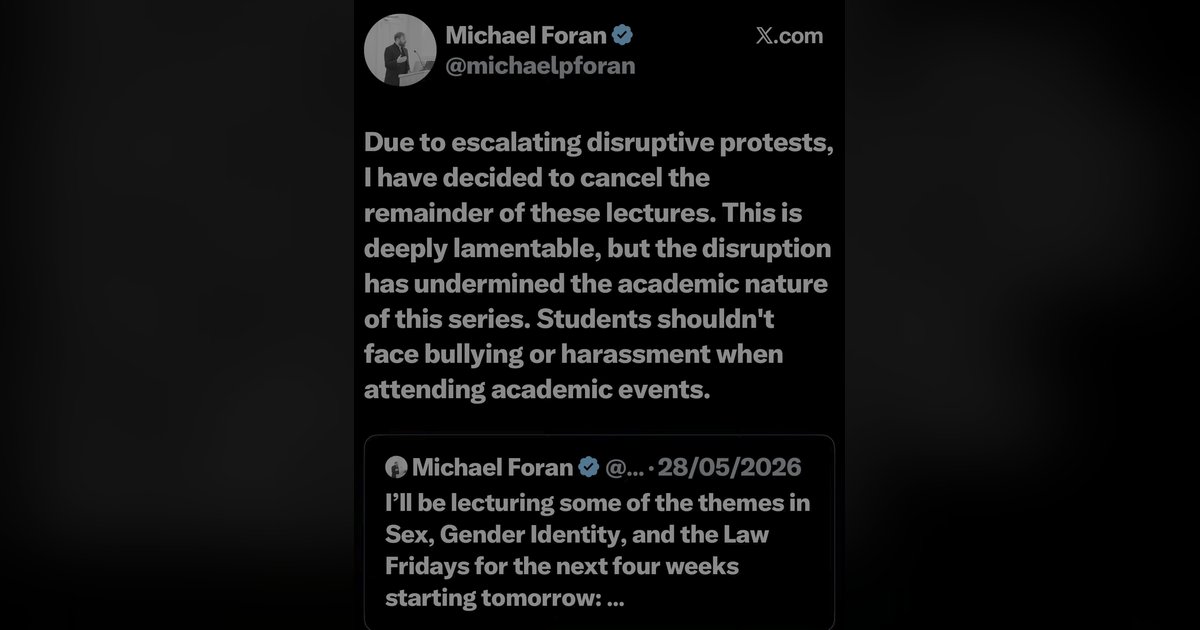
Michael Foran's lecture series on sex, gender identity, and the law has been cancelled after student protests disrupted his events. He announced the cancellation himself, framing it as a response to "bullying and harassment", but the story is more interesting than that framing suggests, and I think the students deserve a lot of credit.
I reviewed Foran's book and the ideas he promotes in a video on my channel, and what struck me most was the gap between what his arguments appear to say and what they quietly omit. He frames gender critical belief as simply a matter of protected speech, you hold a view, you express it, and that is that. What he consistently skips over is the part that actually matters in law and in life: not whether you can hold a belief, but what you do with it and who gets hurt.
The Equality Act 2010 does protect gender critical belief as a philosophical belief. That is not news. What Foran presents as a revelation, courts have recognised for years. But the same Act also protects trans people under the characteristic of gender reassignment, and the Employment Appeal Tribunal ruling in the Forstater case was quite specific on this point. It does not give those with gender critical beliefs licence to misgender trans people with impunity, and it explicitly notes that harassment and discrimination against trans people in the workplace remain unlawful. Foran's framing emphasises one half of that judgment and lets the other half blur quietly into the background.
You can hold your beliefs. You can express your beliefs. How you express them, and who you target when you do, is another matter entirely, and that is where the law actually bites. An employer with a clear, well-applied policy on dignity and inclusion is on solid legal ground. The difficulty in the Forstater case was not that her employer tried to act; it was that they failed to follow their own processes properly. The lesson for institutions is not "you cannot touch gender critical speech", it is "get your policy right and apply it consistently".
What Foran does not address, and what his lecture series apparently never got around to discussing, is the impact on trans people who have to go to work, attend university, or use public services while others platform the view that their identities are not real. That is not an abstract legal question. It is a daily reality for a lot of people I have spoken with over the years.
Now, to the cancellation. Foran says the protests were disruptive and that students should not face bullying at academic events. I agree that students should not face bullying. But calling a lecture series on sex, gender identity, and the law "academic" when its framing is consistently critical of trans identities and draws on the same intellectual infrastructure as organised campaigns to restrict trans rights, that framing does not hold up. Academic work examines questions from multiple sides. A series that uses legal commentary to platform one side of a culture war is something different.
Helen Joyce's response is revealing. She is frustrated that a regulatory mechanism she had been counting on was not available to Foran. She frames student protest as disgraceful. What I see is students exercising exactly the kind of agency that universities are supposed to produce: people who think carefully about what is being presented to them, who understand the difference between academic inquiry and advocacy, and who are willing to say so out loud.
Sex Matters, the organisation Joyce leads, has run a sustained and coordinated effort to restrict trans people's legal recognition, healthcare access, and public participation. Calling student pushback against that effort "disgraceful" is a strange use of the word. The students are not erasing anyone; they are refusing to sit quietly while others erase them.
The thing I keep coming back to is this: the debate Foran wants to have, about whether trans identities deserve legal recognition, whether people can really be who they say they are, is not a neutral academic exercise when the people whose identities are under discussion are in the room. Trans students at those lectures were not being invited to participate in an intellectual discussion. They were being asked to listen while a legal scholar provided scholarly scaffolding for the view that their lives are a category error.
Of course they protested. And from where I stand, the fact that the series was cancelled is not a failure of academic freedom. It is students doing exactly what engaged, thoughtful people do when the framing is wrong.
Comments