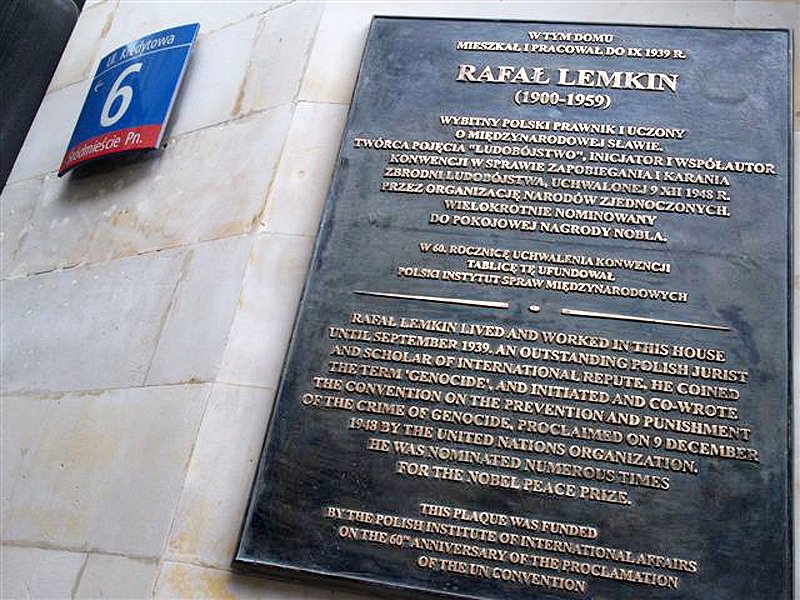
The Lemkin Institute for Genocide Prevention and Human Security has condemned the EHRC's updated Code of Practice, presented to UK Parliament in May 2026, as genocidal in nature. The Institute invokes the 9th Pattern of Genocide, arguing that the code criminalises trans existence by threatening service providers who include trans people with sex discrimination claims, and effectively tells trans and intersex people to cease existing in public life.
What the Lemkin Institute actually said
I want to quote the Institute directly, because the language matters and I don't want to soften it:
"This is consistent with the 9th Pattern of Genocide: Denial and/or Prevention of Identity. The message to the trans and intersex communities is clear: Cease to exist as a trans person unless you want to be accused of harassment for trying to use a public toilet that matches your identity. For service providers, the message becomes quite threatening: being inclusive of trans people might result in claims of sex discrimination by cis people. In both instances trans existence is criminalized, which is a very common component of genocidal processes."
The Lemkin Institute is not a campaign group. It is a genocide prevention organisation, and its scholars spend their working lives studying the patterns that precede mass atrocity. When they use the word genocidal, they are not reaching for hyperbole. They are applying a framework developed from decades of comparative historical analysis. That framework identified a pattern, and they are saying the UK matches it.
What the code actually does to real people's daily lives
The EHRC Code of Practice was presented to the House of Commons on 21 May 2026. It is not yet legally binding in the way a statute is, but EHRC guidance must be considered by courts and tribunals when deciding discrimination claims. Every employer, every gym, every hospital, every café with a toilet has to read this document and decide what risk it faces. That is exactly where the harm lives.
Read the logic of the code carefully and you arrive somewhere extraordinary. If a service allows both trans women and cis women to use the women's toilet, but not cis men, then according to this guidance, a cis man could bring a claim of sex discrimination. The EHRC itself acknowledges that a service provided to women and trans women together "could also be unlawful sex discrimination or lead to unlawful harassment against women." In other words, the mere presence of a trans woman in a women's space becomes, in the EHRC's framing, a potential harm to the cis women there. No evidence is offered for what that harm might be. None is required, apparently.
The practical consequence is this: trans and intersex men, assigned female at birth, may be excluded from women's toilets. Trans and intersex women may be forced into men's toilets. Both groups may find themselves legally excluded from every option. The EHRC notes, almost in passing, that it would be "very unlikely to be proportionate" to leave a trans person with no usable facility, and then offers nothing whatsoever to prevent that outcome. No mechanism, no duty, no fallback. Just a note that it would be unfortunate.
That is not a safeguard, it is a wish.
Now think about this in a hospital. A healthcare setting. A changing room before a swimming lesson. A refuge. Anywhere that a trans or intersex person needs access to a service that keeps them safe, clean, healthy, or simply able to participate in ordinary life. The code's logic does not stop at public toilets. It runs through every single-sex space in the country, and it tells every provider that inclusion carries legal risk while exclusion does not.
The High Court already said exclusion could be discrimination
Earlier this year, the High Court ruled on a challenge brought by the Good Law Project to a previous draft of this guidance. The court found that excluding trans people from toilets might itself constitute discrimination, on the grounds of gender recognition. That was a significant finding. The EHRC then produced a new Code of Practice that moved in the opposite direction, cementing a preference for exclusion in spite of that ruling. The Lemkin Institute notes this directly: the EHRC chose the most trans-exclusionary interpretation available to it, and it did so knowingly.
The For Women Scotland Supreme Court ruling, which I have written about before, did not create a new law. It offered one court's interpretation of existing legislation. The justices themselves said the decision would not strip trans people of protection. The EHRC has proceeded to strip trans people of protection anyway, using that interpretation as its mandate. That tells you something about choices, and who is making them.
Intersex people have been erased from the conversation
The Lemkin Institute also highlights something that has received almost no attention in UK media: intersex people. When the EHRC chair, Dr Stephenson, was asked directly about intersex people during parliamentary proceedings, she contested the use of the word intersex and suggested intersex people might use unisex spaces. The Council of Europe used the term intersex in a recommendation as recently as October 2025, a recommendation the UK supported. The EHRC chair apparently disagrees with her own government's international commitments.
There are people who were born with bodies that do not fit neatly into either biological category the EHRC insists is clear and binary. The code ignores them. The chair dismisses them. The Lemkin Institute has noticed, and named it.
Delay is not neutral
Some people will say this code has not fully come into force yet, that guidance is not statute, that there is still room to challenge it. All of that is technically true. None of it means trans and intersex people are currently safe.
The previous draft guidance, before any final code, was already causing direct harm. The Lemkin Institute records that an increase in harassment and violent threats against trans and intersex people in toilets followed its publication. Trans people reading hostile guidance do not wait for legal enforcement before they feel the message. The message is already being received. And when the message is "your existence is the problem," people hear it clearly.
The EHRC was not required by the Supreme Court ruling to produce guidance this exclusionary. It chose to. The Lemkin Institute is asking the world to register that choice for what it is: not an administrative quirk, not a technicality, not a balanced interpretation of a difficult area of law, but a step in a pattern that has a name.
I think they are right to name it.
.png)
Comments