
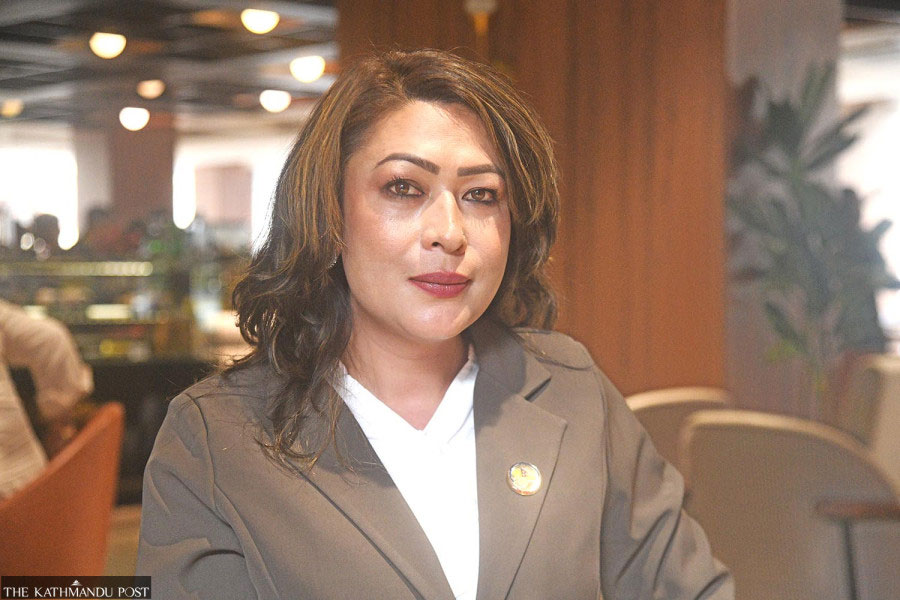
Bhumika Shrestha is Nepal's first transgender Member of Parliament, elected after two decades of grassroots activism. In her first months in office she helped rename a government ministry to formally include gender and sexual minorities, and is now fighting to protect intersex children from non-consensual surgery. Her story is a reminder that trans people are gaining real political power, and that the global picture is far more hopeful than the anglophone news cycle tends to suggest.
The girl who stopped drinking water
Before any of the history, there is the image I keep returning to: a young girl who stopped drinking water during the school day because the boys who harassed her in the bathrooms had made those spaces unbearable. She was in eighth grade. She carries kidney stones today as a result.
Bhumika Shrestha's early life contained all the cruelties that so many trans people across the world will recognise. Teachers used the Nepali term for neuter gender, napunsak linga, and the whole class would turn and laugh at her. Her family's apparent acceptance, she eventually understood, had been conditional on an expectation that she would one day become a man. When that never happened, the tolerance did not survive the realisation. "I felt like I was the only person in the world," she says, "whose biological body and mental identity were different."
There was no language available to her, no community, no mirror. That changed at a bus stop at Ratna Park, around 2003, when a young woman named Pinky Gurung noticed a teenager in black cotton trousers, a white shirt, a red woollen half-sweater, hair dyed burgundy, a red tika on her forehead. Gurung was working outreach for the Blue Diamond Society, Nepal's pioneering LGBTIQA+ rights organisation, and she recognised her immediately. "She seemed a bit scared and uncomfortable," Gurung recalls. "She was a child, unaware of the LGBTIQA+ community and hadn't met any peers." Gurung talked to her and brought her to the office. Bhumika was fifteen.
That encounter gave her a name for what she was, and then a purpose. Over the next two decades, she moved from volunteer to trainer to one of the Blue Diamond Society's central figures: documenting violence, running legal awareness sessions, lobbying district offices and municipalities, pushing them to issue citizenship documents that reflected third-gender identity. When Nepal's Supreme Court ruled in 2007 that gender identity must be determined by self-identification rather than medical examination, much of her work sharpened into a single, concrete demand: that the verdict be implemented, not merely acknowledged. Meeting by meeting, office by office.
What walking into parliament actually looks like
In April this year, all of that accumulated work carried her through the doors of Singha Durbar as a Member of Parliament. She entered through the Janajati women's proportional representation quota, because Nepal's system still has no formal category for gender and sexual minorities: a contradiction that tells you everything about where the country stands. Progressive in its court rulings, slower in its institutions.
The working day is longer than most people imagine. The House can run from eleven in the morning until seven in the evening. On other days, committee meetings, subcommittee programmes, ministry visits. Her family and friends, she says with warmth, joke that she has stopped remembering their birthdays. "The care is there," she says. "But since this is just the beginning, I'm still learning to manage things."
The most striking result so far came from something that might look small on paper. For years, activists had found themselves shuffled between government ministries when they raised issues affecting gender and sexual minorities, each ministry able to argue that it was somebody else's responsibility. Bhumika raised this directly with the Prime Minister at a meeting for proportional representation lawmakers. She had asked only for an expansion of one ministry's terms of reference. Instead, the government renamed the Ministry of Women, Children and Senior Citizens as the Ministry of Women, Children, Gender and Sexual Minorities and Social Security. Even she was surprised. "I didn't know the name itself would change."
It is the kind of structural win that street advocacy rarely produces and lawmaking occasionally can. It is also, as she knows, evidence of how far the rest of the agenda has yet to travel.
The fight she is taking on now
What strikes me about Bhumika's first months is that she did not arrive in Parliament with a narrow brief. She sought a seat on the Law, Justice and Human Rights Committee, and is now part of a subcommittee focused on children in care homes. She is also pushing to include intersex children in the Child Rights Act amendment, pressing against a practice that too few laws have yet named as the harm it is: the performance of irreversible sex assignment surgeries on intersex infants, before they are old enough to understand or consent, in order to make their bodies conform to standard male or female norms.
This is not the same as gender-affirming care sought by someone who understands their own identity. These surgeries remove that future choice permanently. It is a harm that affects people at the very start of life, and Bhumika is trying to make law catch up with that reality.
"I cannot just raise my voice for my community alone," she says. "I have to look after children's issues and others too." Twenty years of fighting for one community have given her a framework wide enough, it turns out, for the full breadth of what parliament demands.
Why this matters beyond Nepal
When most of the news reaching my desk concerns bans, restrictions, court rulings used to narrow trans people's lives, and political movements that treat trans existence as a problem to be solved, a story like Bhumika's is genuinely bracing. A trans woman who once stopped drinking water to avoid a school bathroom is now in a national parliament, renaming ministries and drafting children's rights legislation. That is not a metaphor or a symbol, but power, used carefully, in a real institution, producing real results.
Pinky Gurung, who has watched Bhumika for more than two decades, puts it simply: "She was one of the few trans people who was visible from a very young age. She never hid who she was, and that visibility became the foundation of her advocacy."
She is just getting started. I, for one, cannot wait to see what comes next.
Comments