
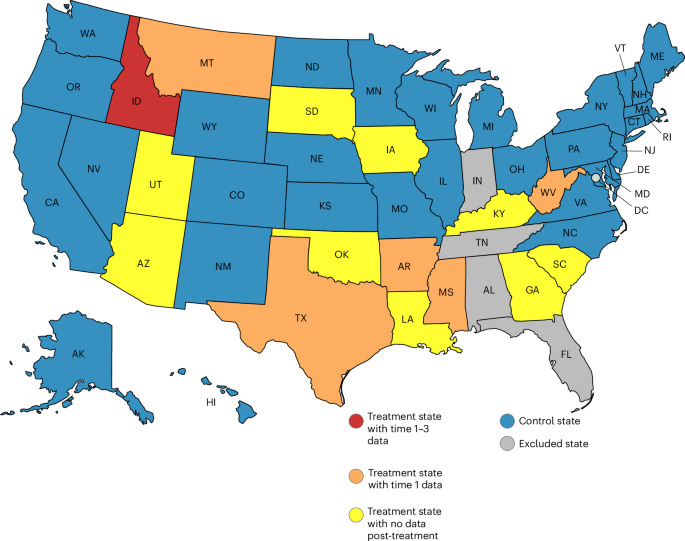
A paper has appeared in Nature Human Behaviour raising methodological objections to a 2024 study by Lee et al., which found that state-level anti-transgender laws in the United States increased suicide attempts among transgender and non-binary young people. The critique focuses on the concentration of post-treatment data in a single state, the choice of control states, and the sensitivity of results to alternative analytic specifications. On the surface, it reads as a routine academic exchange. Look at who wrote it, and the picture changes.
The lead author, J. Cohn, is affiliated with the Society for Evidence-Based Gender Medicine, known as SEGM. That affiliation matters. SEGM is not a neutral body of researchers with a dispassionate interest in getting the statistics right. It is a network whose output has been used, repeatedly and consistently, to delay, restrict, and deny gender-affirming care to young people. Its work featured prominently in the Cass Review, which has since been widely discredited internationally. When a SEGM-affiliated author appears in a peer-reviewed journal raising technical doubts about research that links anti-trans legislation to increased suicide attempts in trans youth, the methodological concern and the political project are not separable.
What the original research actually found
Lee et al. applied difference-in-differences analysis across US states, comparing states that enacted laws the ACLU characterised as anti-transgender with states that did not. Their conclusion: those laws increased suicide attempts among transgender and non-binary young people. This is not a surprising finding. It is consistent with a substantial body of evidence showing that hostile legal and social environments worsen mental health outcomes for trans youth, and it is consistent with what trans young people and their families have been saying for years, in language far more direct than any regression model.
Levengood and Hadland, writing in the Journal of Hospital Medicine in 2023, made the same argument from a clinical angle: hostile legislation threatens adolescent lives. The direction of the evidence is not ambiguous.
What the critique actually does
The Cohn, Sim, and Kerr paper raises genuine statistical questions. Difference-in-differences analysis does have assumptions. The parallel trends assumption can be violated. When post-treatment data concentrates heavily in a single state, that is worth examining. A biostatistician at the University of Washington is a credible voice on those technical questions, and peer review at Nature Human Behaviour is not nothing.
But here is what the critique does not do: it does not present evidence that the laws had no effect. It does not present evidence that anti-trans legislation is harmless. It does not offer an alternative estimate suggesting the effect is smaller than reported. It raises uncertainty. And in the context of a policy debate about whether to restrict, ban, or roll back protections for trans young people, manufactured uncertainty is a tool, not a contribution to knowledge.
This is the SEGM playbook, and it is worth naming it directly. Find a study whose conclusions support gender-affirming care or oppose anti-trans legislation. Identify technical limitations, which exist in every study in every field of medicine. Publish those limitations in a credible journal. Then watch as legislators, journalists, and policy-makers cite "methodological concerns" as grounds for inaction, restriction, or denial of care. The science is not settled, they say. We need more research. In the meantime, the bans stay.
Delay is not neutral
Every field of medicine has ongoing research. Every epidemiological study has limitations. Nobody uses the existence of imperfect methodology in cardiovascular research to argue that we should stop treating heart disease until the evidence base is cleaner. The standard being applied to research on trans youth is not the standard applied anywhere else, and that asymmetry is not accidental.
When a young trans person is living in a state that has banned them from using the correct bathroom, banned their doctor from providing affirming care, banned them from competing in sport as who they are, the question of whether the difference-in-differences model used the optimal control states is not the most pressing issue. The most pressing issue is that the evidence points clearly toward harm, and that harm is happening now, to real young people, in real places, while the methodological debate continues.
The Lee et al. study is not the only evidence we have. It sits alongside years of survey data, clinical observation, and the lived experience of trans young people and their families. The direction is consistent. The mechanisms are understood. Hostile environments cause distress. Legal exclusion causes distress. Being told by your government that you do not deserve protection causes distress. None of that requires a flawless natural experiment to be true.
What is at stake in the methodology wars
I am not saying the Lee et al. paper should be immune from scrutiny. No research should be. What I am saying is that scrutiny does not arrive in a vacuum. When it arrives from a SEGM-affiliated author, targeting a study whose conclusions oppose anti-trans legislation, in a political moment when dozens of US states are actively restricting trans rights, the scrutiny is not neutral. The timing, the authorship, and the target are all part of the picture.
The methodology being built and contested here, the choice of controls, the treatment of parallel trends, the handling of state-level variation in legal enforcement, will matter for every future study attempting to quantify the harm done to trans youth by hostile policy. Getting it right is genuinely important. But getting it right means building more robust research, not using current limitations as a reason to discount the evidence we already have.
Trans young people are not a statistical abstraction. They are living through the policies being debated. The ones in states with the most hostile legal environments are telling us, in survey after survey, that they are struggling. Treating that signal as noise because the model had a data concentration problem is not science. It is politics dressed up as science, and the difference matters.
Comments