
A 1992 episode of Star Trek: The Next Generation called 'The Outcast' was written as a gay allegory, but it describes the life of a trans woman with uncomfortable precision. Soren declares herself a woman, refuses a forced cure, and is erased by a society that calls her identity primitive. Over thirty years on, that story has not aged into history.
A story that was always about more than it knew
I have been thinking about this piece in Gizmodo since I read it, because it names something I have felt for a long time. The claim that trans people are a new phenomenon, a social contagion, a product of the internet or of modern ideology, collapses the moment you look at what human beings have always known about themselves, and at what storytellers have always found worth telling. In 1992, the writers of Star Trek: The Next Generation sat down to make an episode about acceptance, intended it as a comment on gay rights, and accidentally wrote one of the most precise accounts of trans feminine experience I have encountered in mainstream television.
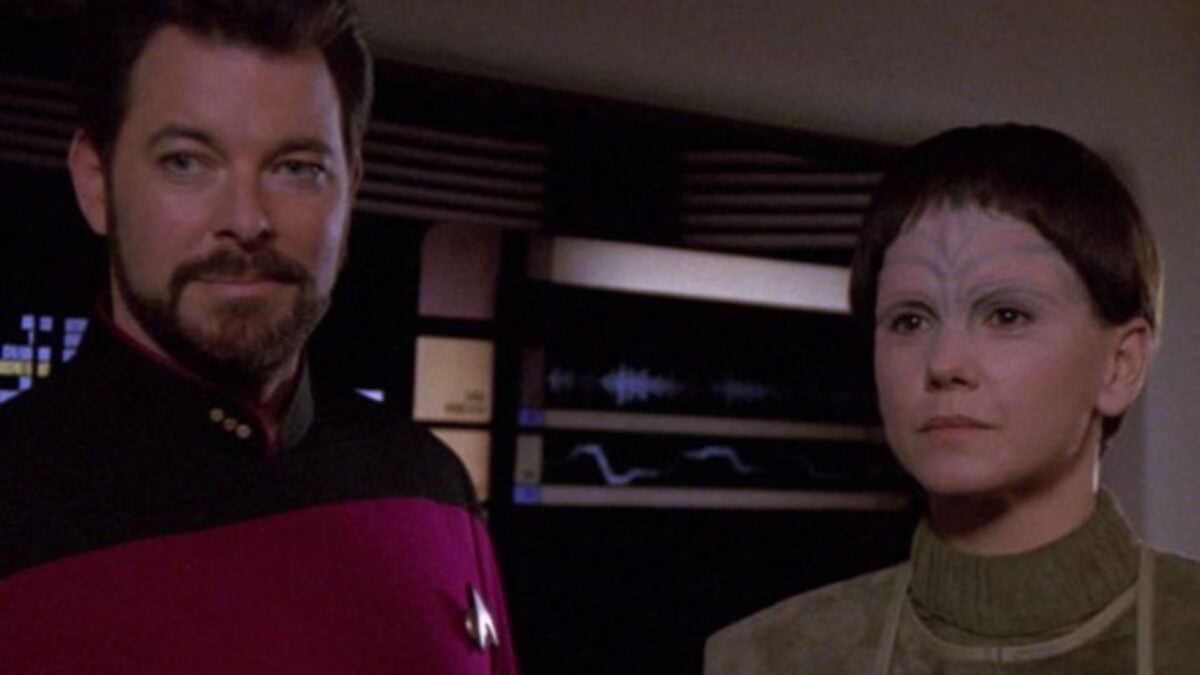
The episode is called "The Outcast." Soren, a member of an alien species called the J'Naii who have no gender, confides in Commander Riker that she is a woman. Not that she feels like one, not that she has a preference: she is one, and she knows it, and she has known it her whole life. Her society considers this a regression, a primitive failure to evolve. When she is discovered, she faces what the episode calls "psychotectic therapy," a procedure designed to remove her sense of gender entirely. Riker tries to rescue her. She refuses to let him cover for her. She stands up in front of her society and says: "I have had those feelings, those longings, all of my life. It is not unnatural. I am not sick because I feel this way. I do not need to be helped. I do not need to be cured."
I have heard those words, in different forms, from trans women across the years. In consulting rooms, in letters, in conversations at kitchen tables. The words change; the shape of the sentence does not.
What the episode gets right, and what it fumbles
The Gizmodo piece is generous and clear-eyed about the episode's limitations, and they are real. Soren is played by a cisgender woman, which softens the discomfort the writers were presumably hoping to provoke. Jonathan Frakes, who played Riker, said afterwards that Soren should have been played by a male actor, and he was right. The episode keeps its politics at arm's length by making the oppressors a genderless alien society rather than anything resembling actual heterosexual culture. It is, as the article says, almost comically palatable to a presumed straight audience.
And yet. Riker accepts Soren as a woman without question or hesitation. He does not interrogate her, does not ask her to prove it, does not treat her declaration as a claim requiring verification. He simply believes her, and acts on that belief. In 2026, with conversion practices still legal in parts of the world and trans people being told in courtrooms and legislatures that their identity is a matter of opinion, that moment of simple acceptance carries a weight it probably was not written to carry.
The part that cuts deepest
The Gizmodo piece brings in Jules Gill-Peterson's book A Short History of Trans Misogyny to make a point I want to underline. There is a strand of utopian thinking, not always malicious, sometimes coming from people who consider themselves progressive, that imagines a genderless future as liberation. In that vision, trans femininity becomes unnecessary, a relic of a world we have moved past. Gill-Peterson describes how both sides of the culture war, opposing in almost every other respect, tend to agree that trans womanhood is not integral to the future they are building.
Soren pushes back against exactly that. She does not want gender abolished on her behalf. She wants to be a woman. That is not a failure of political imagination, but a person knowing who she is and refusing to surrender it because someone else finds it inconvenient.
The episode ends in tragedy. Soren, after her therapy, tells Riker she is cured. He retreats, heartbroken. The return to her society's version of normalcy is presented not as resolution but as a kind of horror. Riker will move on. Soren will remain, reshaped into someone her society can tolerate. The Gizmodo piece calls it a fable, and that is exactly right. It is a story about what is lost when a society decides that some people's sense of themselves must be treated as a disease.
Thirty-four years later
What strikes me most about revisiting this episode now is not that it was ahead of its time, but that it was of its time, in ways the writers may not have fully understood. Trans women existed in 1992. They knew who they were. Some of them were watching Star Trek on a Thursday night and seeing, in a clunky sci-fi allegory, the first flickering reflection of their own experience in mainstream culture. That matters. Representation in fiction is not a luxury. For people who have no language for what they feel, who have been told their whole lives that what they experience is impossible or wrong, a story that says someone like you has always existed can be the beginning of survival.
The argument that trans identity is new does not survive contact with history, with anthropology, with literature, or, apparently, with 1990s science fiction. People have always known who they are. The question has never been whether trans people exist, but whether the society around them will allow them to.
Soren's answer to that question, standing in front of a court that wanted to erase her, was the only one available to her: I am not sick because I feel this way. It still is.
Comments