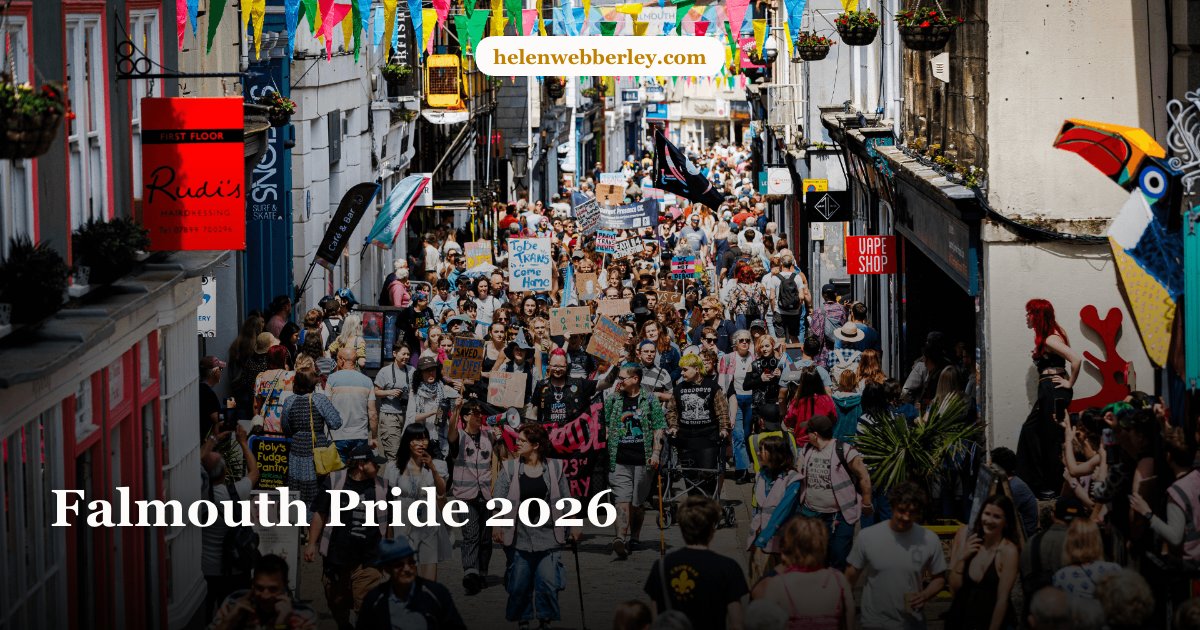
When an elected member stands up in a council chamber and declares that the statement "trans women are women" is a "demonstrably false claim", and when a colleague who called trans women "men pretending to be women" is cleared of any wrongdoing, the community does not quietly absorb that. It marches. And on Saturday 23rd May 2026, it marched through Falmouth.
Trans Pride Falmouth held its second annual march, beginning at the Prince of Wales Pier and moving through the town to Discovery Quay, where people shared their lived experiences with the crowd. This was Cornwall's second dedicated Trans Pride, and the fact that it exists at all, funded entirely by private donations and run by volunteers from within the trans and non-binary community, tells you something important about both the need and the determination behind it.
What happened in that council chamber?
The timing of this march was deliberate. The organisers were explicit: it came just days after what they described as the UK Government reaffirming policies that continue to strip away rights trans and non-binary people had fought hard to secure. And right on their doorstep, a Cornwall Council member had stood up and defended a colleague's use of the phrase "men pretending to be women", calling any statement to the contrary demonstrably false.
Let me be plain about this. Trans women are women. That is not a contested philosophical proposition. It is the position of every major medical body, it is consistent with the World Health Organisation's reclassification of gender incongruence in 2019, and it reflects the lived reality of trans women's lives. An elected official calling it a false claim is not engaging in good-faith debate. It is using a position of power to deny other people's existence, and doing so in a public institution that is supposed to serve those same people.
The fact that the colleague who used the phrase "men pretending to be women" faced no consequences tells you exactly where the institution's priorities currently sit.
"We are not a threat to anyone, we just want to live"
That line from the organisers is the one I keep returning to. Because it is said so simply, and it should not need saying at all. Trans people are not a coordinated campaign, not an ideological movement imposed on an unwilling public, not a threat to children, to women's spaces, or to anyone else. They are people, living their lives, who want access to healthcare, legal protections, and the ordinary dignity of being addressed as who they are.
The organisers described transphobia as "alive and well on our doorsteps". They are right, and the council chamber episode is only one example. Trans people across this country are fighting for referrals that take years, for prescriptions that are withheld, for documents that do not reflect who they are, for the right to walk through a town without being told they are a fabrication.
Against that backdrop, a march through Falmouth, an art market, workshops, drag, music, and community, is not a political stunt. It is people refusing to be invisible. And there is joy in that refusal, real, defiant, uncomplicated joy, which is exactly what the evening celebration at The Cornish Bank was made of.
Trans rights are human rights. Full stop.
The message from Trans Pride Falmouth was direct, and I am repeating it because it deserves to be said as many times as necessary. Trans rights are, always have been, and always will be, human rights. Trans women are women. Trans men are men. Non-binary people are non-binary. These are not slogans. They are statements of fact about people's lives, and they matter most when the institutions around us are doing their worst to pretend otherwise.
Cornwall's trans and non-binary community showed up. They showed up in numbers, they showed up with art and music and each other, and they showed up knowing that someone in their council chamber had just spent a week publicly denying their existence. That takes courage, and I want them to know that people far beyond Falmouth are watching, cheering, and standing with them.
If this is useful to you, please share it. Every share helps more people find accurate information about gender diversity.
Dr Helen Webberley, Gender Specialist and Medical Educator.
helenwebberley.com

Comments