
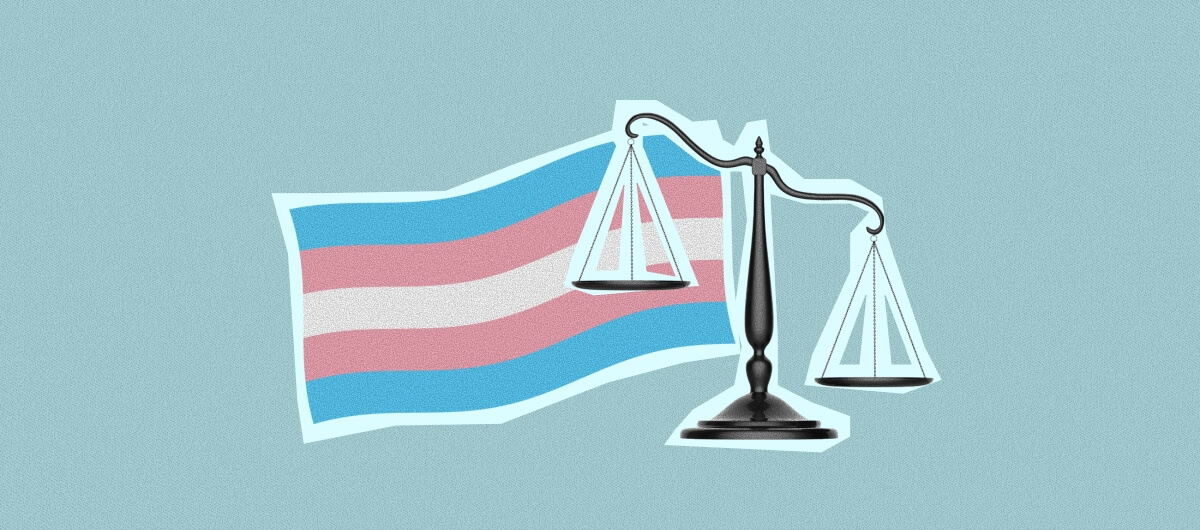
Trans rights in the US now hinge on which court hears the case and which state a person calls home. The Supreme Court is expected to uphold bans on trans athletes, closing the federal route further. For real people, this means the legal landscape shapes everyday decisions about where to live and where to build a life.
What is actually about to happen
By the end of June, the Supreme Court will hand down decisions in two cases, West Virginia v. BPJ and Little v. Hecox, that will determine whether trans people can be excluded from sport based on gender identity. A 6-3 ruling in favour of those bans is widely anticipated. The deeper question is how expansive the language will be, because these cases are not only about athletics. They rest on the Equal Protection clause and Title IX, which means the Court's reasoning could provide a template for bathroom bans, strict sex-at-birth segregation in any federally funded educational setting, and a great deal more.
This follows last year's U.S. v. Skrmetti, in which the Court applied rational basis review, the lowest constitutional standard available, to state bans on gender-affirming care for trans youth. That decision, framed as being about medical condition and age rather than about trans identity directly, has already become a roadmap. BPJ looks set to consolidate it. The argument will run: as long as a policy is framed in terms of "biological sex," any level of constitutional scrutiny can be bypassed. The practical effect is that decades of anti-trans legislation, from healthcare bans to bathroom restrictions, gains legal insulation that will be very difficult to challenge in the federal courts for a very long time.
What I find myself thinking about
When I read pieces like the one published in Dame Magazine, my mind goes not to constitutional doctrine but to the people I have heard from over the years. Parents who tell me they moved their family across state lines because their child needed care that was no longer available where they lived. Young people who tell me they are weighing up universities not by course or campus but by which state will not strip away their identity the moment they arrive. Adults who describe the particular exhaustion of following legal proceedings the way a person follows a weather forecast: not out of abstract interest, but because the outcome changes whether it is safe to go outside.
That is the part that tends to get lost in the commentary. The legal landscape is not a backdrop to trans lives. For many people right now, it is the central practical question of their lives.
How we got here, and why it matters to say it clearly
The Dame piece traces the trajectory honestly and I think it is worth following that line of argument, because the temptation to attribute this moment to a cultural miscalculation by trans people or their allies is both wrong and harmful. What happened to trans rights in the federal courts followed the same path as the erosion of abortion rights: a long, deliberate, extraordinarily well-funded project to capture the judiciary. The Federalist Society, founded in 1982, became the ideological pipeline for conservative judicial nominations. Leonard Leo's network spent over $1.6 billion explicitly pushing the courts toward pro-corporate, socially conservative outcomes. The Trump administration used that network to fill over 200 judicial appointments and three Supreme Court seats. All six members of the current conservative supermajority are current or former Federalist Society members.
On the other side, the Alliance Defending Freedom has spent tens of millions drafting, lobbying, and litigating anti-trans legislation. The 2024 Trump campaign alone spent close to a quarter of a billion dollars on anti-trans advertising. This is not a culture war in the sense of an organic collision of values. It is an organised, funded, strategic effort, and it has worked, so far, in the courts it was designed to work in.
Where genuine protection still exists
The federal route has narrowed dramatically, and pretending otherwise does not help anyone make real decisions. But the federal courts are not the only courts, and this is where the geography starts to matter for people trying to work out where to be.
Several states have constitutional provisions, state-level equal rights amendments, or existing precedent in their own supreme courts that offer protections independent of federal constitutional doctrine. California, Colorado, Illinois, Massachusetts, Minnesota, New York, Oregon, and Washington have all enacted explicit statutory protections for trans people, and their state courts have, to varying degrees, been willing to enforce them. For families who can move, or for young people choosing where to build an adult life, those distinctions are not minor. They are the difference between having access to healthcare, being able to play sport, and being able to use a toilet without fear.
I am not suggesting that migration is a solution, or that the people who cannot move should simply accept what their state hands them. The burden of having to relocate your life to access basic rights is itself a form of harm. But I do think that mapping the landscape honestly, rather than describing it as uniformly catastrophic or uniformly survivable, is the most useful thing I can do right now.
Court reform is not a fringe idea any more
The Dame piece argues for court reform as the structural response, and the proposals it outlines deserve to be taken seriously rather than dismissed as wishful thinking. Expanding the Supreme Court to thirteen seats, reflecting the thirteen circuit courts that now exist, is rooted in the Court's own history before the Civil War. Introducing 18-year term limits, after which justices would move to senior status on a circuit court, would reduce the pressure on any individual justice to outlast an opposing administration. Banning federal judges from membership of ideological organisations such as the Federalist Society addresses the pipeline problem directly. The Judicial Conference Committee on Codes of Conduct came close to passing exactly such a ban in 2020 before the very members it would have affected revolted and killed it. Congress can act where self-interest blocked internal reform.
None of this is fast. None of it will help the young person whose sports ban is upheld next month, or the teenager who cannot access the healthcare their family wants for them. But the question of whether trans people have rights in the United States in ten years' time depends on whether the courts that hear those cases are capable of applying the law without ideological capture. That is not an abstract concern. It is the central strategic question.
What this means if it is your life
If you are trans and in the United States, or if you are the parent of a trans child there, the honest answer to "what should I do?" is that it depends on where you are and what you are facing. If you are in a state with strong state-level protections, those protections are worth understanding and using. If you are in a state where the law has moved against you, knowing which organisations are still litigating at the state level, and which states offer realistic options if relocation ever becomes possible, is genuinely useful information rather than defeatism.
And if you are watching all of this from elsewhere in the world, including from the UK, where our own legal landscape has shifted in ways I have written about at length: the American experience is a warning about what happens when one side plays a long game and the other assumes that progress is irreversible. It is not irreversible. It has to be defended, structurally, politically, and in every court that will hear the argument.
Comments