
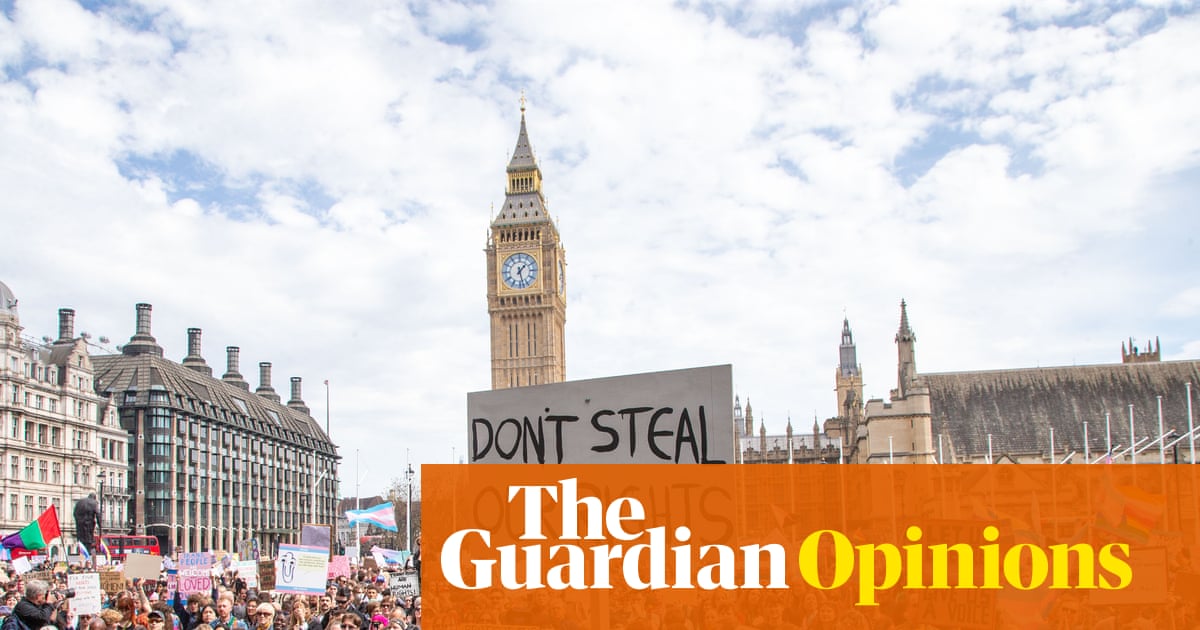
Alexandra Parmar-Yee writes in the Guardian about something that should not need writing about in 2025: the fact that trans people in the UK are now, as she puts it, facing segregation. Not as a theoretical concern, not as a future risk, but as a present reality being ushered in by a combination of a Supreme Court ruling, an Equality and Human Rights Commission that initially seemed to interpret its job as dismantling what little protection remained, and a government that has so far chosen to watch.
What strikes me most about Alexandra's piece is the ordinariness of what she describes losing. She is not writing about grand rights she never had. She is writing about the ordinary life she was already living, a life where other women had made her feel welcome, where she had stopped worrying about bathrooms because the people around her had told her, with their actions, that she belonged. That is the life the Supreme Court ruling and the EHRC's initial guidance have put at risk: not a hypothetical future, but something real that existed and that is now being taken away.
The EHRC's first response to the ruling was, to put it plainly, an overreach. Its initial advice suggested trans people should be excluded from any single-sex service or association that matches their gender, regardless of what those organisations wanted. The Women's Institute, of all places, was apparently supposed to exclude trans women. The EHRC has since softened some of that language, and the revised draft guidance does at least create a route for associations to remain inclusive. But as Alexandra notes, that route is narrow and the rest is just as bad. Inclusive service providers, from writing workshops to hospital wards, are being urged to exclude trans people. The softening is, in her words, a more polite kind of cruelty, and that phrase has stayed with me.
The government's own equality impact assessment admits that the effects on trans people will be wide-ranging and negative. It acknowledges that trans women directed to men's services could face disproportionate risk of violence and sexual assault. It warns that women perceived as masculine will face greater scrutiny, that disabled people will be adversely affected, and that the financial cost of reconfiguring facilities runs to more than half a billion pounds before you count the years of litigation that will follow. This is not an assessment produced by trans rights campaigners. This is the government's own analysis of what its own inaction will produce. And so far, the response has been to carry on regardless.
Alexandra describes being scared to go to hospital with a lung problem, worried she would be admitted to a men's ward. I have heard versions of that fear from so many people. The anxiety is not abstract. It shapes decisions: whether to leave the house, whether to seek medical care, whether to attend a group, whether to take up space in a world that has just been told, officially, that it can ask you to leave. Trans people's worlds shrinking is not a side effect of this policy; it is the effect.
The Supreme Court's ruling was an interpretation of legislation, not a new law. It concluded that "woman" and "man" in the Equality Act refer to biological sex for the purposes of that Act, and that a Gender Recognition Certificate does not change that. The Court was careful to say that trans people remain protected under the characteristic of gender reassignment, and that trans women do not lose all protection. But the gap between what the Court said and what the EHRC's guidance has done with it is considerable. The guidance has run well ahead of the ruling, and Parliament has the power to address both.
Alexandra is right that this is ultimately a political choice. Legislators can fix the law. They chose not to intervene so far, and that choice has consequences. Describing it as a matter for the courts is not a neutral position; it is a decision to allow the current situation to stand. If this becomes Labour's legacy on LGBTQ+ rights, it will be a lasting one, and not in the way anyone on the government benches should want.
What I keep returning to is the image Alexandra offers at the start: a life that was not dominated by fear, a life where other women made her feel welcome, a life that was ordinary and good. That is not a radical demand. That is just a life. The argument for restoring her legal protections is not complicated. Trans women belong in women's spaces, they always have, and the people who shared those spaces with them knew it and were fine with it. The law should catch up with the people it is supposed to serve.
If there is a news story you would like me to cover then just let Sammy know.
Dr Helen Webberley is a gender specialist, medical educator, and founder of GenderGP. She writes about gender diversity, trans healthcare, and the fight for trans equality.
Comments