Donald Trump's anti-trans sports rant at a Pennsylvania factory revealed the contradiction at the heart of this entire debate. To argue that trans women are unbeatable, you have to argue that cisgender women are weak. Trump did exactly that, and in doing so he showed what this rhetoric has always been about.
What actually happened in Pennsylvania
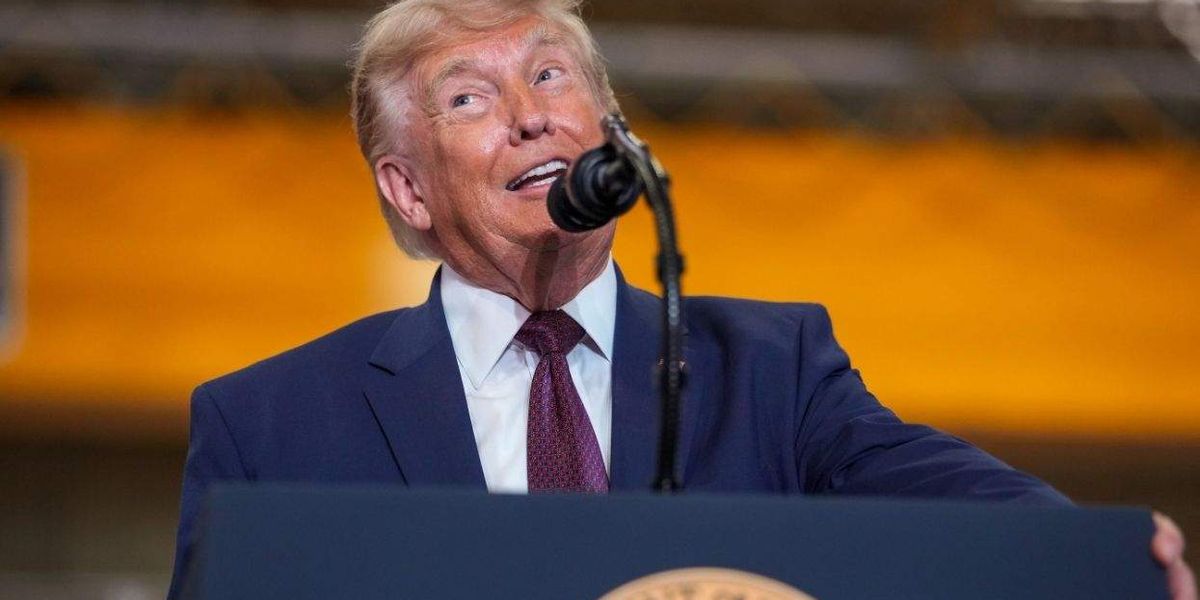
On 23 June 2026, speaking to workers at the Mack Trucks facility in Macungie, Pennsylvania, Trump used a fictitious Olympic scenario to attack transgender participation in sport. The precise details of what he conjured up are almost beside the point, because the shape of the argument was as revealing as the words themselves. To make his case that trans women do not belong in women's sport, he constructed an imaginary competition in which a trans woman obliterates her cisgender competitors. He played it for laughs.
The women he was supposedly defending were the punchline.
The contradiction that undoes itself
I have heard this argument made hundreds of times, in courtrooms and comment sections and parliamentary debates, and it always contains the same hidden insult. The logic runs: trans women are so physically powerful that no cisgender woman can compete with them. Therefore, trans women must be excluded to protect women's sport.
But follow that logic to where it leads. It requires you to believe that women athletes, who dedicate years of their lives to their sport, who train with extraordinary discipline and courage and intelligence, are so fundamentally limited that a single competitor of a different background would simply erase them. It requires you to treat women's athletic achievement as a fragile thing, easily shattered, requiring constant protective management. That is not admiration. That is the most tired dismissal of women's capability there is.
Trump did not just imply this. He said it out loud, in a room full of people, and got a laugh. And that is what troubles me most about this particular moment, not the policy position, but the performance. The ridiculing of women athletes was the entertainment. Their imagined defeat was the joke.
This is what "protecting women" looks like in practice
The people who have driven anti-trans sports bans have consistently claimed to be acting in women's interests. I do not doubt that some of them believe that sincerely. But when a sitting president stands in front of an audience and mocks women athletes as pushover opponents in a made-up story, and does so while arguing he is their defender, it is worth asking what that defence actually looks like from the inside.
Women athletes I have spoken with over the years do not, as a rule, describe themselves as fragile. They describe themselves as competitive, ambitious, strong, and furious at being used as props in other people's political arguments. They have not asked to be rescued. Many of them have spoken out explicitly against the bans being enacted in their names.
The trans women at the centre of this debate are overwhelmingly not Olympians. They are school pupils, recreational runners, people who want to join a team and feel the ordinary human joy of sport. The fictitious superathlete Trump apparently described bears no relationship to the real trans women being affected by these policies, who are being excluded from the most basic levels of participation not because they are winning everything but because the political moment demands a target.
What the rhetoric reveals
Anti-trans sports rhetoric has always needed an enemy that sounds plausible, and "unfair competition" sounds plausible because sport is genuinely about fairness. But the argument collapses the moment you examine it, because it depends on treating both trans women and cisgender women as caricatures. Trans women become unstoppable biological weapons. Cisgender women become helpless victims. Neither is true, and anybody who has spent time with real athletes, trans or otherwise, knows it immediately.
What is left, once the logic dissolves, is contempt. Contempt for trans women, who are framed as cheats and interlopers. And contempt for cisgender women, who are apparently so weak that even their most basic participation needs constant policing to remain meaningful. Trump's Pennsylvania speech did not hide that contempt. He put it on stage and played it for applause.
I find that genuinely enraging, and I am not going to pretend otherwise. Women's sport deserves better than to be used as a rhetorical weapon. Trans people deserve better than to be the target of fictitious scenarios designed to make a crowd laugh. And all of us deserve a political conversation that treats human beings as human beings, rather than as characters in someone else's performance.
If there is a news story you would like me to cover then just let Sammy know.
Dr Helen Webberley is a gender specialist, medical educator, and advocate, and the founder of GenderGP. She writes about gender diversity, trans healthcare, and the lives of trans people and their families.
Comments