
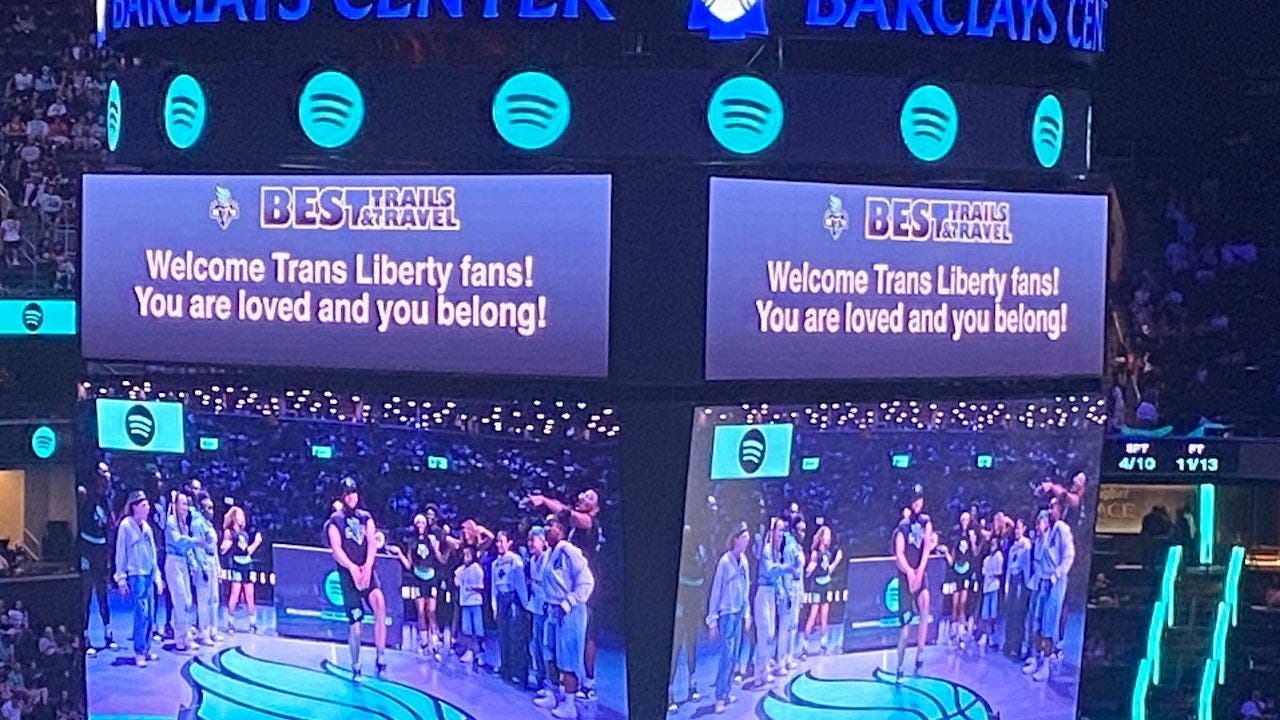
Three messages appeared on the Barclays Center scoreboard during halftime on Saturday. "Big welcome to the NY Liberty transgender fan community! So excited to be here with you all!!" "Welcome Trans Liberty fans! You are loved and you belong!" "Hey trans fans! Glad you're here! Go Liberty!" That is all they said. And the fact that displaying them required courage, that it will be written up as a political act, that it drew a crowd of protesters outside the arena, tells you more about the climate we are living in than any op-ed could.
What the Liberty actually did
The day before the game, a woman named Julie Potter had a paid scoreboard message declined. She had submitted: "Thank you Jennifer Sey! XX-XY Athletics will Save the Day!!" The Liberty rewrote it to remove the slogan, told her that submissions must be limited to "positive, celebratory content", and when she objected, refunded her $100. Potter attended anyway, alongside other women's sports activists who had come to support Sophie Cunningham.
Then, during the same halftime slot where Potter's original message would have run, the Liberty put up their own messages. Three of them. All of them addressed to trans fans directly, by name, with warmth. You can draw your own conclusions about the sequence of events. What I notice is that the team made a choice, and it was the right one.
What it feels like to be welcomed by name
Trans people spend a great deal of time in spaces that communicate, without ever quite saying so, that their presence is complicated. Sports arenas are not always easy places. The crowd is loud, the atmosphere is charged, and the political noise around trans people in sport has been relentless and frequently cruel. To sit in those stands and look up at a scoreboard that says, plainly, that you are loved and you belong here: that is not a small thing.
I have heard from so many trans people over the years about the moments that stayed with them, the first time a teacher used the right name, the first time a form didn't force a wrong box, the first time a public space acknowledged them without drama. Those moments do not fix structural problems. They do not change law or policy. But they matter to the person who experiences them, because they signal that someone, somewhere, decided their presence was worth celebrating rather than merely tolerating.
The trans fans who came to Barclays Center on Saturday came knowing there would be protesters outside. They came anyway. Seeing those messages appear would have meant something real.
The protest outside, and what the Fox News framing does
The source article here is Fox News, and it is worth naming what that means for how the story is told. The piece leads not with the scoreboard messages but with the counter-protesters declining to be interviewed, with a sticker placed on a reporter's back, with glasses taken from a photographer and not returned. These are the details Fox News chose to centre. The three messages welcoming trans fans are reported, but they sit inside a frame designed to make the people celebrating their humanity look like a mob.
The protesters outside were there because a rally supporting Sophie Cunningham was taking place. Cunningham has been vocal in ways that many trans people and their allies find harmful. The counter-protesters came in force, with flags and signs and, yes, bubble blowers. They had pre-agreed not to give media interviews, a decision an ambassador explained. That is an organised, considered group making a collective choice, not a mob. Describing them as one is a framing decision, not a factual one.
The glasses incident, if it happened as described, was wrong. But one incident at the edge of a large protest does not define the people who were there, and it does not change what the Liberty did inside the arena or what it meant to the fans who were present.
Sophie Cunningham's own words
Cunningham spoke to reporters before the game, and what she said was interesting. She described the arena as something she wanted to be "a safe space" for Liberty fans and Indy fans alike. She framed the rallies and counter-protests as proof of the platform women's basketball now has, and said that more eyes on the WNBA was "an awesome thing". She did not, in these quotes, address trans fans directly. But the framing she chose, safe space, wider audience, more fans, sits oddly alongside the rallies being held in her name, which are not primarily about growing the game.
What the Liberty's decision signals
A professional sports team chose to use its platform, literally its scoreboard, to tell a group of fans that they are loved. That is what happened. The political noise around it, the refunded message, the protesters, the Fox News framing, is all real, and all worth naming. But underneath all of it is a simple act: a team looked at its trans fans and decided they deserved to be welcomed by name.
Other teams and venues are watching. So are trans fans across the country, wondering whether the spaces they love have room for them. The Liberty answered that question on Saturday, in letters big enough to read from the upper deck.
New York City is, as we covered recently, also running a citywide "Trans Rights are Human Rights" campaign through the Commission on Human Rights, with messaging across public transit and LinkNYC kiosks throughout the boroughs. The scoreboard at Barclays Center on Saturday fits inside that same city-wide signal: that in New York, at least, trans people are being told clearly and publicly that they belong. That it takes courage to say so is the part we should all be paying attention to.
Comments