
Siobhan Kirchstein cleans the women's restrooms at Parker Hall on the University of Kansas campus. In July, she was formally warned for using one of them. Someone had reported her under Kansas's SB244, a law requiring people to use bathrooms matching their sex assigned at birth. Her community's response was to form Trans Solidarity KU and start fundraising.
The gap between the policy debate and the actual event is vast. The people who wrote SB244 talked about safety, about protecting women, about common sense. What the law produced, in practice, is a written warning to a trans woman for washing her hands in the building where she works.
What actually happened at Parker Hall
Siobhan Kirchstein has worked at KU long enough to be well known, and by her own account, well liked. "Most people have been supportive of me as a trans woman," she told Kansas Public Radio. She cleans the restrooms and other spaces in a building that houses the Kansas Geological Survey, and she says she has never experienced hostility from her colleagues there.
Someone, whose identity has been withheld from her under the university's whistleblower policy, reported her for using the women's restroom. KU sent her a warning letter. That is what a first offence looks like under SB244: a formal document telling a custodian that she broke the law by using the room she cleans.
She has no legal fees yet. She wants to be ready in case she does. The law is precise about what comes next: a second offence can mean a $1,000 fine and a misdemeanor charge. There is also a bounty provision, allowing anyone who feels aggrieved by her bathroom use to sue her directly for $1,000. "It just takes one person," she said, "just one person, to be freaked out enough to report someone."
Her community's answer
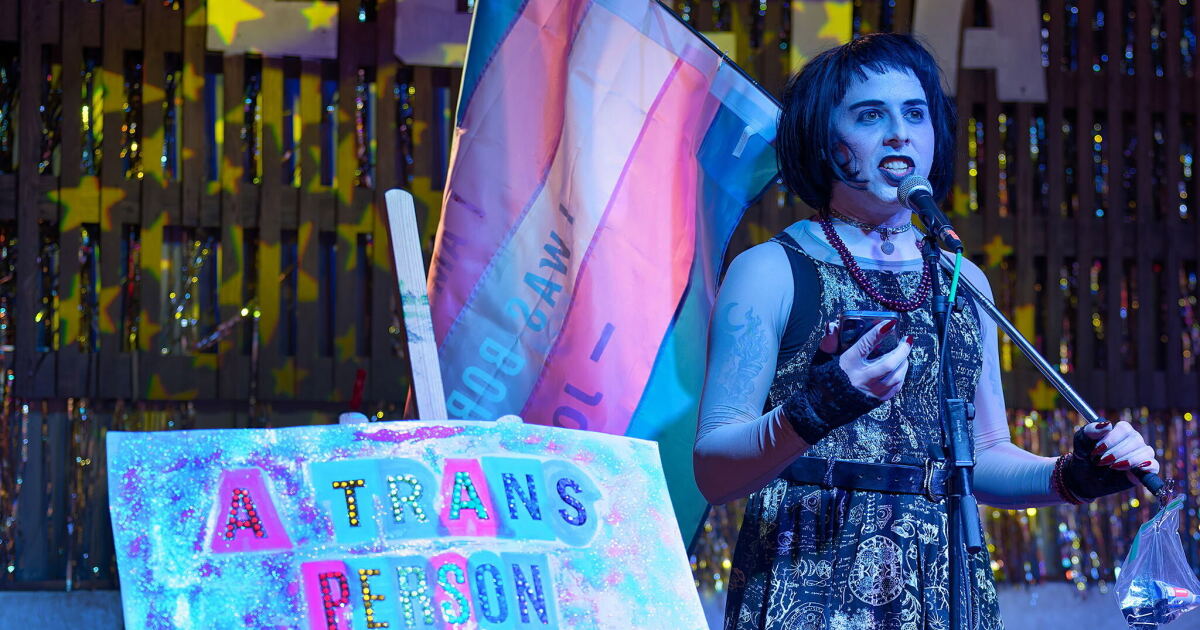
The fundraiser in Lawrence was not just about money. It was the founding moment of something new. "We've actually formed a group," Kirchstein said. "We call it Trans Solidarity KU." The aim is a petition, a set of demands to the university, and a signal to the institution that it owes its trans staff and students a demonstration of good faith.
She also named what she hopes the group will reduce: what she called "transvestigations", the practice of reporting trans people for existing in the spaces they have every human right to use. The complaint against her at Parker Hall came from the state law, not from any university policy. That distinction matters, because it means the university has room to act differently from the state, if it chooses to.
The law is the problem, and this is not the first time it has shown that
This story sits alongside one I covered earlier: the SB244 Compliance Crew, a group of transgender men in Kansas who began protesting the law by following it exactly, walking into women's restrooms in rural communities, watching managers call the police, watching officers spend twenty minutes in conversations nobody was prepared for. In Dodge City, protesters were asked to describe their own genitalia before being told they were free to go. In Emporia, a woman fled the restroom to complain. In every case, the chaos was the law's doing, not the protesters'.
What Siobhan Kirchstein's case adds is simpler and, in some ways, more devastating. She was not protesting. She was not making a point. She was doing her job. And the law reached into her ordinary working day and made her a subject of formal discipline for it.
Kirchstein herself has a sharp read on the politics. "Kobach himself doesn't even seem to be interested in enforcing this law," she said. "Most people seem to think it's just a rallying cry for their political base." The University of Kansas has not been fined under the law, which allows for a $25,000 penalty for publicly owned facilities. The Attorney General's office did not respond to requests for comment. The law, in other words, has been used precisely once at KU: to warn a custodian.
What bathroom laws cost in practice
I have heard this question framed, endlessly, as a debate about principle. About what a bathroom is for. About who belongs where. About safety and discomfort and rights in competition with one another. I understand why the framing persists, because the people who benefit from it are the ones with the loudest platforms.
But Siobhan Kirchstein is not a principle. She is a person who went to work, cleaned a restroom, and used it, and was reported to her employer for doing so. The person who reported her did so anonymously, protected by a whistleblower policy designed for situations rather different from this one. She does not know who it was. She may never know. She is preparing for fines and legal fees that she hopes will never materialise, because the law has made that preparation necessary.
That is what SB244 looks like from inside it. Not a debate. A warning letter. A fundraiser. A new solidarity group named after the university where a custodian was reported for cleaning a bathroom and then using it.
I am glad her community showed up. I hope Trans Solidarity KU gets every signature it is going for. And I hope the University of Kansas reads the petition and decides that good faith toward its trans staff is worth more than waiting to see what the Attorney General does next.
Comments