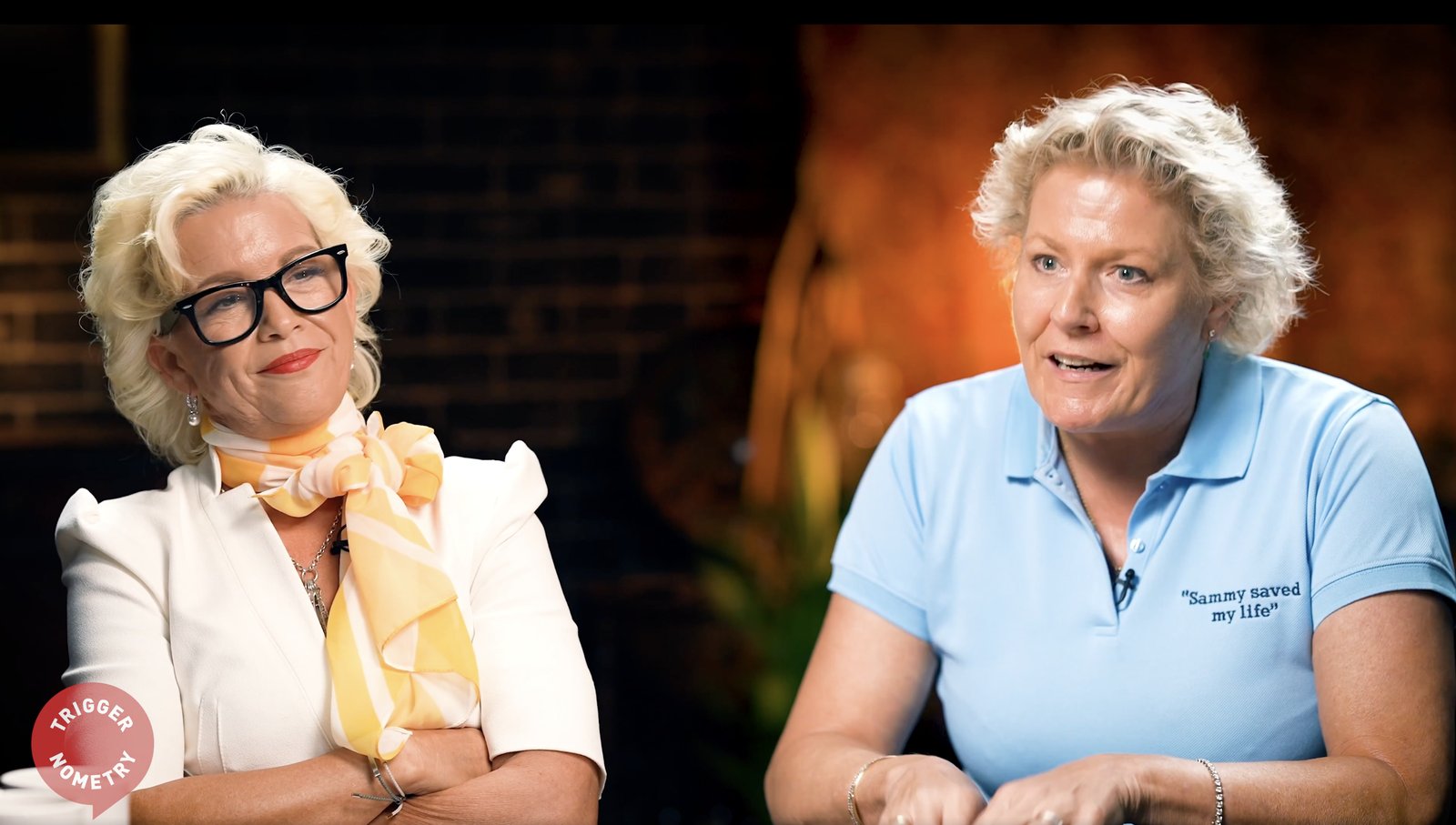
When you sit down to debate someone who thinks your patients don't exist, who calls your work child abuse, and who says you belong in prison, the hardest thing is not losing your temper. It is staying clear and human in a room that has decided in advance that clarity and humanity are optional.
I appeared on Triggernometry, hosted by Konstantin Kisin, alongside Kellie-Jay Keen-Minshull. I knew what I was walking into. I went anyway, because views like hers do not become less harmful when they go unchallenged, and because the trans people watching deserved to have someone in that room who actually knew what they were talking about.
I want to tell you what that felt like. Not to relitigate every exchange, but because I think the shape of that conversation, and conversations like it, matters. It matters to every trans person who has ever watched one of these debates and felt themselves shrinking. And it matters to every parent, partner, or friend who has sat at a kitchen table wondering why this is so hard and so loud.
The technical malfunction and what it told me
We had barely started when the producer realised the recording equipment had not been capturing all the tracks. There was a brief flurry of apology, a restart, and then we began again. It was a small thing, and nobody minded particularly. But I noticed something in those few minutes of gentle chaos: Kellie and I were entirely civil. The producer apologised. We all reassured each other. For about ninety seconds, it was just three people in a room sorting out a technical problem, and it was fine.
Then the recording started, and it was not fine anymore.
I am not saying that to be pointed. I am saying it because I think it is worth noticing what happens when a microphone goes on and the format of a debate kicks in. Positions harden. Interruptions multiply. The other person stops being someone you are talking to and becomes someone you are performing against. That is not unique to this conversation. It is what adversarial formats do. And trans people pay for it every time, because the thing being debated is not an abstraction. It is whether they should be allowed to receive care. Whether they exist in any meaningful sense. Whether the people who help them belong in a prison cell.
Explaining the same thing, again and again
Konstantin asked good-faith questions, mostly. He was genuinely trying to understand the distinction between sex and gender identity, and I have a lot of patience for genuine confusion, because it is real and it is common and it does not make someone a bad person. The language is genuinely difficult if you have not spent years inside it. I tried to explain, more than once, that chromosomes and gender identity are distinct things, that hormones do not change one's gender but can change one's body, that the Equality Act recognises sex reassignment as a protected characteristic for a reason.
What I find tiring is not the explaining. I will explain this until I am blue in the face, because it matters and because people deserve to understand it. What I find tiring is the format in which the explaining happens, where every answer is interrupted before it is finished, where the same objection returns three minutes later as if the answer was never given, and where the goal is not understanding but the appearance of having landed a blow. At one point I was mid-sentence when Kellie cut across with a Harold Shipman reference. A serial killer. As a comparison. For me. Because I had helped trans people access care.
I kept my voice level. I made a small joke about broadening our examples. But that moment was an attempt to associate the medical care of trans people with murder, on a platform with a large audience, and it was allowed to stand unchallenged by the host.
The word "feelings"
There was an exchange that I keep returning to. I was explaining the criteria used in gender-incongruence assessments, one of which is whether a person has experienced a persistent mismatch between their gender identity and the sex they were assigned at birth. Kellie interrupted with the word "feelings", said with a particular kind of contempt. As if feelings were the least reliable thing in the world. As if medicine never used them.
Pain is a feeling. Nausea is a feeling. Grief, which we now know has measurable physiological effects, is a feeling. Depression, which we treat with medication, is largely assessed through what people tell us they feel. The entire field of psychiatry, which Kellie seems to want to redirect trans young people towards, is built on listening to feelings. But when a trans child says, quietly and consistently, "I am not the gender everyone assigned me at birth," suddenly feelings are not a valid source of information.
What I tried to say, and what I will say again here more plainly: there is no blood test for gender identity. There is also no blood test for most of what makes us who we are. What we have is a person in front of us, a history, a pattern, a family, and a careful conversation. That is how medicine works across enormous swathes of what it does. We do not refuse to treat depression because we cannot extract the sadness from a blood sample. The standard applied to trans people, the demand for a definitive biological proof before anything is taken seriously, is not a standard we apply anywhere else. It is a standard invented specifically to obstruct.
What Kellie said about a trans woman
At one point, Kellie described a trans woman she knew of, a young person of around twenty-three. She described this person as "clearly just a quite effeminate gay man." She speculated about what his life might have looked like if he had not transitioned. She expressed pity and contempt in roughly equal measure.
I stopped the conversation to apologise to that person, whoever she was, for being publicly misgendered and speculated about on a podcast she may well have been watching. Kellie said she did not know who it was. That is not the point. The point is that she had just taken someone's identity, stripped it away, diagnosed them from a distance with gayness as though that were a consolation prize, and offered this as evidence that medical transition should not exist. And this person, this actual human being, had no say in any of it.
This is what I mean when I say that anti-trans rhetoric causes real harm. It is not only about legislation or policy, though those matter enormously. It is about what it does to a person to hear their existence treated as a case study in someone else's argument. To hear themselves described as confused, or traumatised, or simply gay and in denial, by a stranger with a microphone and a confident voice. To watch that stranger be treated as an equally valid interlocutor to a doctor who has spent decades listening to the people she is now dismissing.
The prison conversation
Kellie said, clearly and without hesitation, that she would like to see me face criminal prosecution for my work with trans young people. I said, in return, that misgendering, particularly repeated and deliberate misgendering, constitutes a hate crime in the way the law understands it, because it targets someone on the basis of a protected characteristic. Konstantin then summarised the situation: "You both want each other in prison."
Those two things are not equivalent, and the false equivalence matters.
I was talking about the harm done by public rhetoric that dehumanises a group of people. I was talking about the correlation, which is not disputed, between hostile public discourse about trans people and the rates of self-harm and suicide in the trans community. I was talking about a legal framework that already exists. I was saying, clumsily perhaps, that when the law provides protection, it should be taken seriously.
Kellie was talking about criminalising the medical care of trans young people. About removing legal recognition from trans people who already have it. About sending trans women into male spaces. About stripping passports.
These are not mirror images. One is a person saying that hate speech causes deaths and should be moderated. The other is a person saying that trans people should have their legal existence removed and that those who helped them should face criminal consequences. Presenting them as "both wanting each other in prison" is a rhetorical trick, and it is a harmful one, because it suggests that those positions carry equal moral weight. They do not.
What I wish I had been able to say
There is always a gap between what you can say in a fast-moving debate and what you want to have said when you are walking home afterwards. So let me say a few things here, where no one is talking over me.
To the trans woman who was misgendered in that room: I am sorry you had to hear that. Your identity is not available for other people to debate.
To the trans young people who watched that conversation and felt their futures being argued over by someone who has never sat with them, never listened to them, never tried to understand what they have been carrying: you are not a case study. You are not evidence in someone else's argument. You are a person, and you deserve care, and the noise in that room was not about you. It was about the people making it.
To the parents who watched and felt confused, or frightened, or unsure who to believe: the person in that room who has actually sat with trans children and their families was me. Not Kellie. I am not saying that to score a point. I am saying it because it is relevant. Experience of real people matters. Conviction without experience is not the same thing, however loudly it is expressed.
And to anyone who thinks debates like this are a useful way to arrive at the truth about complex medical and human questions: they are not. They are useful for generating heat and clicks. The truth about what trans people experience, what helps them, what harms them, and what they deserve, is found in the research, in the clinical guidelines, in the voices of trans people themselves. Not in an adversarial room where one participant thinks the other should be in a cell.
Why I went anyway
Someone will ask why I agreed to this. Kellie asked it herself, with some satisfaction. If I think this format is harmful, why participate?
Because the alternative is that only one voice is heard. Because there are people watching who are genuinely uncertain, who have heard a lot of noise and very little careful explanation, and who deserve to see someone hold a position calmly and with knowledge. Because the trans community does not have the luxury of declining to show up when its existence is being debated on a show with hundreds of thousands of viewers.
And because I am not afraid of the questions. I am not afraid of Konstantin's genuine confusion about the sex-versus-gender-identity distinction, because it is a real and reasonable confusion and I can explain it. I am not afraid of hard questions about consent and young people and medical risk, because those are exactly the questions that good medicine engages with every day. What I object to is those questions being used not in good faith, to understand, but as tools to foreclose the answer before it is given.
I would much rather sit on a programme that celebrates the beauty of gender diversity, that brings trans people and their families to speak in their own voices, that lets the evidence speak instead of the noise. Maybe we will get there. I think we will. But until then, I will keep showing up, because the people watching deserve at least one voice in the room that knows what it is talking about and refuses to pretend otherwise.
If there is a story that you would like to share or hear about, just let Sammy know.
Dr Helen Webberley is a gender specialist, medical educator, and advocate. She is the founder of GenderGP and works full-time in education, advocacy, and the promotion of gender diversity. You can find her at helenwebberley.com and @helenwebberley[1].
Comments