
In the summer of 1966, on a hot night in San Francisco's Tenderloin neighbourhood, a drag queen threw a coffee mug at a police officer. It sounds like the beginning of a joke. It was the beginning of a movement. The Compton's Cafeteria riot predates Stonewall by three years, and it is, as historian Susan Stryker has spent decades arguing, one of the earliest documented acts of organised trans resistance anywhere in America. Trans women, drag performers and sex workers fought back against a police raid with dishes and chairs and their own fury. What came after was the first time, according to Stryker's research, that direct street action by trans people produced lasting institutional change in a city's treatment of them.
I find myself thinking about that coffee cup a lot this week.
Because today, the building where that happened, 111 Taylor Street, is occupied by Geo Group: the world's largest for-profit prison company, and ICE's biggest contractor. Geo Group runs a 240-bed halfway house on the site. The building's exterior carries a historical marker recognising the Compton's riot. Inside, a company that profits from immigration detention is operating a facility that has been under investigation by San Francisco city officials since last July, when a man was found dead nearby after being held there. Geo Group did not respond to the Guardian's request for comment.
A community effectively walled into a neighbourhood
To understand why this matters so much, you need to understand what the Tenderloin was, and still is. From the early 1950s, trans women and queer people were concentrated there not by choice but by exclusion: locked out of housing and legitimate employment by discrimination, subject to arrest for wearing clothes that matched who they were, harassed and criminalised for existing on the street. Gene Compton's Cafeteria, a 24-hour greasy spoon, became a hub because it was one of the few places that would have them. The community built something there, out of very little, in conditions that were hostile in almost every direction.
Sixty years on, the Tenderloin is now home to the world's first official Transgender District, which was initially named Compton's Transgender Cultural District in direct recognition of that history. Trans people have lived there for at least a century. That is not nothing; that is a community that survived, built, resisted and put down roots. The question now is whether the city that benefits from that history is willing to protect what remains of it.
What Compton's x Coalition is actually doing
The group organising the fight to reclaim the building is called Compton's x Coalition, and they are working on two tracks at once. They are pushing the city to declare the interior of 111 Taylor a historic landmark, which would give the space legal protection. And they are appealing the building's current zoning, with hundreds of people attending public hearings in support. The next hearing has not yet been rescheduled.
Janetta Johnson, a founder of the Transgender District, CEO of the advocacy group TGI Justice Project, and a person who was herself once held at 111 Taylor, wants the space converted into LGBTQ+ senior housing. That vision, a building that once held people against their will becoming a home for the community that fought for its significance, is exactly the kind of reclamation that trans history deserves.
Organiser Chandra Laborde described the corner of Turk and Taylor as a microcosm. "If we can change the corner," she said, echoing Stryker, "we can change the world." That might sound like rhetoric, but the Tenderloin's history gives it weight. Change did come from that corner once before.
The lines being drawn in 2026
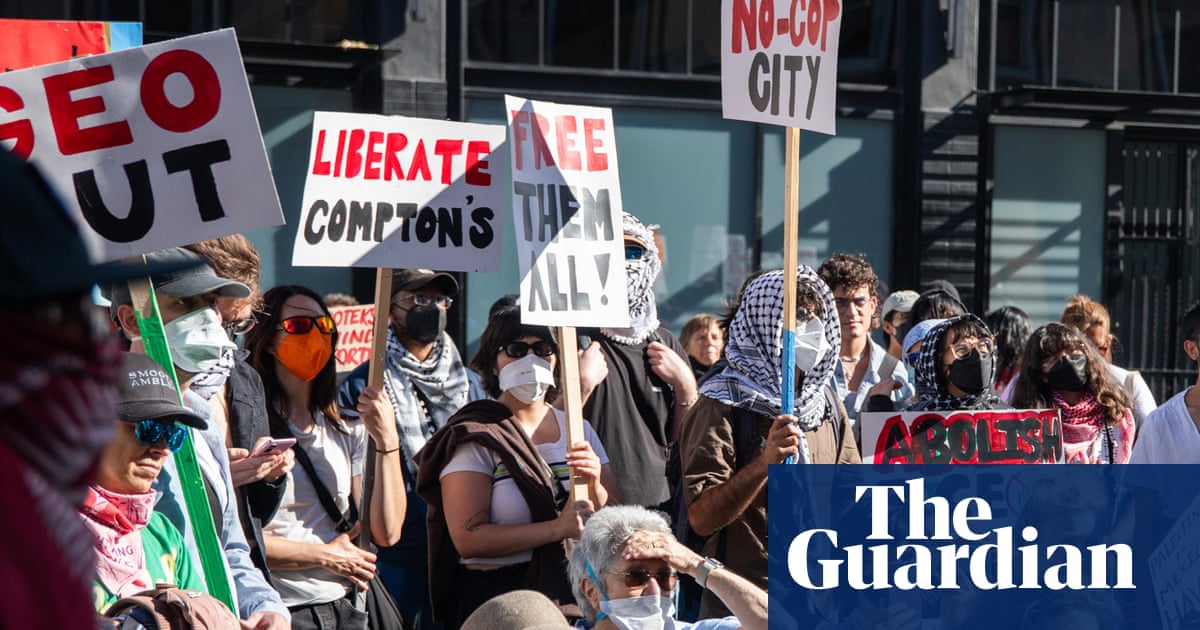
What makes this story particularly striking is how explicitly Compton's x Coalition connects the dots: between ICE's detention operations and the policing that drove trans women into the Tenderloin in the 1960s; between anti-trans legislation rolling through statehouses and the private companies that profit from carceral systems; between then and now. In July, the coalition hosted a solidarity protest for hunger strikers in ICE detention facilities. Among those who spoke was a local drag queen who had been abducted by ICE. Protesters carried signs reading "Geo Out" and "Liberate Compton's". The march at San Francisco's Trans March in June ended at the very corner where Compton's once stood.
The Bay Area remains a destination for trans people leaving states with active anti-trans bans, and San Francisco declared itself a sanctuary city for trans people in 2024. But as Honey Mahogany, a Trans District founder now directing the city's Office of Transgender Initiatives, put it: "We're never going to be able to do enough." The federal pressure is real, and no city is fully insulated from it. The killing of Banko Brown, a 24-year-old unhoused Black trans man shot by a private security guard in 2023, and the subsequent decision not to press charges, left a wound in the community that has not closed. The violent arrests at Pride weekend this year, police drawing guns and batons at protesters who had covered surveillance camera lenses, belong to the same story.
Stryker, who has spent her career making sure the Compton's story is not lost, put it plainly: "San Francisco is not the queer utopia that people have long considered it to be." That is not despair, but the same clear-eyed realism that drove people to throw dishes in 1966, because they understood exactly what they were up against and did it anyway.
What trans history asks of us
Trans history is not abstract. It lives in places, in the physical geography of communities that took decades to build: the cafes, the corners, the buildings where people were safe or fought to be. When those spaces are taken over, when a company that profits from immigration detention occupies the ground floor of a building whose exterior commemorates trans resistance, that is not incidental. It is the logic of erasure made physical.
The coalition is working slowly, through planning appeals and public hearings and political processes that move at the pace of city bureaucracy. On 14 August, the supervisor representing the Tenderloin was removed from the city's land use committee, leaving the process in further uncertainty. None of this is fast, and none of it is guaranteed. But these are people who understand that the Tenderloin's trans community has been fighting, surviving and building through hostile conditions for a century, and that 60 years ago it produced something that changed a city. The fight to protect what remains of that is worth knowing about, worth following, and worth caring about.
If there is a news story you would like me to cover then just let Sammy know.
Dr Helen Webberley is a gender specialist, medical educator, writer and advocate, and the founder of GenderGP.
Comments