
A federal judge has dismissed the US Justice Department's lawsuit against California's trans-inclusive school sports policies, ruling that Title IX does not require states to exclude transgender girls from girls' teams. The Supreme Court's recent ruling permitting biological-sex eligibility standards does not, the judge found, compel every state to adopt them. California's policies remain intact.
What the court actually said
Judge Cynthia Valenzuela's ruling is worth reading carefully, because it cuts through a great deal of noise. The Justice Department argued that Title IX, the 1972 federal law prohibiting sex-based discrimination in education, requires sports eligibility to be determined by biological sex. Judge Valenzuela looked at the law and found that it does no such thing.
She also looked at what the Supreme Court actually decided in June, when it ruled that states may limit girls' sports to biological females. The key word is "may". The Supreme Court, she noted, explicitly declined to decide whether Title IX permits transgender girls to compete on girls' teams, and stated that nothing in its opinion addressed that question. Permission for states to do something is not the same as an instruction to every state to do it. California had received no clear notice that excluding transgender athletes was a condition of its federal funding. Without that clarity, the lawsuit could not stand.
That is a precise, careful piece of legal reasoning, and it matters, because the Trump administration had threatened to strip $44.3 billion in federal funding from California's Department of Education if the state did not fall into line. That threat has, for now, collapsed.
The young people this was always about
The human reality of this is easy to let the legal architecture crowd out.
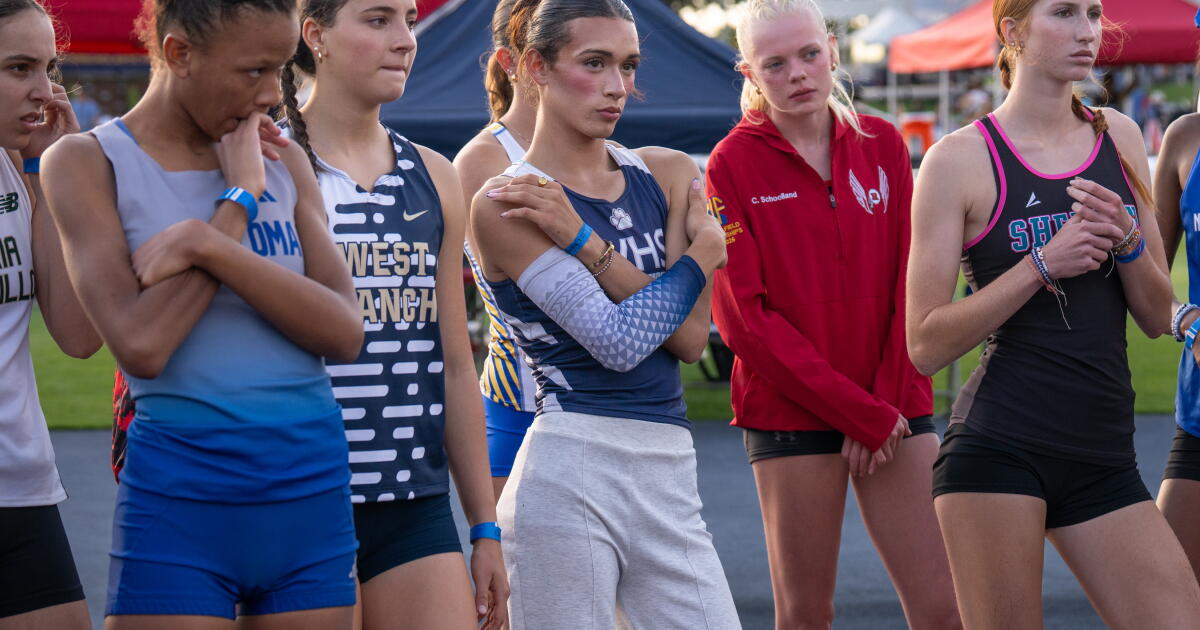
AB Hernandez, a teenage track athlete, found herself named in a national political campaign. The President of the United States took to social media to demand she be banned from competing at the state track and field championship. Think about what it means to be a teenager, working hard at something you love, and to have that happen to you. To have your participation in school sport become a culture war flashpoint, dissected on television, debated in courtrooms, weaponised by politicians.
She competed. She won medals. Under rules the California Interscholastic Federation updated under political pressure, she shared her podium positions with the cisgender athletes who would otherwise have placed there. And then she did it all again this year.
Trevor Norcross, father of Lily Norcross, a transgender track athlete at Arroyo Grande High School, said after the ruling that it is "time to get back to supporting and enjoying girls' and women's sports instead of trying to tear them down." He added that he is "especially excited that girls in California can now focus on athletic competition without having to worry about manufactured culture wars and the prospect of invasive body inspections if they don't look feminine enough."
That last phrase deserves attention. The enforcement of biological-sex eligibility rules does not exist in the abstract. It means somebody checking, inspecting, deciding. Girls who are too tall, too muscular, too fast, not feminine enough by somebody else's measure, become suspects. That is not protection, it is surveillance.
What the lawsuit was really for
The Justice Department lawsuit was brought by Harmeet Dhillon, who heads the DOJ's Civil Rights Division, and Bill Essayli, the US attorney in Los Angeles. Both have been longstanding critics of California's policies for transgender students. The suit was not a spontaneous response to evidence of harm; it was a deliberate instrument of the Trump administration's broader effort to eliminate trans-inclusive policies nationwide, in sport, in bathrooms, in healthcare, in official documents.
The DOJ's statement after the ruling said it "remains committed to enforcing President Trump's agenda preventing boys from playing in girls' sports." The use of "boys" to describe transgender girls is not an accident or a slip. It is the framing, the whole argument condensed into a single word.
Judge Valenzuela's ruling is a reminder that courts can look at that framing and find it legally insufficient. The rhetoric and the law are not the same thing.
This is not the end of the fight
The DOJ has said it is evaluating its options for appeal, so this ruling may not be the last word. The broader political campaign against trans young people continues in states across the country, and the Supreme Court's June ruling gives any state that wishes to exclude transgender athletes the legal cover to do so.
But California has held. A court looked at the evidence, looked at the law, and found the premise of the lawsuit shaky. For the trans girls competing in California schools, that is not an abstraction, it is the difference between being allowed to play and being told you cannot.
Rainbow Families Action called the ruling a "roadblock" to what it described as the Trump administration's "relentless and hateful campaign against transgender children." That is a strong phrase, but I find it hard to argue with. When a federal government threatens to pull $44 billion from children's education in order to exclude a small number of transgender girls from school sport, the word "relentless" seems accurate enough.
What gives me real hope here is not the legal technicality. It is the young people who kept showing up. Who competed anyway. Who stood on podiums and shared their wins with grace, under conditions no young person should have to navigate. That takes something. I hope they know the rest of us are watching, and that we are glad they are there.
If there is a news story you would like me to cover then just let Sammy know.
Dr Helen Webberley is a gender specialist, medical educator, writer, and advocate, and the founder of GenderGP. She writes about gender diversity, trans healthcare, and the lives of trans people and their families.
Comments