
Julia Curlee spent years as a CIA officer and senior White House intelligence official, openly trans, briefing presidents and vice presidents. When Trump announced on his first day back that the government recognised only two genders, Julia was standing in the building. She didn't leave. Her story, told in The Atlantic, is about what it costs to belong to a country that keeps telling you that you don't.
She was already in the room
There is a detail near the start of Julia's account that I keep coming back to. Her colleagues at the CIA had started an office pool on when she'd be fired. The smart money said 12:15, fifteen minutes after Trump's second inauguration began. She tells it with the driest possible delivery, which is exactly the right register for something that bleak.
She wasn't fired. But she did stand in the White House and hear the newly sworn-in president announce, to the country and to her, that official government policy now recognised only two genders: male and female. A colleague glanced at her and looked away. "Yeah," Julia muttered. She was one of those two genders. The administration would have views, she noted, on which one.
She gripped her badge. She thought about walking out the north gate and never looking back. She imagined, with a clarity that tells you this was not a fleeting thought, the story her absence would tell: See? Even she knew she didn't belong.
She didn't move.
Two dreams, carried together
Julia had wanted that badge since she was a child. She raised her hand on the CIA's marble seal in 2007. The other dream, the one she didn't dare say aloud, was that she should have been born a woman. She describes the longing as being like homesickness, growing into an unbearable darkness. I have heard people use almost exactly those words, more times than I can count.
On a June morning in 2013, she sat in the CIA car park, terrified, and then walked in as Julia for the first time. She had chosen a blue button-down and trousers, hoping no one would notice she had changed genders. The guard at the turnstile smiled. "Morning, ma'am." The badge reader flashed green. Her own after-action review: nothing significant to report.
I love that. The weight of years, compressed into a green light and an ordinary good morning.
Briefing Mike Pence
In 2017, Julia volunteered to join the President's Daily Brief staff for the first Trump administration. Almost nobody else did. She had grown up with her grandfather's simple promise: work hard, don't complain, the country will take care of you. Service before politics. Country before self.
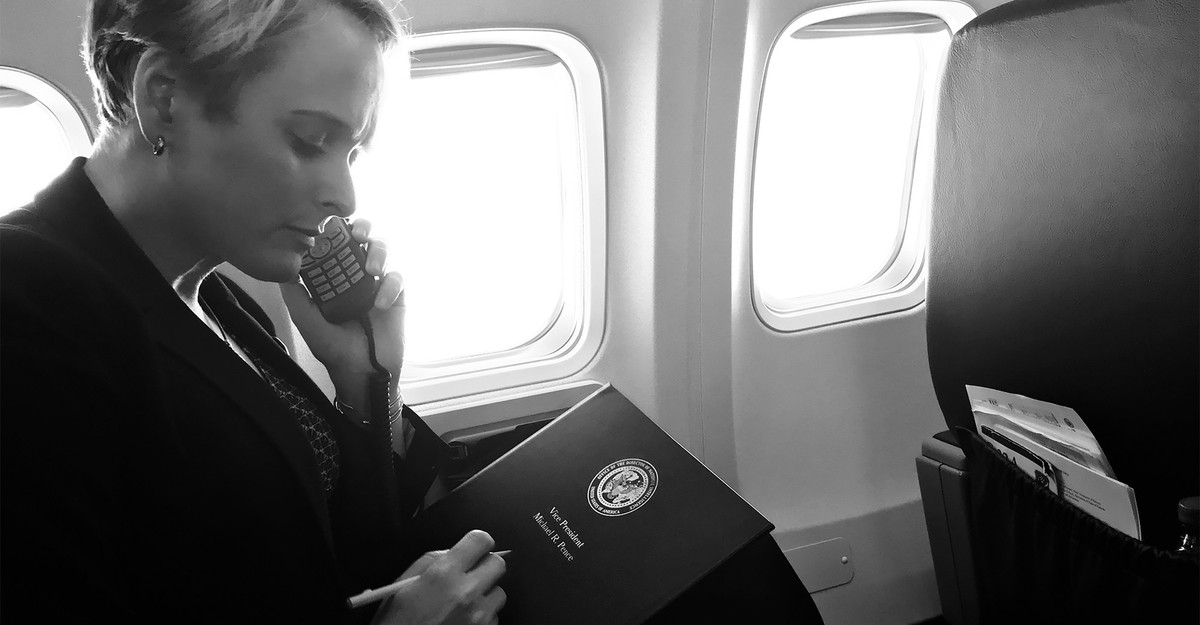
She ended up briefing Mike Pence nearly every morning for a year. She is candid about the strangeness of it. Pence had built his political career, she writes, on public opposition to marriages like hers, to people like her. She kept his identity a secret from her community because his name was shorthand for everything they feared. And yet she showed up, every morning, with the intelligence he needed to do his job.
Pence, for his part, worked hard. He was ready when the coffee was hot, firing questions, scribbling in the margins. He asked her to extend her tour. When it finally ended, he invited Julia's family to the White House, took her mother's hand, and said: "You must be very proud of your daughter."
Julia's mother had once told her that in her grief she had felt, somehow, that Julia had killed her son. Now the vice president was holding her hand.
Julia writes: "No one has affirmed my gender identity quite like Mike Pence." The complexity of that sentence is real: the person whose politics said she shouldn't exist was the one who, in that moment, made her real to her own mother.
What it feels like to be told you are the wrong kind
I am not writing about Julia's story because it is a story about politics, or intelligence, or even about the Trump administration specifically. I am writing about it because of what she describes feeling in that room on inauguration day, and because I have heard versions of it so many times.
The experience of being told, at the highest level of authority available, that you are the wrong configuration of person, is not an abstraction. It is something you feel in your body. Julia describes crying in her office, quickly, efficiently, no sound, the way you do when the walls have ears and everyone thinks you are fearless. That is a specific kind of grief: the grief of having to be invisible about grief itself.
She told her team she was trans and it wasn't a secret. She asked them not to cover for her. They said: we've got your back. That mattered. It always matters.
What strikes me most, though, is the decision not to walk out. Not because she agreed with what had been said. Not because she wasn't hurt by it. But because she had chosen to be there, had wanted that badge since childhood, and she was not going to hand anyone the story that she had known, really, that she didn't belong. She belonged. She stayed.
The cost of belonging
There is a version of this story that gets told as triumph: trans woman reaches the highest levels of US intelligence, briefs the president and vice president, survives the hostile administration. And parts of it are genuinely extraordinary. Julia did things that required extraordinary ability and nerve.
But the cost runs all the way through it. The silence at the dinner table while her wife waited for her to come home from a midnight shift. The letter she wrote Pence on her last day, beginning "I'm a tra—" and then the text cuts off, which feels like the right place to stop, because what follows is hers. The office pool on when she'd be fired. The quick, soundless crying behind a closed door.
Trans people are not asking for the right to be extraordinary. They are asking for the right to be ordinary, to do the work they are good at and come home to the people they love, without a government policy announcement telling them they are an official category of person who needs managing.
Julia Curlee lived both her dreams. She became an intelligence officer and a woman. She served her country through administrations that, in different ways, made clear she was not quite who they had in mind. She served anyway, not because she was naive about that, but because it was also her country, and she had chosen it, and she was not going to walk out the north gate and let them have the story.
That, to me, is what the piece is really about. Not the politics, not the policy, not even the extraordinary career. The refusal to let anyone else tell you whether you belong.
If there is a news story you would like me to cover then just let Sammy know.
Dr Helen Webberley is a gender specialist, advocate, and the founder of GenderGP. She writes about gender diversity, trans healthcare, and the lives at the centre of both.
Comments