
The Trump administration's Department of Health and Human Services has released a study claiming that people who support transgender people may be more likely to justify political violence. The framing matters: it is not research. It is a political instrument that has been given the appearance of research, and the distinction is not a minor one.
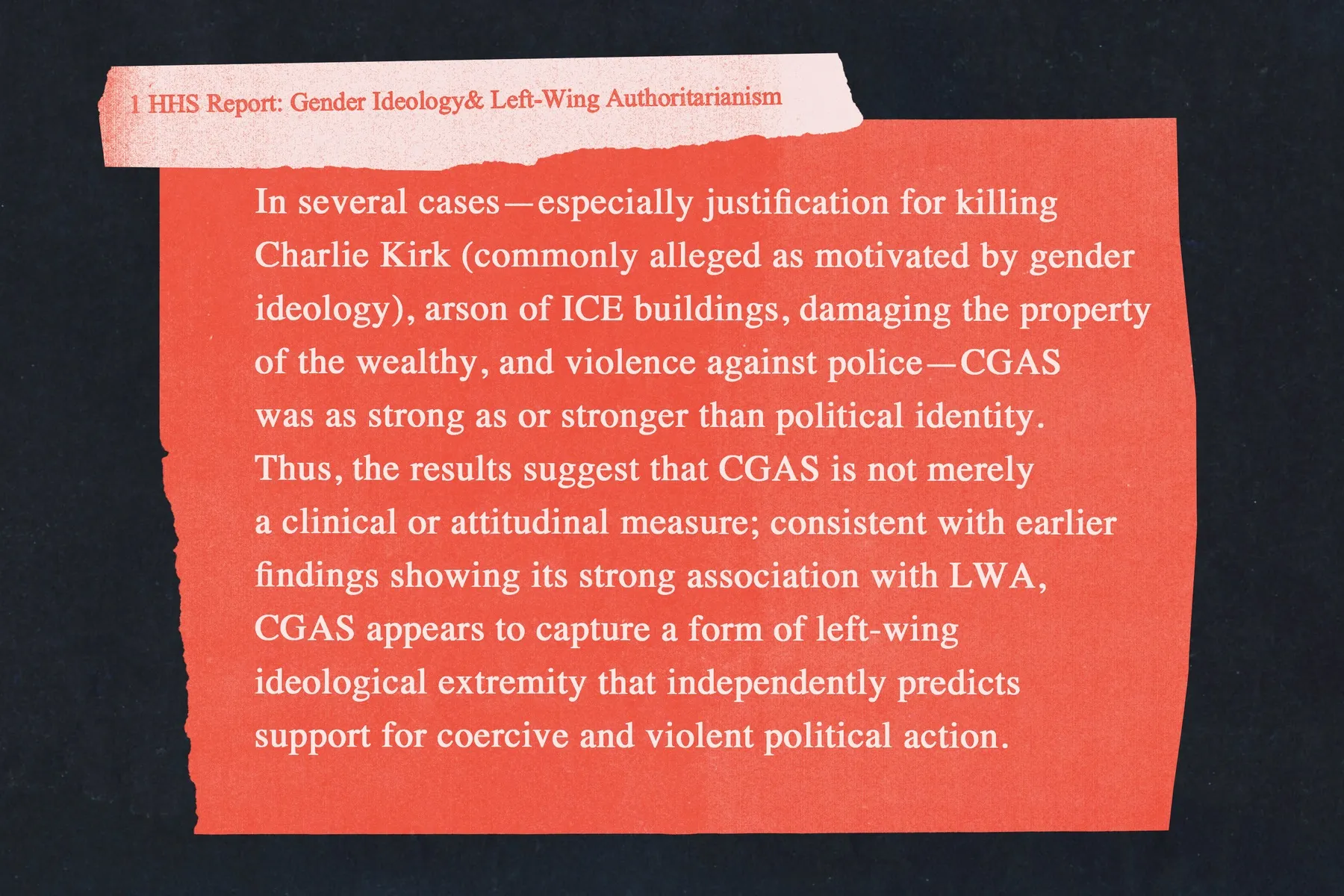
The study, commissioned by HHS and carried out by researchers from Rutgers University alongside the conservative Manhattan Institute and the Network Contagion Research Institute, analysed responses from 1,208 adults to questions about trans support, political violence, and what the authors call "left-wing authoritarianism." Its headline conclusion is that supporting trans people is linked to "left-wing ideological extremity that independently predicts support for coercive and violent political action."
Experts across political science, public administration, and democracy studies have looked at this and described it variously as pseudoscience, a fishing expedition, misleading, and, in at least one respect, unethical. None of those words were chosen lightly, and none of them come from people who oppose the study on political grounds alone. They come from people who read the methodology and found it wanting.
What the study actually does
The researchers created their own measurement tool, which they call the "Clinical Gender Affirmation Scale," designed to gauge support for trans people by asking how much respondents agree with statements like "people should be supported in expressing their transgender identity." They then ran correlations between scores on that scale and scores on measures of political violence and left-wing authoritarianism, and reported that the two are linked.
Jami Taylor, a professor of political science and public administration at the University of Toledo, described this plainly: "Correlation is not causation. The authors jump to a lot of implications based on a correlation. It kind of looks like a fishing expedition to me." She also noted that the study fails to account for respondents' broader beliefs about equal rights, social norms, and traditional gender roles, all of which would obviously influence views on trans people. The sampling technique, she said, means the findings cannot be extrapolated to the general population.
The concept of left-wing authoritarianism that the study leans on has been controversial in academic psychology for decades. At least one published study has argued that scales like the one used here actually measure rebelliousness, sadism, or political leaning rather than authoritarianism at all. Hanah Stiverson, director of policy at the Chamberlain Network and a scholar of fascist movements in the United States, put it directly: the study fundamentally misuses the term. Authoritarianism requires a focus on concentrating power, near-blind adherence to that power, and the rejection of anything outside established norms. That is not what the survey questions are asking about. "What they're actually talking about is a radicalization towards political violence," she said. "Authoritarianism is more nuanced than that."
The ethical problem
Among the questions asked of respondents were their views on political assassination attempts, including on Donald Trump. Taylor said directly: "If I was on the review board for the institution, I would have certainly raised some concerns about asking people about their attitudes on political assassination, particularly of the president of the United States. To me, it is pretty unethical." Her concern is that asking those questions not only invokes harm but potentially exposes respondents to targeting by the very administration that commissioned the study.
The study also references the killing of Charlie Kirk in 2025 as "a case widely covered and publicly perceived as connected to gender ideology," without adequately citing that claim. That is not a footnoting oversight; it is the study's method: assertions made as though they are facts, sewn together to produce a predetermined conclusion.
As of publication, HHS and Rutgers had not confirmed whether the study was peer reviewed, how it was funded, or whether it received approval from an Institutional Review Board, which provides ethical oversight of research involving human subjects. The authors did not respond to interview requests from The 19th.
Why the source matters as much as the content
Poor science gets published. Methodologically weak studies appear in journals and get corrected, challenged, and eventually set aside. That is how research is supposed to work. This is different.
When a government agency commissions, funds, and releases a study, it carries institutional authority regardless of its quality. It can be cited in policy documents. It can be used to justify surveillance, enforcement, or the targeting of groups. Wendy Via, cofounder and CEO of the Global Project Against Hate and Extremism, was unequivocal: "I would call it pseudo-science. They commissioned a report to support the conclusion they had already drawn."
Heron Greenesmith, a policy attorney who has researched anti-trans advocacy networks, described what this study represents as a deliberate expansion of the administration's anti-trans campaign: it moves beyond arguments about youth or sport to something more sweeping, explicitly connecting support for trans people to violence by actors on the left. That is not an academic finding; it is a political strategy with a literature review stapled to it.
Stiverson put the sharpest point on it: "This report is clearly meant for political weaponization."
What trans people and allies need to know
The study is going to circulate. It will be quoted. It will be described as government research linking trans support to extremism. Every one of those descriptions is technically accurate in the narrowest sense, which is exactly why it matters to understand what those words are doing.
"Government research" is not the same as credible research. A conclusion reached before the data was collected is not a finding. A correlation between two survey scores, with no controls, no peer review, and no ethical oversight confirmed, is not evidence of causation, and it is certainly not justification for policy action against millions of people.
The right response to this study is not to debate it on its own terms, because engaging with its methodology as though it were a good-faith attempt at inquiry concedes something that should not be conceded. The right response is to name what it is: a government agency producing work that looks like science in order to function as a weapon.
Trans people exist. People who support trans people exist. The attempt to reframe ordinary human decency as a vector of extremism is not a research question; it is a political project. Treating it as anything else gives it a legitimacy it has not earned and does not deserve.
If there is a news story you would like me to cover then just let Sammy know.
Dr Helen Webberley is a Gender Specialist, Medical Educator, writer, and advocate, and the founder of GenderGP.
Comments