
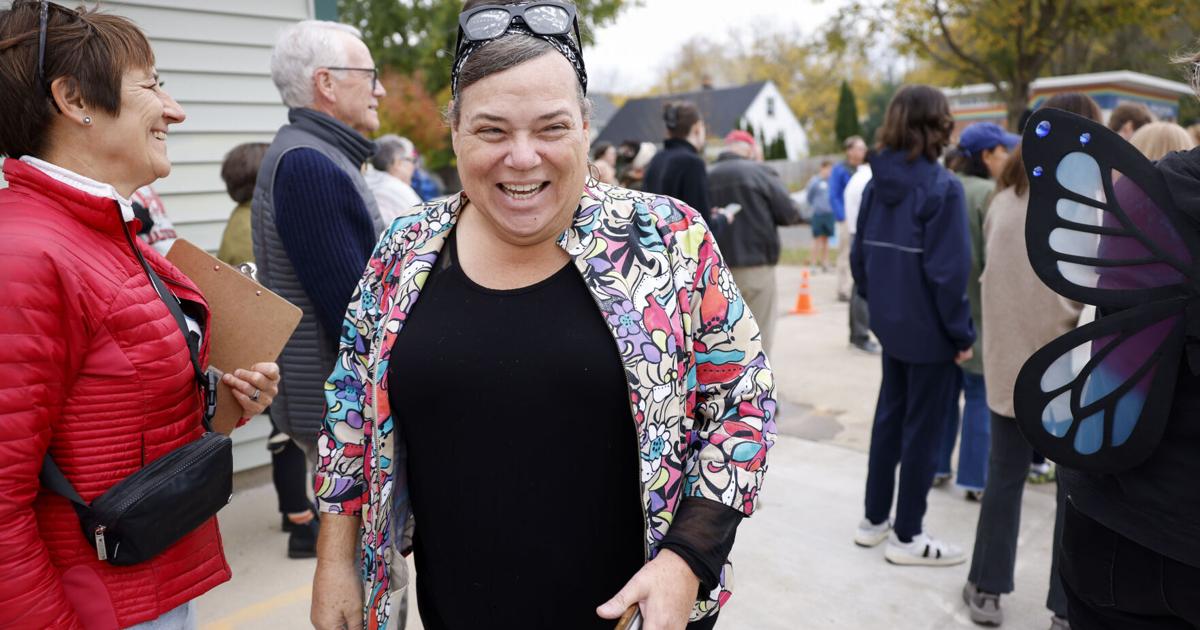
Dina Nina Martinez-Rutherford was elected to Wisconsin's 76th Assembly District, becoming the first transgender state lawmaker in Wisconsin's history. She is one of five transgender candidates who made history on the same night, winning seats in state legislatures across the United States. Martinez-Rutherford, 56, transitioned in her 30s and says she hopes her election gives trans young people and their families the hope she did not have growing up.
What she said at the moment it happened
I want to stay with what Dina Nina Martinez-Rutherford actually said when she spoke to the Cap Times on election night, because it deserves not to be hurried past.
"I think about when I was a kid, had I seen people that were trans doing things like being in government and being on television and living life, I would have been able to transition a lot sooner."
She was 56 years old, speaking on the night she made history, and she was thinking about children. That is who she is, not the symbol, not the milestone: a woman who waited until her 30s to become herself, and who won 92% of the vote, and whose first thought was for the kids who would see her and understand something about their own futures that she had no way of understanding at their age.
I find that genuinely moving. The personal and the political are not separate things here: they are the same thing, in the same person, in the same moment.
Five firsts in a single night
Martinez-Rutherford is not alone. On the same night, four other trans candidates made history as the first elected to their respective state legislatures: Bentley Hudgins in Georgia, Joanna Whaley in Michigan, Allison Montgomery in Alabama, and Jaelynn Scott in Washington. Five people. Five firsts. One night.
I do not think it is possible to overstate what that means, so I will not try to overstate it. I will just say: five, at the same time, in the same country, in the same political climate, in which trans people have spent years being told they are a problem to be managed, an edge case, a political liability. Five people looked at that and ran anyway, and five states elected them.
She already knows how to do this job
Martinez-Rutherford is not new to public life. She has represented District 15 on the Madison City Council since 2023, was reelected in April 2025, and has already delivered something concrete: she helped remove credit score requirements for subsidised housing, so that people on low incomes can actually access the homes they need. That is a real thing that happened, and it happened because she was in the room.
At the state level, she is talking about BadgerCare for all, full funding for public schools, lower property costs, and making sure Madison gets the resources it needs without constantly going back to referendums. These are not abstract aspirations. They are the priorities of someone who has already spent time in office understanding where the pressure points are.
She also knows what is coming. Democrats will control both chambers when she takes her seat in January, but she said plainly that she expects personal attacks from colleagues who oppose trans rights. Her response to that? She plans to lead with kindness. "I hope that people will see that and hope that people who don't agree with us or think that I'm the devil will see the person inside of me and start caring for each other a little bit more."
I admire that more than I can easily explain. It takes a particular kind of strength to walk into a room knowing some of the people in it consider your existence politically useful to attack, and to decide that your strategy is simply to be a person in front of them.
What representation actually does
People sometimes talk about representation as though it is a soft, symbolic thing: nice to have, meaningful in a vague way, but separate from the harder work of policy and rights. I think that is exactly wrong.
When Martinez-Rutherford says that seeing trans people on television and in government when she was young would have let her transition sooner, she is describing something precise. Not inspiration in the abstract: a child's ability to map a future for themselves. Without a map, the journey takes longer, or does not happen at all. Some people spend decades in the wrong life because nothing in their world told them another one was available.
Trans children watching Wisconsin's election results come in now have a map they did not have last week. So do children in Georgia, Michigan, Alabama, and Washington. That is not symbolic. That is concrete, and it matters for the rest of those children's lives.
Martinez-Rutherford put it simply: "I hope that it gives kids or families of trans people hope that they can live to be adults and that their children are going to be safe because they have somebody representing them." Safe enough to become themselves. Safe enough to grow up. Safe enough to run for office one day, if that is who they turn out to be.
What a night to be paying attention.
If there is a news story you would like me to cover then just let Sammy know.
Dr Helen Webberley is a Gender Specialist, Medical Educator, and advocate. She is the founder of GenderGP and writes about gender diversity, trans healthcare, and the lives of trans people and their families.
Comments