
Trans people are not a monolith. They span every political view, cultural background, aesthetic sensibility, and life ambition you can imagine. When media reduces that range to a single subculture image, it misrepresents the majority of trans people and makes it harder for trans kids to see themselves reflected anywhere.
A piece in the Washington Blade this week put this into words better than most. The writer, a trans person describing their own experience of protests, trans-friendly events, and media coverage, makes a point I have wanted to see made for a long time: that the public image of trans people has narrowed in ways that serve no one, least of all trans people themselves.
What the media gets wrong, and why it matters
The article opens with a question that deserves a real answer. How often do you see blue hair, Marxist politics, and a specific set of aesthetic signifiers attached to any story about a trans person? Often enough that it has become a template. Conservative outlets use it to suggest trans identity is a trend, a subculture choice, something a person grows out of. But even sympathetic coverage often reaches for the same shorthand.
The practical effect of framing trans identity as a subculture is significant. If being trans looks like being a goth or a K-pop fan, then it reads as optional, chosen, trend-dependent. And that framing makes it much easier for politicians to talk about "gender ideology" and much harder for anyone to make the obvious point: that trans people exist across every culture, religion, political tradition, and way of living. They always have.
The self-fulfilling shape of activism
Here is where the piece gets genuinely brave. The writer does not only criticise the media. They look at trans activism itself and notice something uncomfortable: that events, protests, and community spaces have developed their own culture, their own aesthetics, and their own political assumptions. When those assumptions are treated as though they belong to trans identity itself, plenty of trans people quietly stop showing up.
The writer describes attending a protest against the EHRC guidelines in the UK and hearing speeches about abolishing bourgeois democracy alongside speeches about trans rights. They are not against socialism. Neither am I. But they make the point clearly: when every trans event becomes a socialist event, it tells a large portion of trans people that they are not quite the right kind of trans. A trans refugee who survived something far worse than any British government does not need that particular framing. A trans woman who likes make-up and wants a traditional family might find the door feels closed before she even knocks.
This is what the writer calls a self-fulfilling prophecy. Activism shapes the image. The image shapes who feels welcome. The people who do not feel welcome stay away. And the image narrows further.
Where are all the other trans people?
I found myself nodding at this part of the piece. The writer asks, quite simply: where are the trans men who want to spend an afternoon at the gym with their friends? Where are the trans women who want children and a kitchen and a life that looks, from the outside, entirely ordinary? Where are the trans people from Middle Eastern, Asian, and African countries who might find the language of certain Western protest slogans bewildering or even insulting, given what they have actually survived?
They are not absent from the community. They are absent from the image the community projects. And that gap costs something real.
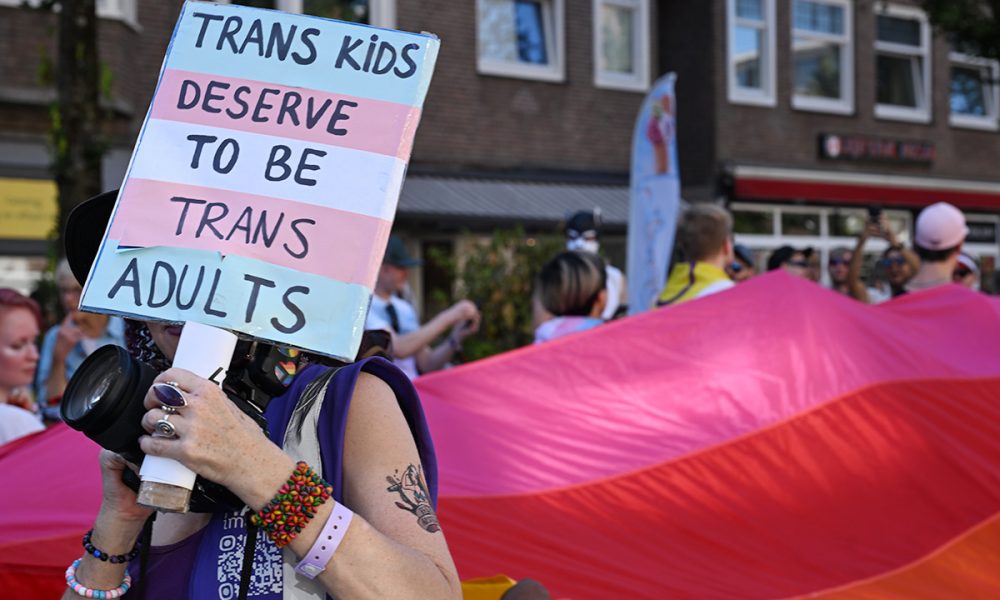
Trans kids are watching. A teenager trying to work out who they are will look at the version of trans life they can see, and if it only ever looks one particular way, they face a choice that no child should have to make: whether to fit into a culture that does not quite feel like them, or to wonder whether they are trans at all.
The range is not the problem
None of this is an argument for performing respectability. The writer is clear on that, and so am I. Trans people should not have to shrink themselves to make others comfortable. A trans person who supports socialist revolution has every right to that view. The problem is not that people hold those views. The problem is when any single set of views, aesthetics, or assumptions gets treated as what trans looks like.
Being trans is about gender identity. It is not a political party, a lifestyle, a subculture, or an aesthetic. A trans person can be conservative or radical, religious or atheist, gender-conforming or entirely gender-nonconforming, working-class or middle-class, loud or quiet, a drag performer or someone who never mentions it at work. All of those people are equally, fully, genuinely trans.
The media needs to do better. When journalists, even sympathetic ones, reach for the same visual and cultural shorthand every time they write about a trans person, they are not covering trans people. They are covering one corner of a very large community and presenting it as the whole picture.
But the piece is right that this is not only the media's failure. Community spaces can do more to make room for trans people who do not share every cultural or political assumption. Not because those assumptions are wrong, but because the tent is large enough for everyone, and the image we project should reflect that.
Trans people are different from each other. Sometimes in ways that are surprising, uncomfortable, or complicated. We can make mistakes. We can hold views others disagree with. We can want ordinary, quiet, traditional lives or extraordinary, loud, revolutionary ones. The whole point is that none of that determines whether someone is trans.
I hope we keep saying that, because trans kids need to hear it. You do not have to look a certain way, vote a certain way, or want a certain kind of life to be a real, true, whole trans person. You just have to be yourself.
If there is a news story you would like me to cover then just let Sammy know.
Dr Helen Webberley is a Gender Specialist, Medical Educator, and founder of GenderGP. She writes about trans healthcare, gender diversity, and the lives at the centre of both.
Comments