
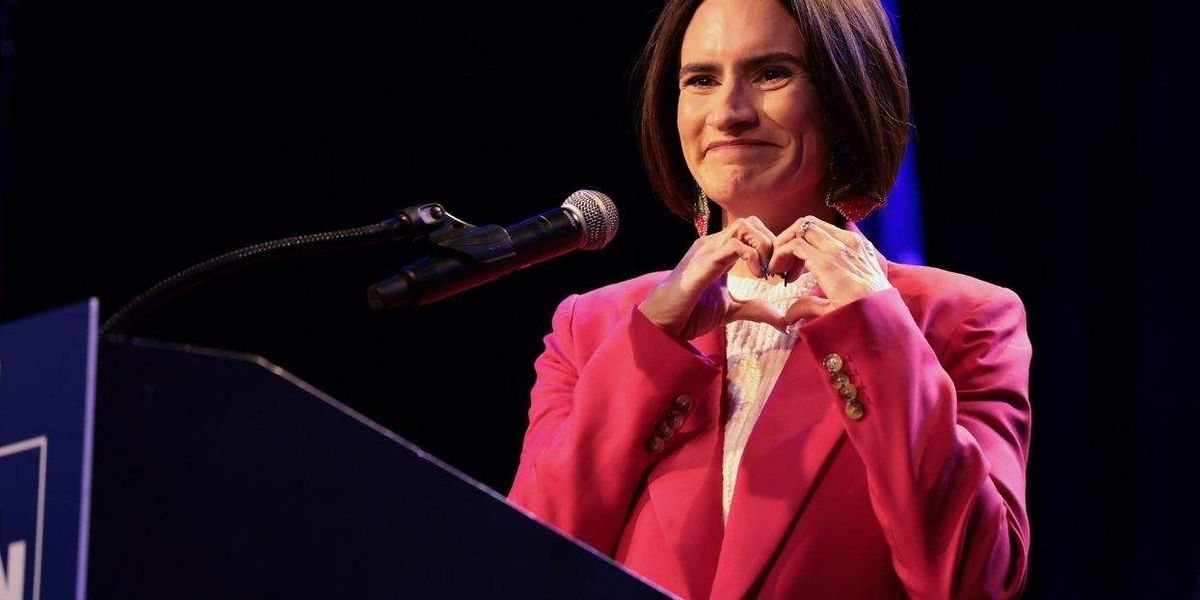
Peggy Flanagan won the Minnesota Democratic Senate primary by nearly 20 points, running openly in defence of transgender rights and warning her party against retreat. Her margin of victory over U.S. Rep. Angie Craig makes a clear case that standing firm on trans rights is not the political liability many Democrats fear it to be.
A nearly 20-point margin is not a coincidence
Minnesota's lieutenant governor did not tiptoe around the issue. She did not triangulate, soften, or quietly drop the subject in the hope that nobody would notice. She ran on it. She warned her own party that retreating from transgender rights was not a safe harbour but a mistake, and then she went out and won by nearly 20 points.
The political class has spent years telling us that supporting trans people is electoral poison, and Flanagan's primary result is a direct, empirical challenge to that story. When a candidate runs unapologetically towards an issue and wins by that kind of margin, the people telling her to run away from it owe the rest of us an explanation.
What Flanagan was actually saying
The warning she issued to Democrats was not complicated. It was this: abandoning trans people does not make you electable. It makes you untrustworthy. Voters notice when a party flinches, and they do not reward the flinch. They reward the candidate who says what they mean and means what they say.
That is a message directed squarely at the Democratic establishment, which has spent considerable energy in recent years debating how much distance to put between itself and trans rights. Flanagan's answer, delivered through the ballot box, is that the distance itself is the problem.
Angie Craig was no easy opponent
Angie Craig is a sitting U.S. Representative and a lesbian. This was not a walkover against a weak field. Flanagan beat a credible, experienced, openly LGBTQ+ politician by a margin that would be notable in any primary. That context matters. It means this result cannot be explained away as a quirk of the candidate matchup.
What it suggests, and I think the evidence is hard to read any other way, is that Democratic primary voters in Minnesota were not looking for someone to split the difference. They were looking for someone to stand up.
The political calculation we keep getting wrong
The conventional wisdom has been that trans rights is a wedge issue: something the right uses to frighten the middle, and something Democrats should therefore handle with extreme caution. I have heard that argument made with great confidence by people who have never had to explain to a trans teenager why the adults in the room decided their rights were too politically inconvenient to defend.
What Flanagan's result points to is something different. The calculation may be running backwards. The risk may not be in defending trans people. The risk may be in the retreat itself, in the signal it sends to every voter who was watching to see whether this party could be trusted, and in the enthusiasm it drains from the people who actually show up to vote in primaries.
None of that is to say that every race in every state will look like Minnesota. It will not. Context is real. But the confident assertion that trans rights must be handled as a liability, deprioritised, softened, or quietly dropped, has just taken a serious empirical hit.
What this means for trans people
For trans people watching from wherever they are, this matters in a way that goes beyond electoral arithmetic. Because the political debate about whether to defend trans rights is always, in practice, a debate about whether trans people deserve to be defended. Every time a politician decides the issue is too hot to touch, a trans person somewhere hears that their existence is a problem their own party would rather not deal with.
Flanagan said something different. She said: these are people, their rights matter, and she was not going to soften that to make her campaign easier. And then she won.
That is good news. Not just as a political data point, but as a signal to trans people that the ground is not uniformly hostile, that there are politicians willing to say their name out loud, and that doing so can win.
Comments