
Trans people have always existed, and the Catholic Church's own saints prove it. Medieval figures such as Marinos, who was assigned female at birth and lived as a monk, and Juana de la Cruz, who understood God to have changed her gender before she was born, have been part of Catholic tradition for centuries. Trans history did not begin recently.
I find this piece in the National Catholic Reporter genuinely moving, and I want to share it with you because it does something rare: it roots trans existence firmly in history and faith, rather than allowing it to be framed as a contemporary invention that society must decide whether or not to tolerate.
Who are these saints?
Emma Cieslik's article names a remarkable list. Saints assigned female at birth who lived as men and entered monasteries: Babylas of Perge, Eugenios, Euphordyne of Alexandria, Theodore, Marinos, Pelagius, Hilarion. Saints who described God as having changed their gender: Onuphrius, Wilgefortis, Juana de la Cruz, Perpetua. Joan of Arc, persecuted for cross-dressing. These are not fringe figures dug out of obscure manuscripts. They are saints whose stories were among the best-preserved texts of the medieval period.
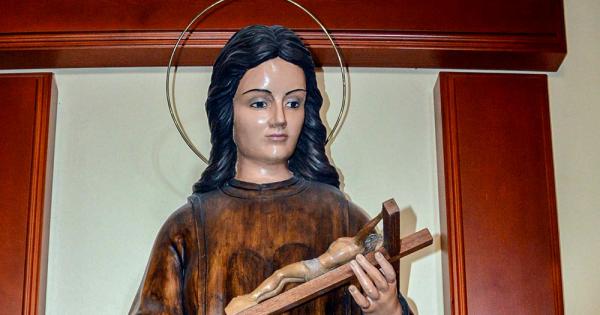
Marinos' story is the one that stopped me. Assigned female at birth, Marinos cut his hair, wore men's clothes, and entered a monastery alongside his father. Years later, he was falsely accused of fathering a child with a local woman. He said nothing to clear his name. Instead, he accepted the accusation, lived in poverty outside the monastery gate, and raised the child. Only after his death did the other monks discover what he had endured, and why the accusation had been impossible. They fell to their knees.
That is a story about faith, integrity, and the willingness to be misunderstood rather than expose yourself to correction on someone else's terms. Many trans people I have spoken with over the years would recognise something in that.
What scholars like Blake Gutt and Alicia Spencer-Hall have done
The existence of these saints was always there in the texts. What changed is who was doing the reading. Blake Gutt and Alicia Spencer-Hall organised conference panels and eventually produced an edited collection, Trans and Genderqueer Subjects in Medieval Hagiography, that takes the medieval sources seriously on their own terms.
Gutt puts it plainly: "A text will say something like he was transformed. He was born a woman but then he was transformed into a man, and it was a miracle, and people will read the text and they might say that's clearly a metaphor. That's not real. I'm just taking these people at their word when they show us how they are living their authentic lives."
That instinct, to take people at their word, is one I recognise. It is the starting point for all good care, and it turns out it is also the starting point for good scholarship.
Spencer-Hall's point about terminology is one I will be repeating. People argue that "transgender" didn't exist as a term in the medieval period. Spencer-Hall's answer: neither did "heterosexual", and yet nobody claims there were no straight people in the past.
Juana de la Cruz and the theology of gender
Juana de la Cruz is the figure in this piece whose story carries the most theological weight, and I think it deserves a little more room. Juana understood God to have changed her gender from male to female before her birth. Her Adam's apple, which others might have used to question or diminish her, she understood as physical proof of divine miracle. Her deep speaking and singing voice, when she entered ecstatic trances, became the voice through which Christ spoke.
Juana did not apologise for who she was. She built a theology around it.
Then there is Sophie Sexon's work on medieval depictions of Jesus' crucified body, described in the piece. In certain Books of Hours and prayer rolls, blood from Jesus' side wound is depicted as milk, and the wound itself is depicted with attributes understood as feminine. Jesus, and therefore God, is shown as containing all people within the divine image. That is not a modern reading. That is what medieval Christians drew and prayed over.
What this means for trans Catholics today
Max Kuzma, a transgender Catholic man, speaks about connecting to queer and trans ancestors in the church as something personally vital: "Just as LGBTQ+ people have always existed in human society, we have of course always existed within the church. Learning these stories provides examples of positive role models and creates meaningful solidarity and a sense of community across time."
I think about what it means to have that. To be told repeatedly that you are new, that you are an ideology, that you have no roots, and then to open a medieval manuscript and find yourself looking back at you. Spencer-Hall describes it as giving "a sense of survivability of our current lives, not even necessarily the sanctity of queer and trans life, but the possibility." And possibility, for someone who has been told none exists, is not a small thing.
There is also something practical in it. For Catholic families where faith shapes daily life, where children choose patron saints for confirmation and dress as saints for All Saints' Day, the existence of recognised trans saints gives families a language. "People explore being their full selves with their family because there is suddenly a way for them to explain their identity, their authenticity in a way that touches where their family already lives."
Why this piece matters now
This appeared in the National Catholic Reporter, a publication read by Catholics who take their faith seriously. That placement matters. The argument being made here is not being made from outside the Church, in opposition to Catholic tradition. It is being made from within it, drawing on the Church's own saints, its own medieval texts, its own history of venerating people who lived in ways that contemporary transphobia would refuse to recognise.
Trans people are being told, right now, by governments and by parts of the Church hierarchy, that they do not belong, that their identities are incompatible with faith, that they are a modern danger. Meanwhile, here are centuries of holy men and women who understood their gender differently, who were venerated for it, who are still saints.
Gutt says it clearly: "When trans people claim sanctity or holiness for their own embodiments, their own identities, it's not about saying, 'Oh, trans people are better than cis people.' It's about saying we are just as good, and we are made just as intentionally to be who we are."
That is not a radical claim, it is the most straightforward claim imaginable, and it has medieval saints standing behind it.
If there is a news story you would like me to cover then just let Sammy know.
Dr Helen Webberley is a Gender Specialist, Medical Educator, and advocate for trans rights and gender diversity.
Comments