
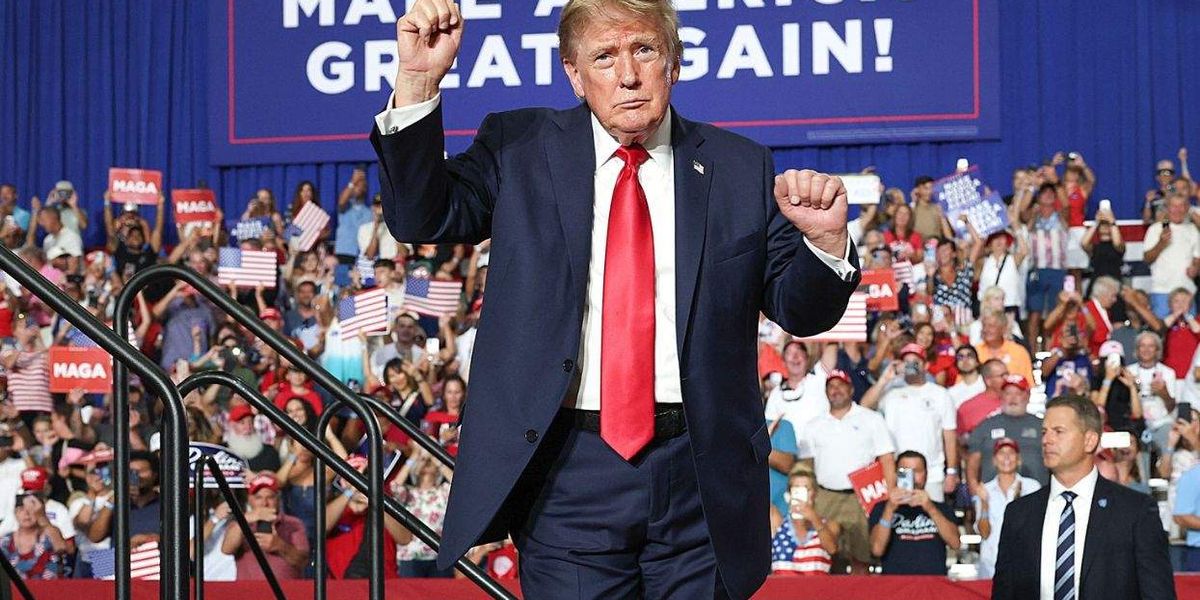
Donald Trump stood on a stage in Myrtle Beach, South Carolina, and told a crowd that hospitals are performing what he called "reverse surgery" on trans patients, and that this is happening at his order. There is no such procedure, no such order, and no such thing happening in any hospital. This is not a misunderstanding or a clumsy summary of a real policy. It is invented, from the ground up.
Adrian Shanker, who served in the Department of Health and Human Services under the Biden administration, called it a "wild statement" and said plainly that politicians have no place between patients and their providers. He is right. But I think it is worth going a little further, because the fabrication itself is doing work, and we should see what it actually is.
What Trump described does not exist
There is no procedure called "reverse surgery". The phrase describes nothing. Detransition is real: some people who have transitioned do later change course, and for those who want surgical revision or other changes, there are medical pathways to pursue that. Those pathways involve a patient, a surgeon, and a conversation between them. They do not involve a presidential order. They never have. No executive instruction from any administration has the power to direct a surgeon to operate on a patient who has not consented, for a purpose the patient has not requested, under a name that does not correspond to any recognised procedure.
What Trump described is not a policy, and not a distorted version of a policy. It is a fiction.
Why the fiction is not harmless
I have heard from so many trans people over the years who describe the moment they realised the world was not going to simply let them live their lives. The moment a news report, a political speech, or a piece of legislation made clear that their existence was considered a matter for public debate rather than private reality. Each of those moments costs something.
When a president invents a medical procedure and claims credit for it in front of a cheering crowd, the people who pay the price are not in that arena. They are at home, reading about what was said, wondering whether the system they were considering trusting is safe. Some of them will decide it is not. Some of them will not make the appointment they were about to make. Some of them will not start the conversation with their doctor that they had been building up the courage to have. That is the harm. It is not dramatic, and it does not make headlines, but it is real, and it is happening to real people right now.
There is also a longer-term damage. When fabricated claims about medical procedures circulate without being effectively challenged, they shift what the public believes is possible. People who have no reason to doubt a president's account of what is happening in hospitals will absorb this as fact. That shapes opinion. Opinion shapes policy. Policy shapes what care is available, to whom, and on what terms.
Detransition deserves honesty, not weaponisation
I want to say something specific about detransition, because it keeps being dragged into this conversation in ways that do nobody any good. People who detransition deserve the same care, respect, and access to the right medical support as anyone else. Their experiences are real and they matter. But using detransition as a rhetorical weapon, or inventing procedures and attributing them to detransitioning people, does not serve those people. It instrumentalises them. It takes a genuine human experience and turns it into a prop in a political performance.
The clinical picture on this is not what the rhetoric suggests. The vast majority of people who access gender-affirming care report that it improved their lives. That is not a contested fringe view: it is what the evidence, gathered over decades, consistently shows. Detransition happens, and when it does, people need good care. Fabricating mass coerced reversal procedures and claiming presidential authority for them helps no one, least of all the people whose experiences are supposedly being invoked.
What politicians cannot do to medicine
Adrian Shanker's point is worth returning to: politicians do not belong between patients and their providers. The reason that principle matters is not procedural. It is because medicine works when it is grounded in the needs of the person in front of the doctor. The moment political performance starts shaping what care is available, described, or permitted, people get hurt. Not as a side effect. As a direct consequence.
What happened in Myrtle Beach was a head of state describing an invented medical procedure to a crowd, attributing it to his own authority, and counting on the claim to land without scrutiny. The scrutiny it deserves is simple: it is not true. No hospital is doing this. No order created it. The procedure does not exist.
The people who need to know that most are the ones who were already frightened before the rally, who are now a little more frightened, and who deserve to hear clearly that the care they need has not been turned against them by a presidential decree, because no such decree is real.
If there is a news story you would like me to cover then just let Sammy know.
Dr Helen Webberley is a gender specialist, medical educator, and advocate for trans rights and gender diversity.
Comments