
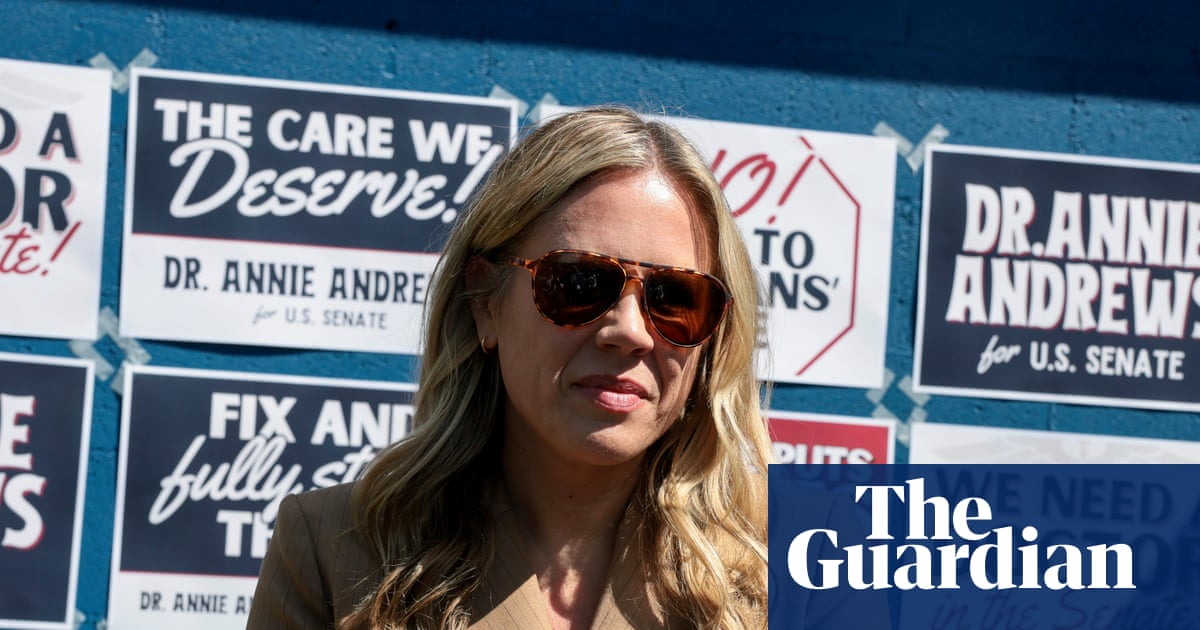
Annie Andrews, the Democratic Senate candidate in South Carolina, has released an ad responding to Republican attacks that frame her as a threat to women and children. She stands in a white lab coat, stethoscope around her neck, and says what she wants voters to hear loud and clear: she does not support biological men playing in women's sports, and she has never performed gender surgery on minors. The ad is a direct response to a super PAC campaign running on behalf of her Republican opponent, Darline Graham, and to Donald Trump's sustained use of anti-trans messaging as a political weapon.
I have read that statement several times now. And each time I read it, I feel the same thing: a quiet, specific sadness.
Not at Annie Andrews personally. She is a paediatrician, a mother, running in a state that has not sent a Democrat to the Senate in decades, against a campaign that has run ads depicting a trans person ominously approaching a little girl in a grocery store aisle. The political pressure she is under is not abstract. But what happened here deserves to be named plainly.
What the ad is really saying
When a candidate goes on television to say she has never performed gender surgery on minors, she is not correcting a false claim about her own record. She is reinforcing the idea that such care is the relevant thing to be worried about, that it is something a reasonable person would distance themselves from, that the Republican attack ads had the right target even if the wrong person. She is confirming the frame.
Andrews is not alone. She is part of a pattern this cycle that the new Guardian reporting makes even clearer. Congresswoman Marcy Kaptur of Ohio aired an ad saying she "voted with Republicans to keep transgender ideology out of our schools" and that "boys should not play in girls' sports." Congressman Don Davis of North Carolina released an ad deferring the question to states. Blake Gendebien in New York said "boys shouldn't play on girls' sports teams" while adding, almost in the same breath, that he had never once heard the issue come up in twenty years living in his district. That last moment is almost poignant in its honesty: he knows this is manufactured, and he said it anyway.
And the frame keeps gaining ground because of exactly that. Each accommodation makes the next one easier to justify and harder to resist.
What was said, and what was not said
In 2022, Andrews called South Carolina's law banning trans athletes from women's sports "shameful" and said she would "always support trans youth." Her Republican opponents say her new ad contradicts that record. On the narrow question of her earlier statements, they appear to have a point.
More striking than what she said is what she chose not to say. She did not say that trans people deserve dignity and protection. She did not say that trans children exist and deserve care. She did not say that depicting a trans person as a predatory threat to a child in a grocery store aisle is a piece of dehumanisation rather than a political argument. She said, essentially: I am not one of them.
That will land somewhere. It will land on every trans teenager in South Carolina who understood exactly what it meant when a candidate decided the safest thing was to prove she was not on their side.
The attack ad deserves its own moment
Before Andrews released her response, the pro-Graham campaign was already running an ad showing a trans person walking towards a child in a grocery store. Ominously. As if proximity itself were the threat.
That ad is not a political argument. It is a piece of dehumanisation designed to make trans people feel dangerous simply by existing near children. There is no policy being debated in it. There is no fact being asserted. There is only the implication: these people are a threat to your daughter. That implication is false. It is harmful. And when the response to it accommodates rather than challenges it, the implication gains ground.
What fighting back could look like
The Human Rights Campaign, in a Substack piece aimed at guiding Democrats, put it plainly: "Turning on a vulnerable community is not a winning political strategy, and it's exactly what Trump, Musk, and MAGA want. It legitimises their side and weakens ours. And it harms transgender people."
They pointed to Ohio Senate candidate Sherrod Brown as a better model. His ad features voters who dismiss the anti-trans attacks entirely and redirect the conversation to affordability and the record of his Republican opponent. "With everything going on, that's what they're talking about?" one voter says. Brown did not concede the premise. He let voters name the distraction for what it is.
Equality PAC, the fundraising arm of the Congressional Equality Caucus, called Kaptur's language "unacceptable" and said it was "absolutely not supporting her campaign at this time." That is a consequence. It is also a signal that the calculation some Democrats are making, that accommodation costs nothing, is not quite right.
Some candidates this cycle have looked at the same political landscape and decided that the answer to dehumanisation is direct rebuttal: trans people are our neighbours, our children, our patients, and they deserve protection. That is a harder message to run in South Carolina. It is also the only message that does not ask trans people to accept being the price of someone else's electability.
Why this keeps happening
The pro-Graham ad uses almost identical language to the pro-Trump ads that targeted Kamala Harris in 2024: "Kamala's agenda is they/them, not you." The Andrews attack uses the same logic, the same imagery, the same implication. Republicans have found a formula that works, not because the underlying claim is true, but because enough Democratic candidates keep responding to it as though it might be.
Every time a Democrat releases an ad agreeing with the Republican premise, they do two things at once. They tell trans people they are not worth defending. And they confirm to Republican strategists that the attack is working, which guarantees it will keep coming.
Andrews may still win. The race is genuinely competitive, and she is a paediatrician running against a candidate whose brother held the seat for decades. She deserves credit for running at all, in a state where the odds are steep. But the trans young people of South Carolina deserved something different from that ad. Not a complicated political calculus. Just someone willing to say, on camera, that they are worth defending.
If there is a news story you would like me to cover then just let Sammy know.
Dr Helen Webberley is a Gender Specialist, Medical Educator, writer, and advocate, and the founder of GenderGP.
Comments