
The HHS report claiming gender-affirming care 'may' radicalize people was produced without peer review, without published data, and without disclosed funding. Its authors include a researcher from a right-wing think tank, and independent political psychologists have identified serious design flaws. The word 'may' in its central conclusion is not supported by the data presented. This is not how evidence-based research works, and it is not how policy affecting trans people's healthcare should be made.
What the report actually claims
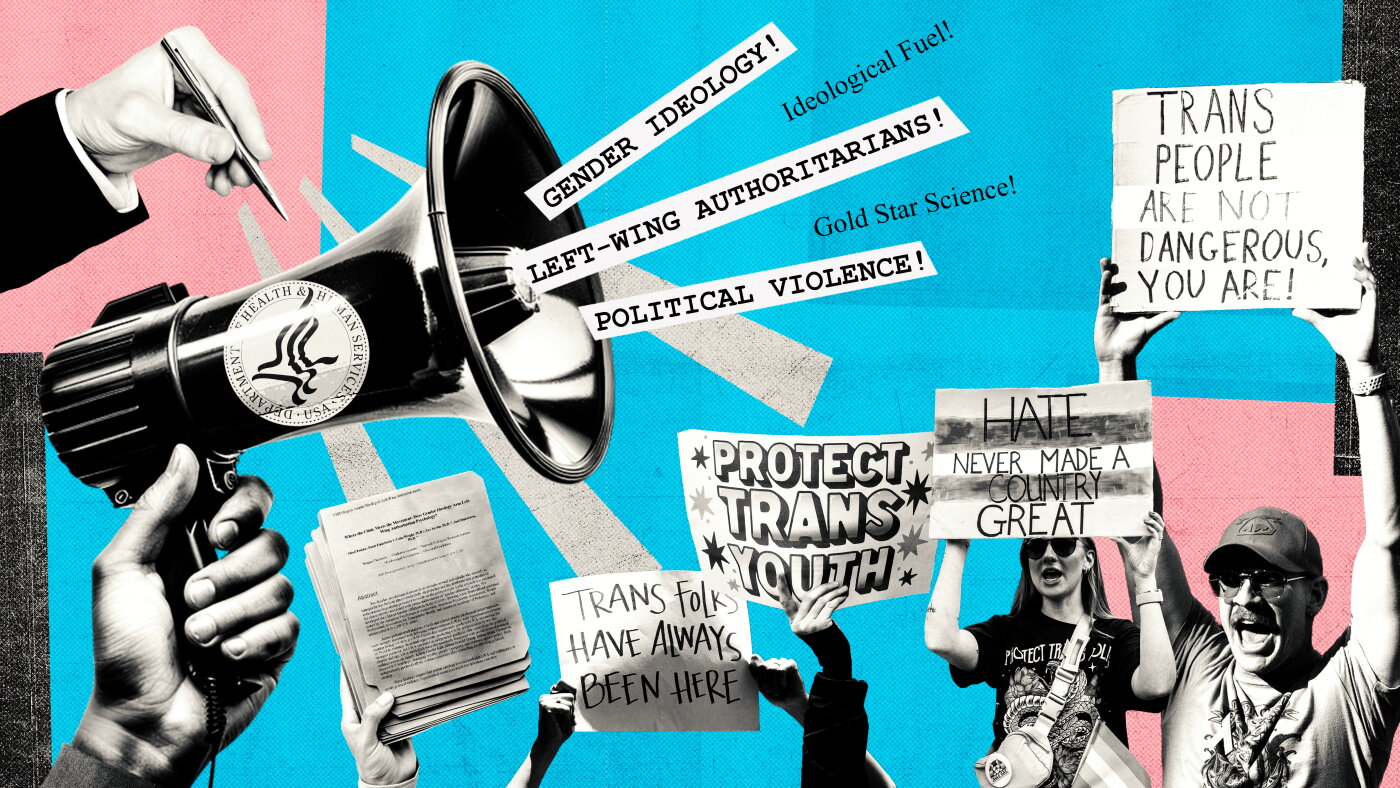
In August 2026, the US Department of Health and Human Services released a report titled "Where the Clinic Meets the Movement: Does Gender Ideology Arm Left-Wing Authoritarian Psychology?" Its central argument is that support for gender-affirming care is tied to something the report calls "Left-Wing Authoritarianism" and, from there, to a willingness to justify political violence. Gender-affirming care, it suggests, functions as "an ideological accelerant," telling people who the enemy is and giving those already inclined toward force a reason to use it.
One of the report's own co-authors, Colin Wright, told NPR that "'may' is doing important work in that sentence." He was right about that, even if not in the way he intended. "May" is there because the data does not support the stronger claim. That single word is a retreat presented as precision, and it is worth noticing how much the headline framing relies on the reader not spotting it.
Who wrote it, and what that tells us
Wright is an evolutionary biologist affiliated with the Manhattan Institute, a right-wing policy think tank that has been prominent in campaigns against diversity, equity and inclusion. He is not a clinical researcher, not a gender specialist, and not a political psychologist. The report was not peer reviewed. Its data has not been released. Its funding sources have not been disclosed. These are not minor procedural complaints: they are the basic conditions under which scientific claims can be examined, challenged, and trusted.
Adrian Shanker, who served as a deputy assistant secretary for health policy under the previous administration, put it plainly to NPR. In his experience, HHS worked with generalist science writing firms that were not political in any way. What is happening now, he said, is "vastly different": the administration appears to have the answers before the reports are written, and partners with politically aligned researchers to produce conclusions that meet a political need rather than a scientific one.
I cannot improve on that description. It is exactly what this looks like.
What the independent researchers say
Liliana Mason is a political psychologist at Johns Hopkins University who has spent more than a decade studying what actually drives support for political violence. She told NPR she would recommend the paper be rejected if she were a peer reviewer, on the grounds that it is not written in good faith and its measures are not well validated.
Her specific criticisms matter. The survey sample overrepresents Democrats compared to the actual political demographics of the United States. Crucially, the study omits context that Mason's own research has consistently found: approval for political violence shows up across the political spectrum, concentrated most heavily among people with the strongest partisan identities on either side. A study that measures attitudes toward violence on the left while stripping out that comparison is not measuring something real. It is manufacturing a finding.
Alexander Tsai, a psychiatry professor at Harvard Medical School, reviewed the paper and found that the "ideological accelerant" conclusion is simply not backed up by the data the study presents. When the data does not support your conclusion, you do not have a finding. You have a problem.
The language is doing political work
The report uses the term "gender ideology" interchangeably with "gender-affirming care." That substitution is not accidental. "Gender ideology" is a phrase developed and used by the religious right to frame acceptance of trans people not as a matter of human diversity but as a sinister agenda imposed on society. Using it as a synonym for the accepted medical standard of care is a rhetorical move, not a scientific one. It tells you what the report is for before you reach the first data table.
Wright, in a separate post on X, called support for gender-affirming care "an extremist political movement disguised as a medical guideline." That is not the framing of a researcher trying to understand a phenomenon. It is the framing of someone who has already decided what they think and is looking for numbers to attach to it.
What the actual evidence shows
The established research on gender-affirming care does not show what this report implies. It shows the opposite. Trans people are, as a group, far more likely to be the targets of violence than the perpetrators of it. Gender-affirming care, including hormones and, where accessible, surgical options, is associated with improved mental health outcomes, reduced distress, and better quality of life. That is the finding of the major clinical bodies whose guidelines govern this area: WPATH, the Endocrine Society, the American Academy of Pediatrics, and others.
This report does not engage with that evidence. It does not attempt to explain it away. It simply proceeds as though it does not exist, which is not how science works.
Why this matters beyond the US
When a government agency with the reach and authority of HHS publishes a report, even a methodologically weak one, it becomes a resource. It will be cited in legislation, repeated in political speech, and used in other countries to justify restrictions on trans healthcare. The Cass Review played that role in the UK and beyond: a document with serious methodological problems that nonetheless shaped policy because it carried institutional weight. That is the template. The goal is not to win a scientific debate. The goal is to produce something that looks like evidence and functions as a political tool.
Trans people reading this deserve to know that clearly. This report is not a finding about you. It is a document produced to make it easier to take healthcare away from you, and the researchers who actually work in this field have said so directly.
If there is a news story you would like me to cover then just let Sammy know.
Dr Helen Webberley is a Gender Specialist and founder of GenderGP. She writes about gender diversity, trans healthcare, and the lives of trans people and their families.
Comments